Animals
Why our tilapia pond nearly killed every fish in it
Half a 5,000-litre tank sunk into the ground, stocked with Nile tilapia, and a margin of error roughly twenty times smaller than the guides assume. This is the failure article.
The short answer
Small aquaponics systems fail because thermal and oxygen buffering scale with volume. A 2,500-litre pond swings temperature and dissolved oxygen far faster than the 10,000-litre-plus systems most guides describe. In Gauteng, Nile tilapia (Oreochromis niloticus) is a listed invasive species requiring a permit — check your provincial position before stocking.
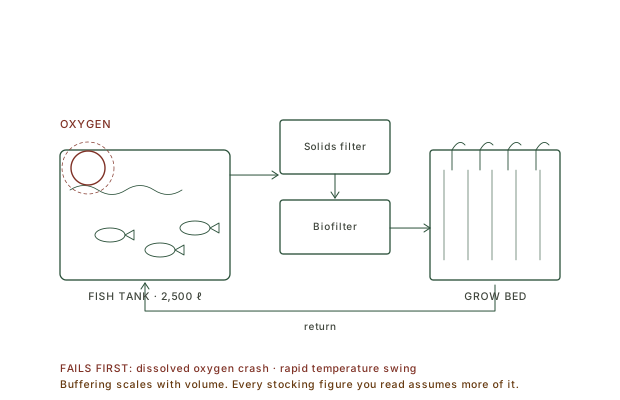
This is the article we would have wanted before we started, and it is mostly about what we got wrong.
The pond is half of a 5,000-litre JoJo tank, cut and sunk into the ground — so roughly 2,500 litres of water. It looked generous when it went in. It is, in aquaponic terms, very small indeed, and almost everything difficult about the last two years traces back to that number.
Why volume is the whole problem
Water buffers. A large body of water changes temperature slowly, holds dissolved oxygen more stably, and dilutes a spike in ammonia. A small one does none of those things well.
Most of the aquaponics literature — and nearly all of the confident YouTube material — describes systems of 10,000 litres and up. At that scale a hot afternoon moves the water a degree or two. At 2,500 litres, half sunk in an inland South African soil with a dark surface, a still January afternoon can move it far more than that, and warm water holds markedly less oxygen than cool water at exactly the moment the fish need more of it.
That is the trap. The failure mode is not gradual. It is an overnight loss.
What actually went wrong
Three things, compounding.
Oxygen. We ran a single small air pump on the assumption that the grow bed return would do most of the aeration. On a still, hot night with a warm water column and a high biological load, it was not close to enough. We came out one morning to fish at the surface, gulping.
Temperature swing. Unshaded, the pond went from comfortable to stressful within a few hours in midsummer, and then dropped hard overnight. Tilapia tolerate warmth well but they do not tolerate rapid change, and the swing was doing more damage than the peak.
Stocking density. We stocked to a figure from a guide written for a system four times the size. Everything else was survivable until that was added on top.
What we changed
- Two air pumps, on separate circuits. One is a single point of failure and the failure is total. This is the cheapest insurance in the entire system.
- Battery or inverter backup for aeration. Aeration is the one load that genuinely cannot go down, and load shedding does not care about your fish.
- 40% shade cloth from November through March. It cut the daily temperature swing more than any other single intervention.
- Halved the stocking density. Fewer, healthier fish, and a system that no longer runs at the edge.
- A dissolved-oxygen meter, not a guess. It is the one instrument that turns this from an opinion into a reading, and it is the difference between noticing a crash and preventing one.
Would we do it again?
Not at this volume, and not for food.
If the objective is protein, the same money and attention in chickens would have produced far more, far sooner, with a fraction of the risk. If the objective is to understand a closed nutrient loop — and to have somewhere for the water from the wetland to go — then it has been worth every hour.
Be honest with yourself about which one you are building. Most people building small aquaponics think they are doing the first and are actually doing the second, and there is no shame in that as long as the budget reflects it.