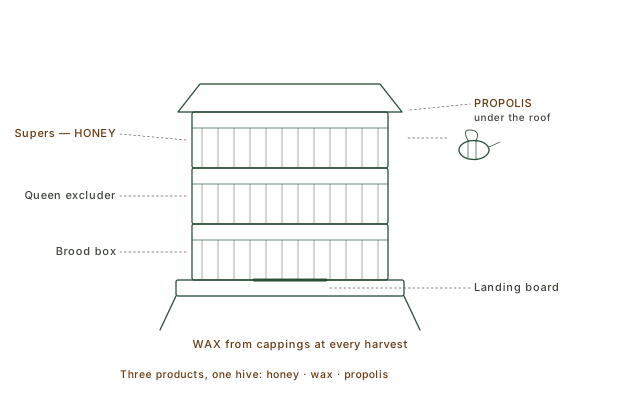
Animals
Four hives, one season: what beekeeping actually returns
Establishment cost, actual yield, and the three products people forget about. Bees are the highest-return animal on a small property — and the one that asks least of you.
Pillar 04
What they cost to keep, what they give back, and which of them you may legally hold where you are.
Chickens, bees and fish are the three species that work reliably at small scale in South Africa. Each gives back more than it takes — but only if housing, feed and the relevant by-laws are sorted before the first animal arrives. Start with what is legal in your municipality, then match species to the space and water you actually have.
Keeping animals changes the economics of a smallholding faster than almost anything else — but the direction of change depends entirely on what you keep, how many, and whether the infrastructure was ready before they arrived.
This pillar covers the three species that work at small scale without requiring commercial-scale inputs: bees, chickens and fish. It also covers feed and housing, because those are where most of the cost and most of the failure live, and it covers the legal question, because in South Africa that question is genuinely complicated and the answer is different in every municipality.
The sequence matters. Legal first, then infrastructure, then animals. Reversing that order is the single most common and most expensive mistake.
Bees are the lowest-input animal on this list and, managed well, one of the higher-return ones. A single productive hive in a good forage year will yield between 10 and 30 kg of honey, plus beeswax, plus the pollination benefit across every food plant on the property. None of those outputs require daily attention. Bees do not need to be fed year-round, do not produce waste that needs daily removal, and do not alert neighbours to their presence the way chickens or dogs do.
What they do require is equipment, training and timing. A new beekeeper who opens a hive without knowing what they are looking for will miss early signs of American foulbrood, the most destructive bacterial disease in South African apiaries and one that is notifiable under the Agricultural Pests Act 36 of 1983. An infected hive must be destroyed — equipment and all — and the failure to report it is an offence. This is not a reason to avoid bees; it is a reason to join a local beekeeping association before acquiring any.
South Africa has a specific advantage here that the international beekeeping literature mostly ignores: Apis mellifera capensis, the Cape honey bee, is endemic to the Western Cape and behaves very differently from the subspecies used in most temperate-country advice. If you are east of the Hex River Mountains, you are working with A. m. scutellata, the African honey bee, which is more defensive, swarms more readily and requires different hive management. Most YouTube beekeeping tutorials are filmed with Italian or Carniolan bees in northern-hemisphere conditions. That advice is not wrong, but it is incomplete.
The article Four hives, one season: what beekeeping actually returns covers the inputs, the yields and what a first season realistically looks like — read it before you commit to equipment.
Chickens are the most forgiving entry point into small-scale animal keeping and the most commonly mismanaged one. The bird is hardy; the system around it is where things go wrong. Housing that is not predator-proof, feeding that relies entirely on commercial pellets, and a flock size that exceeds what the property can absorb are the three failure modes that account for the majority of disappointing outcomes.
A laying hen in good condition will produce 250–300 eggs a year for the first two laying seasons, dropping off after that. Dual-purpose breeds — Australorps, Potchefstroom Koekoeks, Naked Necks — outperform commercial hybrids in backyard conditions because they forage better, handle heat better and are not dependent on the precise nutritional profile of a commercial ration. They will not match a Lohmann Brown on peak output; they will outlast it in a free-range system.
The legal position on urban and peri-urban chickens varies by municipality and is covered in detail in What is legal to keep on a smallholding in South Africa and Keeping chickens: by-laws, housing and predators. The short version: almost every municipality permits laying hens in residential zones, almost none permits roosters, and the definition of "residential zone" does not map neatly onto what most people think of as a suburb. Check the zoning for the specific erf before the birds arrive.
| Factor | Indicative figure | Notes |
|---|---|---|
| Peak lay rate | 250–300 eggs per hen per year | Dual-purpose breeds; drops in moult and winter |
| Feed conversion | Roughly 125 g of feed per egg | Better in hens with genuine foraging access |
| Water use | 200–500 ml per hen per day | Higher in summer; critical in heat events |
| Housing space | 0.1–0.2 m² per bird inside, 1 m² outside | Minimum; more is better for flock health |
| Productive laying life | 2–3 seasons at good rates | Third season output typically halves |
Predator pressure in South Africa is higher than most northern-hemisphere advice assumes. Genets, mongoose, African wild cats, martial eagles and, in peri-urban areas, domestic dogs account for the majority of losses. Hardware cloth (welded mesh, not chicken wire) on all openings, an apron buried at least 300 mm into the ground, and a solid roof are the minimum. Chicken wire keeps chickens in; it does not keep predators out.
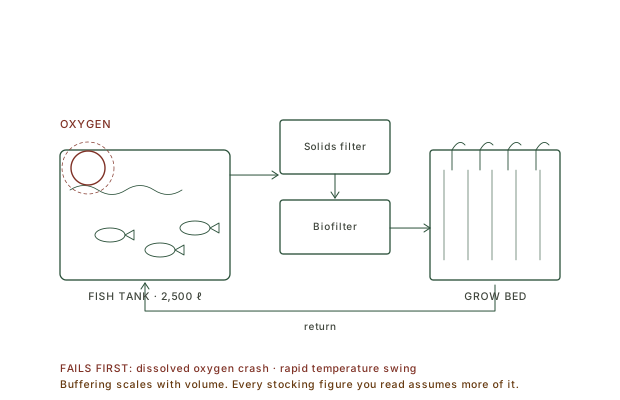
Aquaculture at small scale is genuinely possible, genuinely productive and genuinely unforgiving of inattention. A well-managed tilapia pond or aquaponics system will produce between 20 and 50 kg of fish per 1,000 litres of system volume per year. A poorly managed one will kill every fish in it within 48 hours of a power failure, a pump blockage or a single overfeeding event.
Oreochromis mossambicus (Mozambique tilapia) is the species most smallholders begin with, and for good reason: it tolerates poor water quality better than most table fish, grows fast on a mixed diet that can include duckweed grown on-site, and is widely available through registered hatcheries. The problem is that it is also a Schedule 1 invasive species under the National Environmental Management: Biodiversity Act 10 of 2004 (NEM:BA), which means it may be kept only in closed systems — any escape into a natural watercourse is an offence.
The article Why our tilapia pond nearly killed every fish in it is the most detailed account on this site of what goes wrong with aquaculture systems and why. Read it before designing a system. The specific failure modes — aeration loss, ammonia spike, pH collapse — are predictable and preventable, but only if the system is designed around them from the start.
| Species | Water temperature | Legal status | System type | Relative difficulty |
|---|---|---|---|---|
| Mozambique tilapia | 20–32 °C | Invasive — closed system only | Pond or aquaponics | Moderate |
| Blue tilapia (O. aureus) | 20–30 °C | Invasive — closed system only | Pond or aquaponics | Moderate |
| Rainbow trout | 10–18 °C | Invasive — permit required | Flow-through or RAS | High |
| Catfish (Clarias gariepinus) | 22–30 °C | Native — check provincial regs | Pond or RAS | Moderate–high |
| Duckweed (Lemna spp.) | Warm water | Not regulated | Grown on pond surface | Low — good fish supplement |
Aquaponics — combining fish production with hydroponic plant growing in a recirculating system — works well in the South African climate for nine months of the year. The constraint is winter in the highveld and interior, where water temperatures drop below tilapia tolerance. Heating the water is possible; the energy cost is the tradeoff to calculate before building.
Feed and housing are where most of the ongoing cost of keeping animals lives, and where most of the avoidable losses happen. The design principle that applies across all three species on this page is the same: the animal should be doing as much of its own feeding as the system allows, and the housing should make predator exclusion and disease management straightforward rather than afterthoughts.
A smallholding that relies entirely on commercially milled feed for chickens, commercially formulated pellets for fish and commercially produced supplements for bees is not significantly more resilient than a household that buys everything at a supermarket. The feed supply chain in South Africa is well developed but not immune to price shocks, disruption or load-shedding at the mill. The goal is to reduce — not necessarily eliminate — the proportion of inputs that come through that chain.
Every animal housing structure serves two functions: keeping the animal in, and keeping threats out. In South Africa, the threats are more varied than most published plans assume. Electric fencing, covered runs, hardware cloth rather than chicken wire, and solid floors or buried aprons are not overcautions — they are the minimum for a system that does not lose animals regularly.
Ventilation is the second structural principle. South African summers — particularly on the Highveld and in the Lowveld — produce heat events that kill confined poultry faster than disease does. A coop designed for a temperate European climate will be dangerous in a Limpopo summer. Cross-ventilation, shade cloth on the south-facing side, and adequate cubic volume per bird are not optional in those conditions.
Disease spread in multi-species systems is a real risk. Chickens and fish should not share water. Chicken waste should not contaminate ponds. Both of these statements are obvious; both are violated regularly in systems built without thinking them through. Design the site layout so that waste flows away from the fish system, not toward it.
The legal question has two layers in South Africa: national legislation that sets the framework for invasive species, disease notification and animal welfare, and municipal by-laws that determine what is permitted on a given erf in a given zone. Neither layer can be ignored, and they do not always point in the same direction.
At the national level, the statutes that matter most for smallholder animal keeping are:
At the municipal level, the key questions are: what is the erf zoned as, what does the applicable by-law permit in that zone, and are there specific conditions (distance from boundaries, number of animals, noise or odour provisions) that apply? Most metropolitan municipalities have published their animal-keeping by-laws; most smaller municipalities have not updated theirs in decades, which creates genuine uncertainty.
The article What is legal to keep on a smallholding in South Africa covers the national framework in full and gives practical guidance on how to find and interpret the relevant by-law for a specific property. It is the starting point, not this page.
| Species | Governing legislation | Key restriction | Permit or registration? |
|---|---|---|---|
| Laying hens | Municipal by-laws | Zone-dependent; roosters usually prohibited in residential zones | Usually not required |
| Honey bees | Agricultural Pests Act; provincial regulations | Hive registration required in most provinces; notifiable disease obligations | Registration with provincial authority |
| Mozambique tilapia | NEM:BA (Schedule 1 invasive) | Closed systems only; no release or open-pond keeping | Permit required in most provinces |
| Rainbow trout | NEM:BA (Schedule 2 invasive) | Permit required; not permitted in open systems in most provinces | Permit required |
| Sharp-tooth catfish | NEM:BA; provincial ordinances | Native species — less restricted but check provincial list | Check provincial authority |
| Goats | Municipal by-laws; Livestock Theft Act | Zone-dependent; often excluded from small erven | Municipal permission may be required |
The table above is a working summary, not legal advice. Legislation changes, provincial schedules are updated, and by-laws are amended. Verify the current position with the relevant authority before acquiring any animal that appears in a regulated category.
Almost every smallholder animal-keeping resource published in English is written for the United Kingdom, the United States or Australia. The climate, the legal framework, the disease pressure and the predator suite are all different here, and following that advice without adjustment leads to predictable failures.
The heat is the most immediate difference. Most temperate-country poultry housing is designed to retain heat; most South African summers require the opposite. A well-insulated, small-windowed coop that performs well in a Scottish winter is a heat trap in Mpumalanga. The building should be designed around the hottest week of the year, with passive ventilation as the primary strategy and shade as the structural frame.
The predator suite is different. Genets, mongoose, African wild cats, caracal, raptors and, increasingly, domestic dogs are the main predation risks for chickens and bees. Foxes — against which most British and American chicken housing is designed — are not present. The specific vulnerabilities are different: a run that successfully excludes a fox may not exclude a genet, which can compress its body through a 50 mm gap.
Load-shedding changes the risk profile of any system with an electrical component. An aquaculture system running a pump that fails every day during scheduled cuts is not a stable system — it is a system in slow crisis. Every electrically dependent animal-keeping setup needs a load-shedding plan from day one. That means battery backup for aerators, manual feeding plans for the periods when automated systems are down, and a monitoring routine that does not depend on always-on connectivity.
The bee fauna is genuinely different. Apis mellifera scutellata, the African honey bee, is not more dangerous than European subspecies in the hands of an experienced beekeeper, but it is more defensive, swarms more frequently and requires faster responses when problems develop. The management calendar is also inverted: the main honey flow in most of the country runs from late winter into spring (August to November), not summer. British and American advice that structures hive inspections around a June peak is working from a different calendar.
Water is a constraint in a way it rarely is in temperate-country advice. Chickens need water every day; fish systems are the water. In a drought year, or on a property dependent on a municipal supply that experiences cuts, water security and animal keeping are the same problem. Design the animal system with the dry season and the supply interruption in mind, not the average week.
The failure modes in small-scale animal keeping are well documented and almost entirely predictable. The following three account for most of the losses, most of the expense and most of the abandonment.
The single most common error is acquiring animals before the housing is complete, the feed system is established and the legal position is confirmed. Chickens kept in temporary housing while the permanent coop is finished will be predated. Fish moved into a system that has not cycled will die of ammonia toxicity within days. Bees installed in a hive that has not been inspected for disease pressure will carry the problem forward. The animals impose a deadline on the infrastructure work — and the deadline is always earlier than expected.
Keeping too many animals for the land and the system is the second failure mode, and it compounds quickly. A flock of twenty hens on a property with no pasture rotation produces more nitrogen than the beds can absorb, runs through commercial feed at a rate that erodes any economic case, and creates welfare and disease problems that a smaller flock would not. The right number of animals is the number the system can support without external inputs becoming the dominant cost. That number is almost always smaller than the number that feels productive when starting out.
Roosters in a residential zone, open-pond tilapia in a catchment area, unregistered hives with a foulbrood outbreak — these are not hypothetical risks. They represent real compliance failures with real consequences, ranging from a complaint from a neighbour that forces a council inspection to a formal direction to destroy an entire fish system. The legal question is genuinely complicated in South Africa and the answer is property-specific. It is also the easiest thing to check before starting, and the most expensive thing to fix after the fact.
Guides
Each one names its sources, and says plainly where a figure could not be sourced.
Animals
Establishment cost, actual yield, and the three products people forget about. Bees are the highest-return animal on a small property — and the one that asks least of you.
Animals
Half a 5,000-litre tank sunk into the ground, stocked with Nile tilapia, and a margin of error roughly twenty times smaller than the guides assume. This is the failure article.

Animals
Chickens are the most accessible livestock most households will ever keep — but in South Africa the first question is not breed or housing, it is whether your municipality allows them at all.
Animals
Before you buy a pair of tilapia or a nucleus hive, three different layers of law have an opinion. Understanding which layer applies — and which authority to ask — saves you an expensive mistake.
From the journal
Dated write-ups from the journal that touch this pillar — what is being built, tested and costed right now.
The other six
Nothing on a smallholding is a closed system. These are the pillars this one touches most.
The Sunday Dispatch
What we are building, what we have sourced, and what it costs — with the supplier named and the quote dated. No affiliate padding, no doom, no filler.
One email every Sunday. Unsubscribe in one click, any time.