Journal
Beeswax Production: The Essential Guide for Homesteaders
In short
- Beeswax production is expensive for the bees — beekeeping literature commonly puts the cost at several kilograms of honey consumed for every kilogram of wax — which is why clean capping wax is scarcer, and often pricier per kilogram, than honey.
- Verified South African retail prices in August 2026 ran from R220 to R369 per kilogram across five named suppliers, depending on grade; one supplier published a bulk rate of R265/kg on 5 kg or more.
- Every beekeeper in South Africa — hobbyists included — must register with DALRRD each year under Control Measure R858 of 2013. Registration is free and runs from 1 January to 31 March.
What’s in this guide
- Why is beeswax the real long-term asset of the apiary?
- How do bees make beeswax, and how is it graded?
- What can you actually do with beeswax on a homestead?
- What does beeswax cost in South Africa?
- What does South African law require of beekeepers?
- How do you extract beeswax off-grid with a solar wax extractor?
- Key takeaways
- Frequently asked questions
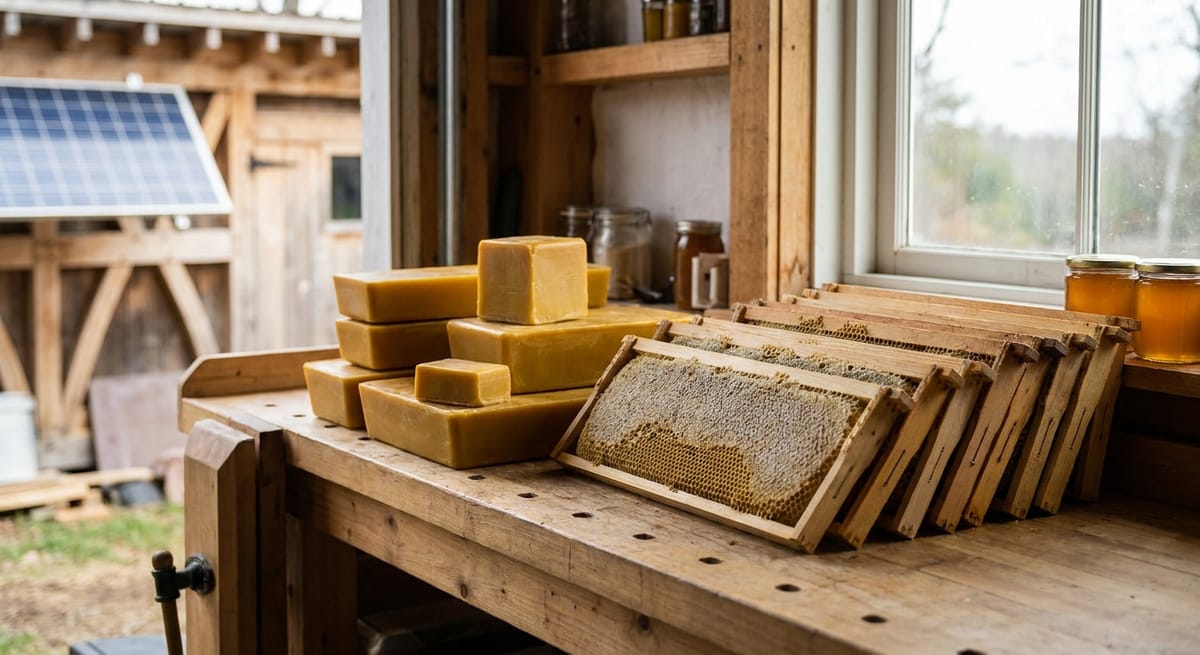
Why is beeswax the real long-term asset of the apiary?
Because it keeps. Honey is sweet, immediate, and disappears fast; beeswax is a stable, non-perishable material with an effectively indefinite shelf life and hundreds of practical uses. For an off-grid homestead, beeswax production turns a byproduct of the honey harvest into a durable store of value that never spoils and never needs refrigeration.
It is also a beautifully closed loop: manufactured entirely by bees from floral nectar, harvested as a byproduct of honey extraction, and processed using passive solar heat that needs zero grid electricity. No factory inputs, no synthetic chemicals, no supply-chain headaches. If you are weighing up whether the bees themselves earn their keep, our account of what four hives returned in one season makes the case with real numbers.
Whether you’re expanding your homestead apiary, producing value-added farm goods, or simply sourcing wax for maintenance and the home workshop, this guide covers the science, the verified pricing, and the legal landscape you need to navigate the beeswax economy with confidence.
How do bees make beeswax, and how is it graded?
Young worker bees synthesise wax internally: glands on the underside of the abdomen convert honey sugars into liquid lipids that harden into tiny scales, which the bees chew and shape into comb. Because that conversion burns through honey, wax is always the scarcer product — and it is graded from premium capping wax down to dark rendered brood-comb wax.
Beeswax isn’t collected from flowers — it’s synthesised by young worker bees (Apis mellifera) roughly 12 to 18 days old. Each bee has four pairs of specialised wax-secreting glands on the underside of her abdomen. These glands convert simple sugars from honey into complex liquid lipids, which harden on contact with air into thin scales. The bees scrape off these scales, chew them with their mandibles, and build the hexagonal combs that form the structural backbone of the hive.
The energy cost is staggering. Estimates in the beekeeping literature commonly run at around 6 to 8 kilograms of honey consumed per kilogram of wax produced, and the usual rule of thumb is that a harvest yields only 1 to 2 kg of wax per 100 kg of honey extracted. That scarcity is precisely why clean capping wax commands a premium.
Physical properties worth knowing
- Melting point: 62°C to 65°C — low enough for a solar box to handle. Sustained heat above roughly 85°C starts to discolour the wax, and badly overheated wax becomes a fire hazard, so melt it gently and never leave it unattended on direct flame.
- Density: approximately 0.95 to 0.96 g/cm³ at 20°C — it floats on water, which is exactly what makes water-bath rendering work.
- Chemical composition: hundreds of organic compounds — roughly two-thirds long-chain esters, with free fatty acids, hydrocarbons, and fatty alcohols making up most of the rest.
Quality grades at a glance
- Raw capping wax (premium grade): Harvested from fresh wax caps sliced off honeycombs during extraction. Light yellow to golden brown, virtually free of brood debris, richly aromatic. Commands the highest price.
- Rendered brood comb wax (industrial / technical grade): Sourced from old dark combs that held bee larvae. Higher in propolis, pollen, and larval cocoons; requires aggressive filtering. Best for lubricants, polishes, and fire-starters.
- Refined yellow pellets: Melted and micro-filtered, formed into small pastilles. Popular among crafters for precise measuring in recipes.
- Bleached white beeswax: Decolourised chemically or naturally (sunlight or charcoal). Used in cosmetics, pharmaceuticals, and decorative candles where yellow tinting is unwanted.
What can you actually do with beeswax on a homestead?
Nearly everything the hardware-store aisle of petroleum products does, and usually better: food wraps and cheese coatings, slow-burning candles, rust protection for tools, wood and leather conditioning, and a traditional base for home balms. Integrating beeswax into the homestead workflow meaningfully reduces reliance on paraffin, silicone, and mineral oil.
Food preservation
- Beeswax food wraps: Cotton fabric infused with beeswax, pine resin, and jojoba oil creates a reusable, washable alternative to single-use plastic wrap.
- Hard cheese coating: A clean wax coat seals ageing homemade cheeses against mould spores while retaining internal moisture.
Off-grid lighting
Pure beeswax candles burn slower and cleaner than paraffin — which is, after all, a petroleum byproduct — with a steadier flame and far less soot. On a homestead where indoor air quality matters and candles are working light rather than decoration, that’s not a trivial difference.
Homestead maintenance and tool care
- Rust prevention: Heat a metal tool — axe head, spade, cast-iron skillet — and rub raw beeswax over it while hot. It leaves a water-impermeable barrier that keeps oxidation at bay.
- Timber and leather conditioning: Mixed with boiled linseed oil or turpentine, beeswax forms a deep-penetrating polish for wooden furniture, gunstocks, and timber framing. Applied to leather boots and saddlery, it waterproofs and keeps things supple.
The still room
Beeswax is the traditional emulsifier and hardening agent in home-made balms and salves — traditionally used to carry herbal infusions such as calendula or comfrey and to form a simple protective layer over dry, weathered skin. It also pairs naturally with the hive’s other great gift: once the honey harvest is in, mead from your own hives is the logical next project.
What does beeswax cost in South Africa?
Checked against live supplier listings in August 2026, South African retail beeswax ran from R220 to R369 per kilogram depending on grade — raw wax at the bottom of the range, filtered and pharmaceutical grades at the top. One supplier published a bulk rate of R265/kg on orders of 5 kg or more.
Globally, demand from natural-cosmetics makers and eco-friendly packaging keeps beeswax prices firm, and South Africa’s strict biosecurity import restrictions keep local raw wax prices robust on top of that. Here is what named local suppliers were actually charging when we checked their listings in August 2026:
| Supplier | Product | Listed price (Aug 2026) |
|---|---|---|
| Fleures Honey | Natural pure beeswax, per kg | R220 |
| The Honey Company | Raw beeswax, per kg | R235 |
| Beeswax.co.za | Cosmetic-grade 1 kg block | R295 (R265/kg on 5 kg+) |
| Springvale Honey Co | Filtered pure beeswax, per kg | R300 |
| YourGZone (Hartbeespoort) | Pharmaceutical-grade 1 kg block | R369 (on sale, from R536) |
The market insight is straightforward: grade drives price. Raw, unfiltered wax sits at the bottom of the range and rewards anyone willing to render it themselves; filtered and pharmaceutical grades carry the premium. Small craft bars and moulded foundation sheets are priced per piece by beekeeping suppliers and work out considerably more per kilogram — if you need volume, buy blocks, and ask suppliers directly for bulk rates, because not all of them publish one.
What does South African law require of beekeepers?
Registration, for everyone. Under Control Measure R858 of 15 November 2013, issued under the Agricultural Pests Act 36 of 1983, any person who keeps, owns, or is in charge of a honeybee colony — commercial, hobbyist, or bee-removal service — must register annually with DALRRD. It costs nothing, and the registration window runs from 1 January to 31 March each year.
The Agricultural Pests Act (Act 36 of 1983)
All apicultural activity in South Africa falls under the Department of Agriculture, Land Reform and Rural Development (DALRRD) via the Agricultural Pests Act 36 of 1983. Two requirements stand out for homesteaders:
- Import permits: The Act restricts the importation of beehive products — honey and beeswax — and used apiary equipment, all of which require an official DALRRD import permit as controlled goods.
- Irradiation of imported honey: DALRRD’s phytosanitary rules require imported honey to be irradiated to prevent the spread of the pathogen that causes American Foulbrood (AFB), and biosecurity conditions attach to imported wax and equipment through the permit system.
Sourcing cheap, unverified imported wax online is not just a regulatory risk — it’s a genuine biosecurity hazard that can devastate local wild and managed bee populations.
Mandatory registration and the Capensis problem
The requirement is spelled out on DALRRD’s official Beekeeper Registration Form: every person who keeps, owns, or is in charge of a colony of honeybees — whether commercial, hobbyist, or bee-removal service provider — is legally required to register annually, between 1 January and 31 March, at no cost. Registered beekeepers must also mark their hives with their registration number and keep records of their beekeeping activities.
The rules exist because South Africa has a unique and genuinely tricky biological situation: two indigenous subspecies whose ranges must be kept separate.
- African honeybee (Apis mellifera scutellata): dominant in the northern and inland regions.
- Cape honeybee (Apis mellifera capensis): native to the Fynbos biome of the Western and Eastern Cape.
Cape bee workers can lay diploid female eggs without fertilisation. If moved north into scutellata territory, they invade hives, act as social parasites, overthrow the native queen, and cause total colony collapse. The control measures — hive marking, record-keeping, and restrictions on moving infected colonies — exist to prevent exactly that ecological catastrophe, and they make South Africa’s regime stricter than most countries, where hobbyist registration is often voluntary. American Foulbrood is also a notifiable disease here, which every wax producer handling old comb should take seriously.
How do you extract beeswax off-grid with a solar wax extractor?
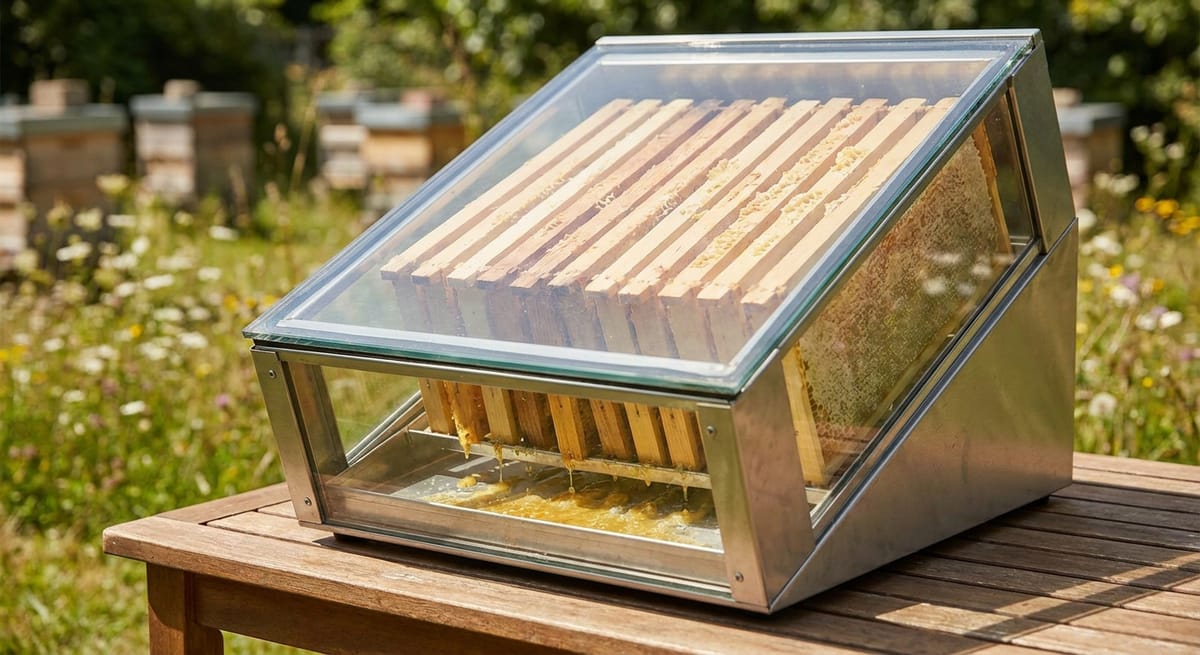
With an insulated box, a sheet of black metal, and a glass lid. A basic solar wax extractor comfortably exceeds beeswax’s 62°C to 65°C melting point on a clear day, letting molten wax drain through a filter into a water-lined catch pan — clean, rendered wax with zero grid electricity and nothing to buy but the glazing.
For the off-grid practitioner, this is the whole game: passive solar heat does the work that commercial operations do with electric melters. The box is an afternoon’s build — an insulated wooden carcass lined with black sheet metal, topped with a double-glazed glass or polycarbonate lid, angled at the sun.
Step-by-step processing method
- Initial wash: Submerge raw comb or capping scrapings in clean water for 24 hours. This dissolves residual honey, propolis dust, and sugar that would otherwise scorch or discolour the wax.
- Solar loading: Place the wet, washed comb onto the angled metal tray inside the extractor over a cheesecloth or stainless-steel mesh filter. Put a silicone pan filled with 2 cm of clean warm water in the catch area beneath.
- Solar heating: Position the box toward direct sunlight. Molten wax will flow through the filter cloth, leaving cocoons, bee bread, and slumgum behind.
- Filtration: Clean liquid wax drips into the collection container, floating on top of the water layer — which prevents sticking and catches most of the remaining debris.
- Slow cooling: Close the box and let the wax cool as slowly as possible. Rapid cooling causes the top of the block to crack. Once solid, pop the block out and scrape any dark debris off the bottom surface.
Pro-tip: Never melt beeswax in iron, copper, or zinc pots. These metals react with the free fatty acids in beeswax and turn your golden wax a dull grey or green. Always use stainless steel, silicone, or enamelled cookware.
Key takeaways
- Beeswax production is energy-intensive for bees — commonly cited estimates run at 6–8 kg of honey consumed per kilogram of wax — which is why pure capping wax is scarcer and often more valuable than honey by weight.
- Verified against live supplier listings in August 2026, South African retail beeswax ran R220–R369/kg depending on grade (Fleures Honey, The Honey Company, Beeswax.co.za, Springvale Honey Co, YourGZone), with one published bulk rate of R265/kg on 5 kg or more.
- Every South African beekeeper — hobbyist or commercial — must register annually with DALRRD under Control Measure R858 of 2013, free of charge, in the 1 January to 31 March window; hives must be marked with the registration number.
- Importing honey, beeswax, or used apiary equipment requires a DALRRD permit, and imported honey must be irradiated against American Foulbrood — cheap unverified imported wax is a biosecurity hazard, not a bargain.
- A passive solar wax extractor requires no electricity, costs little to build, and produces clean, high-quality rendered beeswax using only sunlight.
- Always use stainless steel, silicone, or enamelled cookware when melting wax — reactive metals (iron, copper, zinc) will ruin the colour of the finished block — and render old brood comb too: it yields serviceable industrial-grade wax for rust prevention, leather care, and fire-starters.
Frequently asked questions
What is a typical beeswax production yield, and how long does pure beeswax last in storage?
The usual rule of thumb in beeswax production is 1 to 2 kg of wax per 100 kg of honey harvested. As for shelf life — pure beeswax essentially never expires; workable wax has famously been recovered from ancient Egyptian tombs. Store rendered blocks wrapped in breathable cotton in a cool, dark spot. Heat above about 40°C may soften it, but the wax itself keeps indefinitely.
My stored wax blocks have a white, powdery coating — is something wrong?
Nothing is wrong at all — this is called “wax bloom”, and it’s actually a hallmark of pure beeswax. It occurs when low-melting-point fatty acids migrate to the surface, particularly in cold weather. It doesn’t affect quality one bit. To restore the golden lustre, simply wipe the block with a warm cloth or leave it briefly in direct sunlight.
Are low-cost beeswax imports safe for South African homesteaders to use?
They carry serious risk. Honey, beeswax, and used apiary equipment are controlled goods that need a DALRRD import permit, and imported honey must be irradiated against American Foulbrood. Unverified imported wax that has skipped those controls can carry the spores that cause AFB — a disease that can devastate managed and wild colonies alike. Buy from registered domestic suppliers.
Is DALRRD registration really mandatory if I only keep one or two hives?
Yes. Under Control Measure R858 of 2013, issued under the Agricultural Pests Act, anyone who keeps, owns, or is in charge of a honeybee colony must register with DALRRD — whether you have one hive or a thousand, and whether your beeswax production is a hobby or a business. Registration is free, renewed annually between 1 January and 31 March.
Is it worth rendering old, dark brood comb or should I focus only on capping wax?
Both are worth your time — just for different applications. Capping wax is the gold standard of beeswax production: light, aromatic, and ideal for food wraps, fine candles, and cosmetics. Old brood comb yields a darker, industrial-grade wax that’s perfect for rust prevention, leather conditioning, timber polishes, and fire-starters. Rendering both ensures no hive byproduct goes to waste — which is very much the off-grid philosophy.
Beekeeping sits at the heart of our Animals pillar, and the wax is only one line in the ledger — for the full picture of what an apiary contributes to a smallholding, start with what four hives returned in one season.