Security
Solar security lighting that still works in year three
Almost every cheap solar security light fails inside eighteen months, and always for one of three reasons. None of them is the panel.
Pillar 07
Private provision as permanent infrastructure — costed, layered, and without the fear-mongering.
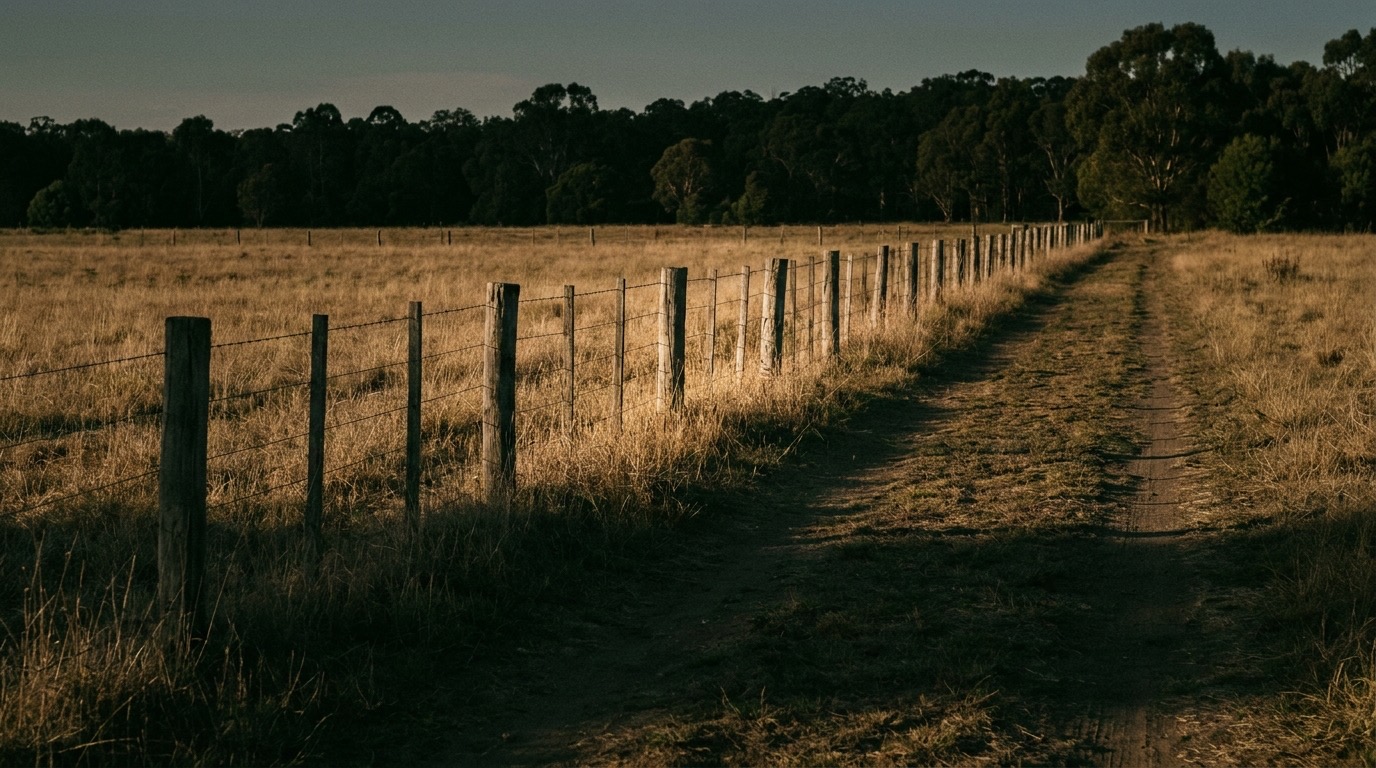
Security on a rural or peri-urban property in South Africa is not a reaction to a crisis — it is permanent infrastructure, the same category as water and power. A layered perimeter, independent communications, and a water supply that does not depend on municipal pressure are the three things that hold together when everything else fails.
Security infrastructure is not a luxury bolt-on that you add once the garden is planted. In South Africa, private provision fills the gap left by municipal services that cannot reach every street, every hour of every day. The gap is structural, not temporary, and the sensible response is structural too: build layers that keep working even when the grid is down, the pressure is off, and the phone signal is poor.
The word "layered" does most of the work here. No single system — not an electric fence, not a camera, not a guard — is a solution on its own. The value of each layer comes from how it interacts with the others. A fence that cannot be seen at night, cameras that go dark in load-shedding, a gate motor without battery backup: each of these turns a complete system into a sieve. The design question is not which single thing to install but how the pieces reinforce each other.
This pillar covers the four subjects that determine whether a perimeter actually holds: the physical perimeter itself, the power and communications that keep it alive, the water supply that underpins everything else, and what a properly built system costs to put together. Each hub links to deeper articles where the specifics are worked through. Start with the section that matches the gap you currently have, and use the table in "What it costs" to sequence what comes next.
A perimeter is not a fence. It is a sequence of obstacles, signals, and responses that together make undetected entry difficult enough to deter opportunistic intrusion. The fence — whether palisade, pre-cast panel, or electric strands — is the most visible element, but it is rarely the most important one.
Start with the principle of layers. The outer perimeter announces that the property is bounded and observed. The intermediate layer — usually the electric fence or a secondary barrier — imposes a physical consequence on anyone who crosses the outer line. The inner layer, which might be motion-activated lighting, sensor beams, or a dog run, gives advance notice before anyone reaches the structure itself. Each layer buys time. Time is what allows a response.
Visibility is the foundation all three layers rest on. Vegetation that reaches the perimeter wall creates concealment. Trees with low branches that overhang a fence line give a climbing point. Dense shrubs against a palisade hide a person working at the base. Good perimeter design trims or removes these before installing any electronic system — because a sensor that cannot see past a shrub does not trigger, and a fence that is easy to approach unseen is a fence that is easy to work on quietly.
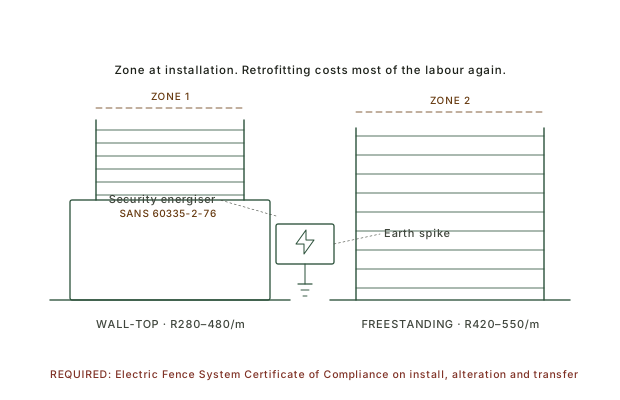
Palisade and pre-cast concrete walls each have a role. Palisade is transparent — a body cannot press against it unseen from the road — and it makes a poor surface to climb because there is nothing to grip between uprights. Pre-cast or brick gives privacy but removes the deterrence of visibility: nobody sees a person against the inside face. Electric fencing on top of either adds the intermediate-layer consequence, but its effectiveness depends entirely on whether it is energised and monitored. The article on electric fencing — Electric fencing on a smallholding: what it costs and what it does not do — works through the difference between a fence that is alarmed and one that is merely electrified, which is not the same thing.
Gates are the weakest point in any perimeter and receive the least design attention. A gate motor with a pedestrian bypass that opens under moderate force, or a gate that swings inward (so it can be forced by a vehicle) defeats the perimeter at the one point where traffic concentrates. The gate deserves at least as much engineering time as the fence line.
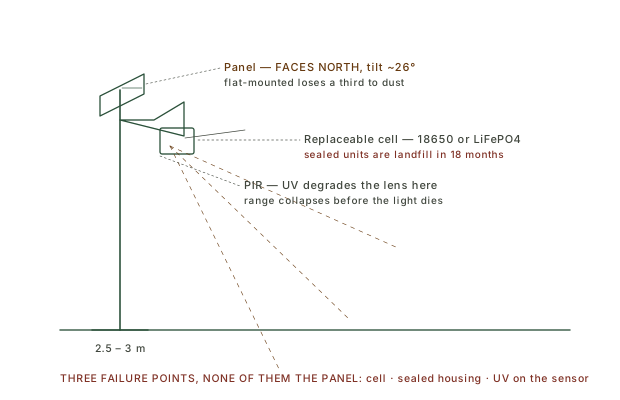
Lighting does two things: it removes concealment, and it triggers a behavioural response in anyone who has been assuming darkness. Motion-activated floodlights at the perimeter work best when they are angled to illuminate the approach rather than the inside — you want the light in the face of the person arriving, not in the eyes of the person responding. Solar lighting makes this viable along fence lines that are far from a distribution board. Solar security lighting that still works in year three covers the component choices that determine whether a solar light is still functioning at rated output after two wet seasons, which most budget units are not.
Layering the perimeter properly is a design exercise that rewards doing once, slowly, rather than adding devices reactively after an incident. The article Layering a smallholding perimeter on a real budget takes the design sequence from site assessment through final specification, including what to tackle first when the budget does not allow everything at once.
A security system that goes dark during load-shedding is not a security system — it is a security system with a published schedule of when it is off. This is the most common and most serious design error in residential and smallholding security across South Africa, and it has a straightforward remedy: treat security power as a separate, always-on circuit with its own battery backup.
The loads are modest. Electric fence energisers typically draw 5–15 W. IP cameras draw 5–12 W each. A DVR or NVR runs at 10–30 W. An alarm panel and its siren draw very little. Even a moderately specified system — eight cameras, an NVR, an energiser, and a panel — runs well under 200 W continuous. A small UPS or a dedicated lithium battery bank with a charge controller is sufficient to carry this load through a standard Stage 4 load-shedding block with margin to spare. The question is not whether backup power is feasible; it is whether anyone specified it at installation time.
Alarm systems that communicate over the municipal phone network or depend on a single SIM card have a single point of failure. Dual-SIM alarm communicators, which switch between networks automatically, add meaningful resilience at low cost. Some installations add a fixed-line path as a third option, though the reliability of fixed lines in many areas now lags behind cellular.
The more important communications question is what happens when the alarm triggers. An armed response SLA specifies a response time, but that SLA assumes the signal reaches the monitoring centre, the centre can reach the responder, and the responder can reach the property. Each link in that chain can fail independently. A local siren that is audible to neighbours who have agreed to respond is not a backup to armed response — it is a different and sometimes more reliable layer. Neighbours are already on-site.
IP camera quality has improved sharply over the last five years, but the useful range — cameras that produce forensically usable images at night — is narrower than the product range suggests. Infrared night vision that produces a legible face at 8 metres is common and cheap. Infrared that produces a legible face at 15 metres in cross-wind rain is not. Specify by lux rating and minimum illumination, not by megapixel count, and insist on a live demonstration at the fence line after dark before signing off on any installation. Storage on a local NVR that is protected from voltage spikes matters as much as the cameras themselves — footage that does not survive the load-shedding surge event is footage that does not exist.
The power pillar article Backup power that works and Battery storage cover the broader power architecture. For security-specific sizing, the key is to put the security circuit on a dedicated breaker that is served by the backup system regardless of what the rest of the distribution board is doing.
Water security sits in the security pillar because a property without a functioning independent water supply cannot sustain the simplest security responses: flushing a toilet, washing hands, filling a dog bowl, or supplying a firefighting point. Municipal water pressure also drives many irrigation-linked systems. When pressure drops — which happens during infrastructure failures that often correlate with other service disruptions — several systems that depend on it stop working.
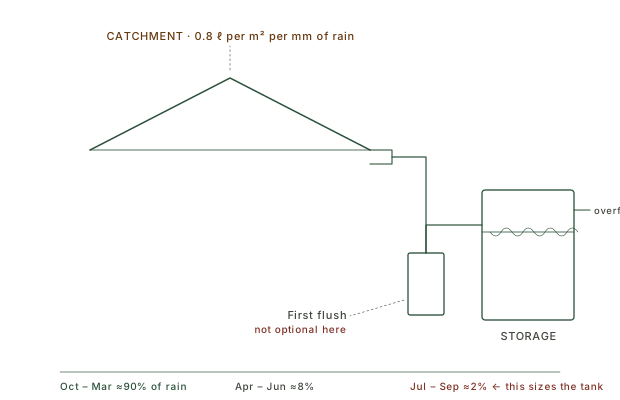
The independence question has three parts: storage, supply, and pressure. Storage means enough tank capacity to bridge a realistic outage — not a catastrophic, permanent failure, but the three- to five-day outages that occur when a main bursts or a pump station loses power. Supply means a source that does not depend on the municipality — a borehole, a harvested rainwater tank, or a grey-water system that recycles what is already on the property. Pressure means a pump that can deliver water at usable pressure from that independent source, backed by the same independent power circuit that serves the rest of the security infrastructure.
The article Water security when the municipal supply fails works through each of these three elements in detail, including the legal position on borehole registration under the National Water Act and what a realistic storage calculation looks like for different household sizes.
In dry conditions — which in many parts of South Africa means a large part of the year — a veld or grass fire against the perimeter is a credible threat that a water-dependent response depends on. Municipalities do not guarantee supply during a fire event in an outlying area. A property with 5,000 litres of stored water on an independent pump circuit can do something useful in the first minutes before emergency services arrive. A property on municipal pressure alone cannot, the moment the fire or the event that caused it also interrupts supply.
This is not a reason for panic. It is a reason for a fixed hose point on the perimeter fence side of the house, a known isolation valve, and enough stored water to matter. None of these are large expenses and all of them are permanent infrastructure.
| Household size | Daily consumption (litres) | 3-day bridge | 7-day bridge | |||||||||||||||||||||||||||||||||||||||||||||||||||||||||||||||||||||||||||||||||||||||||||||||||||||||||||||||||||||||||||||||||||
|---|---|---|---|---|---|---|---|---|---|---|---|---|---|---|---|---|---|---|---|---|---|---|---|---|---|---|---|---|---|---|---|---|---|---|---|---|---|---|---|---|---|---|---|---|---|---|---|---|---|---|---|---|---|---|---|---|---|---|---|---|---|---|---|---|---|---|---|---|---|---|---|---|---|---|---|---|---|---|---|---|---|---|---|---|---|---|---|---|---|---|---|---|---|---|---|---|---|---|---|---|---|---|---|---|---|---|---|---|---|---|---|---|---|---|---|---|---|---|---|---|---|---|---|---|---|---|---|---|---|---|---|---|---|---|
| 2 persons | ~300 L/day | 900 L | 2,100 L | |||||||||||||||||||||||||||||||||||||||||||||||||||||||||||||||||||||||||||||||||||||||||||||||||||||||||||||||||||||||||||||||||||
| 4 persons | ~600 L/day | 1,800 L | 4,200 L | |||||||||||||||||||||||||||||||||||||||||||||||||||||||||||||||||||||||||||||||||||||||||||||||||||||||||||||||||||||||||||||||||||
| 6 persons + stock | ~1,000 L/day | 3,000 L | 7,000 L | |||||||||||||||||||||||||||||||||||||||||||||||||||||||||||||||||||||||||||||||||||||||||||||||||||||||||||||||||||||||||||||||||||
| C | o | n | s | u | m | p | t | i | o | n | f | i | g | u | r | e | s | b | a | s | e | d | o | n | D | W | S | h | o | u | s | e | h | o | l | d | w | a | t | e | r | u | s | e | g | u | i | d | e | l | i | n | e | s | . | A | c | t | u | a | l | u | s | e | v | a | r | i | e | s | s | i | g | n | i | f | i | c | a | n | t | l | y | w | i | t | h | l | i | v | e | s | t | o | c | k | n | u | m | b | e | r | s | a | n | d | i | r | r | i | g | a | t | i | o | n | . |
The security budget is the one budget on a smallholding that most people underestimate in the right direction: they think it will be more than it turns out to be when they sequence it properly. The reason is that most security infrastructure is a one-time capital expenditure with low ongoing cost, not a recurring service fee, and the most expensive component — an electric fence perimeter — does most of the layering work on its own.
Sequencing determines the effective cost more than specification does. A system built in the right order — perimeter first, lighting second, cameras third, alarm and monitoring last — means that each phase reinforces what came before and no phase has to be undone. A system built in the wrong order — cameras before the fence is sorted, monitoring before the gate motor has backup power — means spending twice.
The article Electric fencing on a smallholding: what it costs and what it does not do carries detailed specification guidance for the perimeter phase, including what energiser sizing actually means in practice and why the cheapest energiser is rarely the cheapest long-term choice. For the lighting phase, Solar security lighting that still works in year three covers the component quality thresholds below which the three-year total cost exceeds the cost of a better unit bought once.
Armed response subscriptions are a monthly cost that accumulates to a significant annual figure. The fee covers the monitoring centre and the response vehicle; it does not cover the communication equipment, the alarm panel, or the sensors — those are separate capital items. When comparing quotes, confirm exactly what is and is not included. A low monthly rate with a four-year contract and a hardware ownership clause that transfers only at contract end is often more expensive over the full period than a higher monthly rate with owned hardware from day one.
Battery replacement is the other cost that goes unbudgeted. Gate motor batteries, UPS batteries, alarm panel batteries, and solar light batteries all have a service life of two to five years depending on chemistry and cycling. A system installed in a single year will have a synchronised battery replacement bill three to five years later. Stagger the battery types — or note the installation dates and budget for replacements — before it arrives as a surprise.
| Phase | What it covers | Why it comes here | Key article |
|---|---|---|---|
| 1 — Perimeter | Fence, gate, gate motor with battery backup | The boundary that makes every other layer meaningful | security/perimeter-layers |
| 2 — Lighting | Motion-activated floodlights, solar perimeter lights | Removes concealment; low ongoing cost | security/solar-security-lighting |
| 3 — Cameras | IP cameras, NVR, surge-protected storage | Evidence and deterrence; depends on phase 1 being solid | — |
| 4 — Alarm & comms | Alarm panel, dual-SIM communicator, monitoring SLA | Connects the other layers to a response | — |
| 5 — Water independence | Tank storage, pump, borehole or rainwater supply | Sustains responses and removes a single point of failure | security/water-security |
Most published security advice is written for contexts where the grid is reliable, the municipal water pressure is stable, armed response reaches a specific postcode in four minutes, and the legal framework governing electric fencing is the same as it was when the fence was installed. None of those assumptions holds uniformly in South Africa, and some do not hold at all.
Load-shedding is the biggest single difference. A system designed without reference to it will fail predictably, on a published schedule, in every area where load-shedding reaches Stage 3 or above. The design response is not complicated — it is a dedicated backup power circuit for the security load — but it has to be deliberate. Installers who do not specify it are not designing for the country they are working in.
The legal framework for electric fencing in South Africa is governed by the Occupational Health and Safety Act and the SANS 10222 series of standards. SANS 10222-3 covers electric security fencing specifically and has different requirements from the agricultural fencing standards that sometimes get cited in residential installations. A fence installed to agricultural standards on a residential perimeter may be non-compliant and, more importantly, may behave differently from a fence installed to the residential standard — typically by allowing higher peak voltages that change the risk profile. This matters not only for safety but for insurance purposes.
The National Water Act 36 of 1998 governs borehole registration and the legal status of water use from a borehole on private land. The position is more permissive than many property owners believe — domestic use from a registered borehole is generally lawful without a separate licence — but "registered" is doing real work in that sentence. An unregistered borehole used as a security water supply is a liability, not an asset, if a dispute arises.
The most common and most expensive error is buying the wrong thing in the wrong order. A DVR and eight cameras installed before the perimeter fence is repaired gives good footage of people crossing an unimpeded boundary. That is not security — it is evidence collection after the fact, and most people who install cameras in that sequence had hoped for prevention.
The second error is specifying for normal conditions rather than failure conditions. Gate motors specified without battery backup work during load-shedding exactly once — the stored mechanical energy in the motor runs the gate through one cycle, and then it stops. A motor with battery backup that has not had its battery tested or replaced since installation fails at the same moment, for a different reason, with the same result. The failure condition is the condition that matters; it is also the condition that is most often ignored in specifications and maintenance schedules.
The third error is treating armed response as a first layer rather than a last one. Armed response is a response — it arrives after the trigger, not before it. Everything that deters, delays, or signals before the trigger is the layer that determines whether the response ever has to happen. Properties that invest only in monitoring and response, with no investment in the perimeter layers that slow an intrusion to the point where response has time to arrive, are paying for a service that their own perimeter design makes unlikely to succeed.
Guides
Each one names its sources, and says plainly where a figure could not be sourced.
Security
Almost every cheap solar security light fails inside eighteen months, and always for one of three reasons. None of them is the panel.
Security
Per-metre costs for a real perimeter, the difference between a security and an agricultural energiser, and the certificate most owners have never heard of.

Security
Four layers, in the order that returns the most per rand. Almost everybody buys them in the wrong sequence, starting with the most expensive one.
Security
Municipal water cuts are not emergencies in South Africa — they are a recurring condition. The question is not whether your supply will be interrupted but how long you can last when it is.
From the journal
Dated write-ups from the journal that touch this pillar — what is being built, tested and costed right now.
The other six
Nothing on a smallholding is a closed system. These are the pillars this one touches most.
The Sunday Dispatch
What we are building, what we have sourced, and what it costs — with the supplier named and the quote dated. No affiliate padding, no doom, no filler.
One email every Sunday. Unsubscribe in one click, any time.