Journal
Off-Grid Alarm Systems in South Africa: Power, Signal and Standards
In short
- An off-grid alarm system in South Africa draws very little power. A typical eight-zone panel with a keypad, six indoor PIRs and a 4G communicator uses about 261 mA, roughly 3 W. A 12 V 7 Ah battery can carry that for about a day on paper.
- The weak link is the signal path, not the power. SAIDSA’s installation by-law makes a dual communication path compulsory and advises against 2G and 3G, which are being switched off.
- Fit a dual-SIM 4G communicator and test it where it will be mounted. Give the alarm its own battery rather than relying on the house inverter, and use a PSIRA-registered installer.
What’s in this guide
- What makes an alarm system work off the grid?
- How much power does an alarm system actually draw?
- How long will the alarm battery last, and which one should you fit?
- Should the alarm run from the house inverter or its own battery?
- How do you get the alarm signal out when coverage is patchy?
- Wired or wireless on a smallholding?
- Who is allowed to install and monitor it?
- Key takeaways
- Frequently asked questions
What makes an alarm system work off the grid?
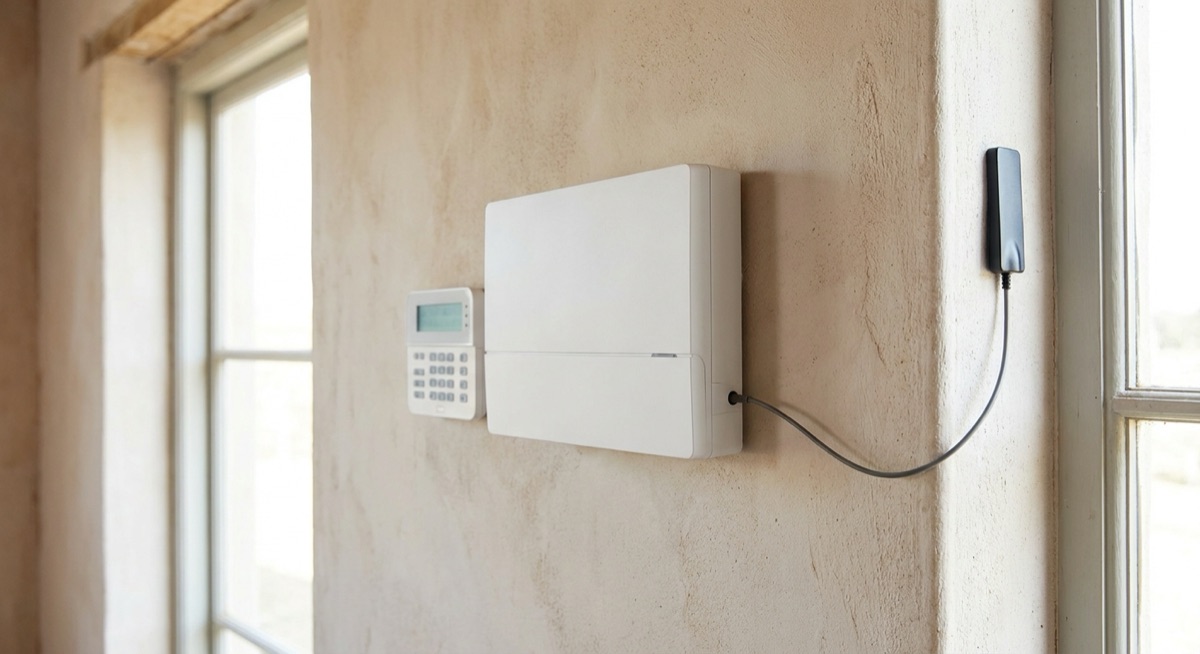
An alarm system works off the grid when three things hold with no Eskom supply and no fibre. It needs a standby battery sized for the longest gap in charging, a signal path that does not depend on one network, and a detector layout that covers distance and outbuildings. Brand matters far less than those three.
This guide covers only the intruder alarm: the panel, detectors, communicator and standby power. The security pillar shows how the layers fit together. Layering a smallholding perimeter on a real budget explains why the house envelope, with an alarm that reaches somebody, should come before the fence line.
How much power does an alarm system actually draw?
A hardwired alarm with an eight-zone panel, one LCD keypad, six indoor PIRs and a 4G communicator draws about 261 mA at 12 V in standby, roughly 3 W. Over 24 hours that comes to about 75 Wh before transformer and charger losses. The communicator is the largest single load, and each PIR is the smallest.
The figures below come from the manufacturers’ own documents. The panel and keypad draws are from the Paradox SP5500+/SP6000+/SP7000+ installation guide. The PIR draw is from the Paradox NV5 datasheet, and the communicator draw is from the Olarm MAX datasheet.
| Component | Qty | Standby draw (manufacturer figure) | Subtotal |
|---|---|---|---|
| Paradox SP6000+ control panel (idle) | 1 | 55 mA | 55 mA |
| Paradox K32LCD+ keypad | 1 | 43 mA minimum (86 mA maximum) | 43 mA |
| Paradox NV5 indoor PIR | 6 | 10.5 mA standby (11.3 mA in alarm) | 63 mA |
| Olarm MAX 4G/Wi-Fi communicator | 1 | 100 mA typical (250 mA maximum) | 100 mA |
| Total standby load | 261 mA (about 3.1 W at 12 V) | ||
| Energy per 24 hours | about 6.3 Ah, or about 75 Wh |
A few things push the total up:
- The keypad draws up to 86 mA when it is active, so a second keypad adds a noticeable load.
- The Olarm MAX peaks at 250 mA when it transmits, and Olarm specifies a supply that can deliver at least 300 mA.
- If you use Paradox’s own PCS265LTE module instead, the Paradox guide lists it at 60 mA standby and 300 mA maximum.
The siren barely registers: even at the SP6000+ bell output’s 1 A rating, SAIDSA’s three-minute minimum sounding uses about 0.05 Ah.

How long will the alarm battery last, and which one should you fit?
A new 12 V 7 Ah sealed lead-acid battery runs the system above for about 27 hours on paper, or about 23 hours at 0 °C. An 18 Ah battery gives about 69 hours. An older battery gives much less. Size the battery for the longest gap in charging you expect, then add half again as a margin.
The hours below are rated capacity divided by the 261 mA load. The 0 °C column applies the temperature derating printed in each battery’s specification.
| Battery | Capacity basis | Hours at 25 °C | Hours at 0 °C | Price |
|---|---|---|---|---|
| 12 V 7 Ah sealed lead-acid (Vautex) | 7 Ah at the 20-hour rate; 85% at 0 °C | about 27 h | about 23 h | R215.00 incl. VAT, priced at Communica, September 2026 |
| 12 V 18 Ah sealed lead-acid (PSS) | 18 Ah at the 20-hour rate; 85% at 0 °C | about 69 h | about 59 h | R695.00 incl. VAT, priced at Communica, September 2026 |
| 12.8 V “7 Ah” LiFePO4 (Securi-POD) | 6.12 Ah typical, as listed | about 23 h | discharge rated to −20 °C; charging only from 0 °C | R680.01 incl. VAT, priced at Communica, September 2026 |
The 7 Ah battery’s rating is quoted at a 0.35 A discharge. This system draws less than that, so a new battery should deliver close to its label figure. Test the battery at every service, and write the fitting date on it.
SAIDSA’s rule for central-station standby power is a useful planning tool. It sizes the battery at the average current drain multiplied by 1.5. Applied to a home system, that gives a 7 Ah battery about 18 hours and an 18 Ah battery about 46 hours. Lithium is not a drop-in swap. SAIDSA’s installation by-law requires batteries to be used within the manufacturer’s charging specification, so check with the installer that the panel’s charger suits LiFePO4. The same by-law does not permit flooded batteries or car batteries.
Should the alarm run from the house inverter or its own battery?
It should use both. Feed the alarm transformer from the inverter’s essential circuit so the panel’s battery stays charged. The panel’s own battery then carries the system whenever the inverter shuts down. The dangerous moment is an inverter that trips on low battery before dawn after a cloudy week, and that is exactly when the alarm must keep working.
Panels such as the SP6000+ take a 16.5 Vac transformer input and charge their own battery from it. On an off-grid system, that makes the alarm a small AC load on the inverter, and inverter idle consumption can exceed the alarm’s 3 W on its own. Backup power that works puts communications first among the loads to keep alive, and choosing an inverter covers low-voltage shutdown.
SAIDSA’s by-law requires security systems connected through solar or an inverter to be installed to SANS 10142-1 and -2 where applicable, which is work for an electrician. It also recommends that the panel report mains failure and low battery to the control room. Off the grid, a mains-failure signal means the inverter is down, so set the panel to report it.
How do you get the alarm signal out when coverage is patchy?
Use two independent signal paths and test both where the communicator will be mounted. In practice, that means a dual-SIM 4G communicator that can switch between Vodacom and MTN, with an external antenna if the signal is weak. Add a second medium where one is available, such as a battery-backed Wi-Fi router or a response company’s radio network.
SAIDSA’s By-law 5, the installation specification for intruder alarms, makes a dual communication path compulsory on all systems. If the customer declines it, the installer must record the system as non-compliant on the certificate. On low-risk installations, both paths may run through one device, such as a SIM plus fibre or Wi-Fi, as long as the router has the same backup battery as the alarm. The by-law lists radio, GSM and TCP/IP as acceptable methods.
- The Olarm MAX uses two managed SIMs, one Vodacom and one MTN, and typically switches networks in under 60 seconds. It has an SMA connector for an external antenna, sold separately, which can make the difference for a panel in a steel cabinet or behind thick walls.
- Check the Vodacom coverage map and the MTN coverage map, but treat both as estimates. Then stand where the panel will go with a phone on each network.
- Avoid communicators that use only 2G or 3G. SAIDSA now says 2G/3G “is not recommended” and requires installers to warn clients about the sunset. In June 2026, MyBroadband reported that MTN is removing 3G area by area with no fixed national date and that 2G will follow. Vodacom had not yet started switching off 3G.
The Olarm MAX was R1,200.00 incl. VAT, priced at Communica, September 2026. It needs a subscription to work. Olarm’s pricing page listed app-only plans from R439 for six months, checked September 2026, and professional monitoring is sold through armed response partners. Armed response fees are covered in home security running costs. Ask your response company whether it runs a radio network in your area, because radio provides a second path that does not depend on a cell mast.
Wired or wireless on a smallholding?
A hybrid system usually suits a smallholding best. Wire the main house, and use two-way wireless for outbuildings and anywhere trenching is impractical. Hardwired detectors run from the panel and need no batteries of their own. Wireless detectors run on cells that need replacing, and each receiver must be installed inside a protected area.
SAIDSA’s by-law allows wireless only with two-way technology on an ICASA-approved frequency. Wireless detectors must report supervision, low battery and tamper. For hybrid systems, the by-law recommends that at least 30% of residential detection be hardwired unless the system is bi-directional.
Plan the zone count carefully. A single zone may hold one infrared beam or beam pair, or one outdoor detector, so beams on the approach and PIRs at the sheds can fill an eight-zone panel quickly. Keep outdoor detectors out of reach of livestock and dogs, or false alarms will train everyone to ignore them. The Olarm MAX datasheet also lists Nemtek energiser support, but fence compliance is a separate subject, covered in electric fencing on a smallholding.
Who is allowed to install and monitor it?
Anyone who installs alarm systems as a security service must be registered with PSIRA, the Private Security Industry Regulatory Authority. The client carries responsibility too: contracting an unregistered provider, knowingly or without reasonable care, is an offence. Before work starts, ask for the installer’s PSIRA number and a current letter of good standing.
PSIRA’s consumer information notice names installers of security equipment among those who must register, and it lists alarm systems as security equipment. It cites section 38(3)(g) of the Private Security Industry Regulation Act as the basis for the client’s liability. A letter of good standing is valid for 90 days.
SAIDSA membership is voluntary, but its 2026 booklet contains By-law 5, the written standard to check the job against.

Key takeaways
- A typical eight-zone alarm draws about 261 mA, roughly 3 W, so power is the easy part.
- A 12 V 7 Ah battery lasts about a day on paper, and less in winter or as it ages. Fit 18 Ah where the inverter may be off overnight, and plan with a factor of 1.5.
- Feed the alarm from the inverter’s essential circuit, let its own battery carry it through shutdowns, and have it report power failure.
- SAIDSA By-law 5 makes dual communication paths compulsory. A dual-SIM Vodacom/MTN 4G communicator is the starting point, and 2G/3G-only units are best avoided.
- Use a PSIRA-registered installer, because hiring an unregistered one can make the client liable.
Frequently asked questions
Can an alarm system run directly from a solar panel without an inverter?
Not as most control panels are designed. Mainstream panels such as the Paradox SP6000+ expect a 16.5 Vac transformer and manage their own battery charging. SAIDSA requires solar or inverter connections to follow SANS 10142-1 and -2 where applicable. A direct DC arrangement needs the manufacturer’s approval and an electrician’s sign-off.
Is a GSM communicator enough on its own?
No. SAIDSA By-law 5 makes a dual communication path compulsory on all systems. On a low-risk installation, a SIM plus Wi-Fi from a router with the same backup battery as the alarm can count as two paths in one device. Where a response company runs a radio network, radio adds a path that does not depend on cell masts.
Will a 2G or 3G alarm communicator stop working?
It may, and without much warning. MTN is removing 3G area by area, with 2G to follow. SAIDSA now advises against 2G/3G communicators and requires installers to warn clients about the switch-off. If your communicator is not 4G, replace it.
How long should an alarm battery last during an outage?
It should last through the longest gap in charging you expect, plus a margin. For a typical eight-zone system drawing about 261 mA, a new 7 Ah battery lasts roughly a day and an 18 Ah battery nearly three days. Cold weather, battery age and an active keypad all shorten those times.
Is armed response needed if the alarm sends phone alerts?
It is not a legal requirement, but a phone alert only helps if someone can act on it. On a remote property, decide who will respond, and how quickly, before choosing between app-only alerts and a professional control room.