Journal
Home Security Running Costs: The Essential Monthly Breakdown
In short
- Home security running costs are an ongoing utility bill, not a one-off purchase — armed response, electricity, data, and battery wear arrive every single month.
- Armed response is the biggest line item: Fidelity ADT publishes regional specials from roughly R220–R350 a month (August 2026), while comparison service Procompare lists typical residential cover at R400–R1,000 a month.
- Powering the perimeter itself is cheap — around R50 a month on Eskom’s 2026/27 Homepower tariff — but outages quietly add a battery-replacement tax on top.
What’s in this guide
- Why is home security a running cost, not a purchase?
- What does armed response cost per month in South Africa?
- What does it cost to power an electric fence and gate motor?
- What do cameras, storage, and connectivity add?
- How do load shedding and outages push up the cost?
- What does it all add up to each month?
- How should you budget for ongoing security?
- Key takeaways
- Frequently asked questions
Why is home security a running cost, not a purchase?
Home security running costs begin the moment the installer hands over the keys. The hardware on your boundary — wire, cameras, gate motor — is inert metal and plastic. What keeps it alive is a continuous flow of electricity, data, and paid human response capacity, and every one of those flows is billed monthly.
Yet most homeowners fixate almost entirely on the upfront quote: the per-metre price of electric fencing, camera resolution, gate motor specs. The ongoing operational expenditure barely gets a mention — and it should, because cut any one of those flows and the perimeter fails quietly.
Security is a utility in every meaningful sense. Like electricity, broadband, or water, it demands a steady monthly cash flow to stay active. This guide — part of our wider security pillar — builds a clear operational ledger for a South African household: what it actually costs, month after month, to keep responders on standby, the perimeter energised, cameras recording, and backup batteries ready for the next outage. Installation costs are a separate conversation; here we deal only with what recurs.
What does armed response cost per month in South Africa?
Armed response is almost always the single largest line item in a household security budget. Fidelity ADT’s own published regional specials run from about R220 to R350 a month for monitoring and armed response (adt.co.za, August 2026), while the comparison service Procompare lists typical residential cover at R400–R1,000 a month (August 2026).
Why the spread? Private armed response fills the gap left by overstretched public policing, and what you pay depends on where you live and what the package includes. Dense suburbs with several competing providers see aggressive promotional pricing — Fidelity ADT’s area specials are a good example, some bundling a few months free or holding an introductory rate for the first stretch of a longer contract. Quieter or outlying areas, where a response vehicle covers more ground per client, sit at the upper end of Procompare’s range, and premium or estate packages climb beyond it.
The contract term matters as much as the headline rate. Promotional pricing is usually tied to a 24- or 36-month agreement, and the rate steps up after the promotional window. Read the escalation clause before you sign — the figure that matters is not month one but month twenty-five. For smallholdings and plots outside standard coverage zones, ask specifically about response times to your gate; a low monthly fee means little if the vehicle is twenty minutes away.
What does it cost to power an electric fence and gate motor?
Very little — the electricity for a typical fence energiser and gate motor comes to roughly 15 kWh a month, which is about R50 on Eskom’s 2026/27 Homepower tariff. The catch is not the size of the number but its persistence: it never stops accumulating, whether anything happens on your boundary or not.
A residential fence energiser delivers high-voltage pulses — typically in the 6,000–10,000 V range — at very low amperage, drawing a modest but uninterrupted 10–15 W. That works out to roughly 7–11 kWh over a 30-day billing cycle. Gate motors add a split consumption profile: a small standby trickle of around 5 W (call it 3–4 kWh a month) plus brief current spikes each time the motor hauls a heavy timber or steel gate open. At ten to fifteen cycles a day, the combined boundary load lands in the region of 15 kWh a month. If you are still choosing or specifying fencing, our guide to electric fencing covers the hardware side.
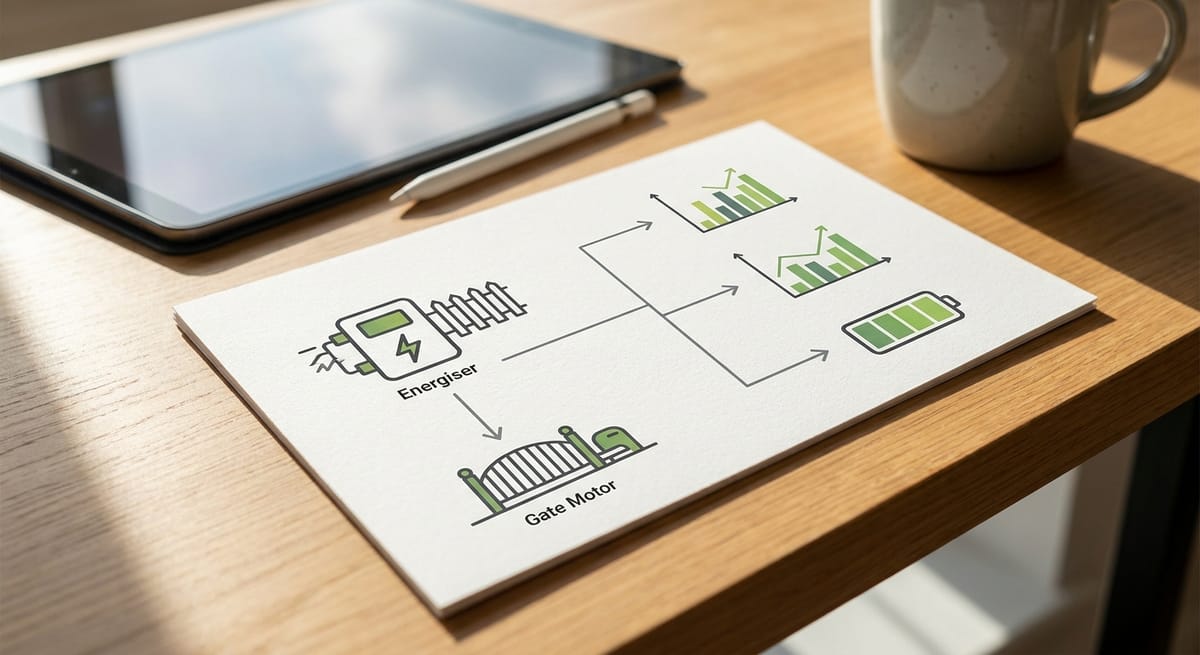
What that 15 kWh costs depends on your tariff. For Eskom direct customers, the 2026/27 Schedule of Standard Prices (April 2026) puts the Homepower energy charge at 322.06 c/kWh including VAT, with the network demand and ancillary charges adding a further 33.5 c/kWh — roughly R3.56 per kWh in variable charges all told. Fifteen kilowatt-hours therefore costs in the order of R50 a month before fixed charges. Municipal customers pay their own council’s tariff, which can sit meaningfully above or below Eskom’s direct rate, so check your own bill rather than assuming.
What do cameras, storage, and connectivity add?
Cameras consume three resources at once: electrical power, storage for the footage, and a data connection to reach you. All three recur monthly, and skimping on any one of them leaves the system with a blind spot — a camera that records to a hard drive nobody can reach is only half a camera.
A standard eight-camera NVR setup with Power-over-Ethernet and continuous hard-drive recording draws in the region of 30–40 W around the clock — roughly 22–29 kWh a month, or about the same again as your fence and gate on the tariff arithmetic above. Fewer cameras, or motion-triggered recording instead of continuous, pulls that down proportionally.
Storage and connectivity are where the recurring subscriptions creep in. Footage stored only on the local recorder is vulnerable — an intruder who finds the NVR can take the evidence with them — so off-site or cloud storage is worth having, and the subscription becomes part of the monthly ledger. Connectivity is the other quiet cost: fibre where it is available, or a 4G/LTE failover router where it is not. Video eats mobile data quickly, so if your cameras lean on LTE, price a dedicated data bundle with your provider rather than guessing — bundle pricing shifts often enough that the only reliable number is the one on your own quote.
How do load shedding and outages push up the cost?
Outages add two costs most budgets never see: a recharging surcharge, because replacing every kilowatt-hour drawn from a battery takes more than a kilowatt-hour of grid or solar power, and — far more expensive — accelerated battery wear, because standby batteries were never designed to be cycled daily.
Recharging inefficiencies
Once power returns, inverters and chargers work to replenish depleted batteries before the next cut. Conversion losses mean the round trip typically runs at roughly 80–90% efficiency, so every unit of energy your security system draws during an outage costs you a little more than a unit to put back — an invisible surcharge of around 10–20% on every post-outage recharge cycle.
Amortised battery degradation
This is the big one. Gate motors, fence energisers, and alarm panels typically ship with small 7 Ah or 18 Ah sealed lead-acid or gel batteries — chemistries designed to float on standby for the occasional failure, not to cycle every day. Under sustained load shedding they can fail in well under a year, and because the cost arrives as a scatter of individual battery purchases rather than one bill, most households never realise how much the outage era has been costing them. Price the batteries in your own system, count how often you have replaced them, and divide — that monthly figure belongs in your security budget alongside the armed response debit order.
Upgrading to lithium iron phosphate (LiFePO4) changes the arithmetic entirely: the chemistry is built for daily cycling and carries a design life measured in years rather than months, though the upfront outlay is higher. Sizing that backup properly is its own subject — our guide to backup power that works walks through it.
What does it all add up to each month?
For a typical suburban South African household running armed response, an electric fence, a gate motor, and a camera system, the verifiable floor is a few hundred rand a month — and once data, storage, and battery wear are counted honestly, the true figure for a fully funded system commonly runs well beyond that.
Here is the ledger, with the figures that can be pinned down pinned down, and the rest stated for what they are — costs you must price for your own setup:
| Security component | Monthly cost | Basis |
|---|---|---|
| Armed response subscription | R220–R350 on published specials; R400–R1,000 typical | Fidelity ADT published regional specials; Procompare listings (both August 2026) |
| Electric fence & gate motor power (~15 kWh) | ~R50 | Eskom 2026/27 Homepower variable charges of roughly R3.56/kWh incl. VAT |
| Camera power (~22–29 kWh for an 8-camera NVR) | ~R80–R100 | Same Eskom tariff arithmetic |
| Cloud storage & LTE/fibre data | Varies — price your own bundle | Provider-dependent; changes too often to quote |
| Outage battery replacement (amortised) | Varies — count your own replacement rate | Depends on outage frequency and battery chemistry |
The pattern is what matters more than any single number: the human response service dominates the budget, the electricity is nearly negligible, and the costs that catch people out are the ones that never appear as a line item — data bundles and dead batteries.
How should you budget for ongoing security?
Treat home security running costs as a permanent operational expense line, fund it fully before you buy another piece of hardware, and design the system around what you can afford to keep alive every month — not around what looks impressive on installation day.
Over-capitalising on hardware without funding the recurring costs creates real vulnerabilities. A homeowner who installs sixteen 4K perimeter cameras may find the storage subscriptions and data costs quickly outrun the budget, leading to disabled cloud storage or unmonitored feeds. That is a far worse outcome than fewer cameras with fully funded operational coverage. A partially funded perimeter gives you the maintenance burden of a big system with the protection of a small one.
Every efficiency gain compounds, because these costs never stop. Motion-triggered recording instead of continuous streaming cuts both power and data. LiFePO4 backup batteries turn an annual replacement cycle into a once-a-decade one. And lighting is the easy win: solar security lighting takes an always-on load off your bill entirely while keeping the perimeter lit through any outage — which is precisely when you want it lit.
Key takeaways
- Home security running costs are a permanent operational utility — budget for them monthly, from day one, alongside electricity and broadband.
- Armed response is the dominant line item: Fidelity ADT publishes regional specials from roughly R220–R350 a month, and Procompare lists typical residential cover at R400–R1,000 a month (both August 2026). Read the escalation clause, not just the promotional rate.
- Powering the boundary itself is cheap — around 15 kWh a month for a typical fence and gate, roughly R50 at Eskom’s 2026/27 Homepower variable rate of about R3.56/kWh incl. VAT. Municipal tariffs differ, so check your own bill.
- Cameras carry a triple overhead — electricity, storage, and data — and all three must be funded or the system has gaps an intruder can exploit.
- Outages impose a hidden battery-replacement tax: small sealed lead-acid standby batteries cycled daily can fail in under a year, while LiFePO4 is built for daily cycling and lasts years. Count your own replacement rate and put it in the budget.
- Fund fewer components fully rather than many components partially — a lean system that is always on beats an impressive one that is quietly dark.
Frequently asked questions
What are typical home security running costs per month in South Africa?
Home security running costs for a suburban household start with the armed response subscription — Fidelity ADT publishes regional specials from about R220–R350 a month, and Procompare lists typical residential cover at R400–R1,000 (August 2026). Add roughly R50 for fence and gate electricity, more for camera power, plus data and battery wear, which vary by setup.
What is the biggest single item in home security running costs?
The armed response or monitoring subscription, by a wide margin. Electricity for the entire perimeter — fence, gate motor, and cameras — typically costs less per month than even a heavily discounted response contract. That is why the contract deserves the most scrutiny: compare providers, ask about response times to your specific address, and read the annual escalation clause before signing anything.
How much electricity does a home security system use each month?
A typical fence energiser draws 10–15 W continuously and a gate motor adds a small standby load plus operating spikes — about 15 kWh a month combined. An eight-camera NVR at 30–40 W adds roughly 22–29 kWh. At Eskom’s 2026/27 Homepower variable rate of about R3.56/kWh, the whole lot costs in the region of R130–R160 monthly.
Is LiFePO4 worth the upgrade for security battery backups?
If your area sees regular outages, generally yes. Small sealed lead-acid batteries are designed to float on standby, and daily cycling through load shedding can kill them in under a year — a recurring cost that quietly inflates home security running costs. LiFePO4 is engineered for daily cycling and lasts years, so the higher upfront price is recovered through batteries you no longer buy.
Do I need cloud storage for my CCTV cameras?
Not strictly, but it is strongly advisable. Footage stored only on a local recorder is vulnerable — an intruder who finds the NVR can destroy the evidence along with the hardware. Off-site or cloud storage keeps the record safe regardless, at the cost of another monthly subscription and the data to feed it. Price both into your home security running costs before choosing a camera platform.