Journal
Borehole Water Systems: The Complete Off-Grid Guide
In short
- Borehole water systems are far more than a hole in the ground — they are an integrated system of pump, pressure control, storage, and water treatment, and the system design matters as much as the drilling.
- A drilling quote is a rate per metre, not a total — our full cost breakdown lives in a dedicated article — What a borehole really costs in inland South Africa — and this guide covers everything around it.
- Never buy the pump before the yield has been tested over a full working day, and never drink the water before a SANS 241 laboratory analysis says you can.
What’s in this guide
- What does a borehole water system actually consist of?
- What does a borehole water system cost?
- Do you need a licence to drill a borehole in South Africa?
- How do you choose the right borehole pump?
- How much storage and pressure do you need?
- How do you make borehole water safe to drink?
- How do you power a borehole water system off-grid?
- What maintenance does a borehole water system need?
- Key takeaways
- Frequently asked questions
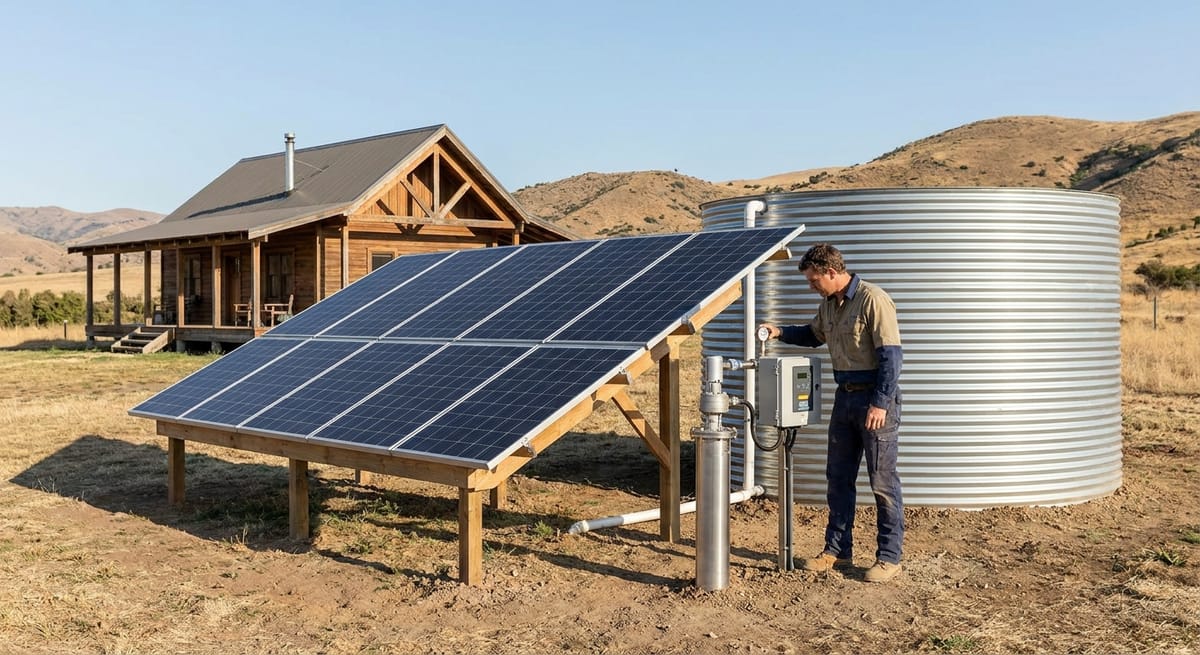
Borehole water systems are the backbone of genuine off-grid self-reliance — the bit that solar panels and battery banks simply can’t cover on their own. You can have the most beautiful 20 kWh battery stack in the world, but if you’re still dependent on a municipal supply that gets cut, rationed, or restricted every dry season, you’re only half-independent.
A borehole is not glamorous in the way solar is glamorous — nobody’s posting photographs of their wellhead — but it is quietly transformative. It is also, done properly, a piece of engineering rather than a purchase. This guide covers the system: the components, the legal framework, pump selection, storage, water quality, solar integration, and the maintenance routine that keeps it all running for decades. Let’s dig in (pun very much intended).
What does a borehole water system actually consist of?
A borehole water system is an integrated chain of five parts: the drilled and cased hole itself, a submersible pump, pressure control, surface storage, and water treatment. Each part depends on the ones either side of it, which is why the weakest component — not the deepest hole — sets the quality of your supply.
Here are the core components you’ll encounter in any serious installation:
- Drilling and casing: Rotary air-percussion or mud rotary rigs drill to the aquifer. Heavy-duty PVC or steel casing lines the upper sections to prevent wall collapse and block surface contaminants.
- Submersible pump: Positioned deep within the water-bearing zone, this pushes water to the surface. Off-grid systems favour DC solar submersible pumps or variable-frequency drive (VFD) AC pumps.
- Pressure tank and pump controller: Maintains steady line pressure and prevents the pump cycling on and off constantly — crucial for motor longevity.
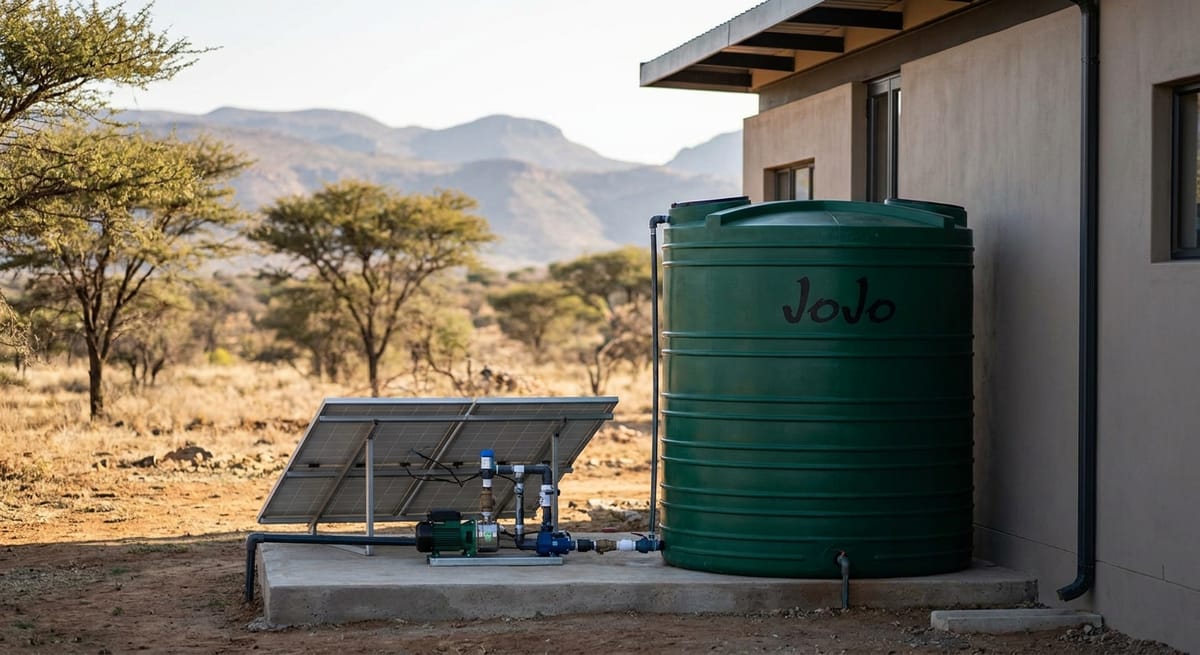
- Storage tanks: Surface tanks buffer supply against peak daily demand and give a solar-driven pump somewhere to work all day.
- Water treatment and filtration: Depending on groundwater chemistry, systems include sediment filters, iron and manganese removal, softening, and UV disinfection to reach potable standards.
Think of it less like plumbing and more like a miniature water utility — one you own outright and nobody can shut off.
What does a borehole water system cost?
The honest answer is that a drilling quote is a rate per metre, not a total — and the finished system costs considerably more than the drilling. We have published the complete, itemised breakdown separately in What a borehole really costs in inland South Africa, and that article is the cost reference for this site.
What belongs here is the shape of the bill rather than the numbers. Beyond the per-metre drilling rate, a real installation carries line items that rarely appear on the quote: siting the hole, casing, the pump and its rising main, electrical compliance, and a SANS 241 water analysis. Because you are buying however many metres the ground turns out to require, budget past your quoted depth rather than to it. The cost article walks through each of these in the order the money actually leaves your account — including why the payback is slower than the enthusiasm suggests.
Do you need a licence to drill a borehole in South Africa?
Usually not for reasonable domestic use — but the word usually is doing real work in that sentence. Water use in South Africa is governed by general authorisation thresholds under the National Water Act, and use above those thresholds must be registered with the Department of Water and Sanitation. Confirm your position before you drill, not after.
The governing legislation is the National Water Act 36 of 1998. Reasonable domestic use on a household or smallholding scale generally sits beneath the general authorisation threshold, while commercial agriculture and larger abstraction volumes require registration with the DWS. Separately, some metros ask property owners to register boreholes for record-keeping and drought management — a quick check with your local municipality settles it. All of this is a cheap phone call compared to discovering the answer after the rig has left.
How do you choose the right borehole pump?
You choose the pump last. The sequence is not negotiable: drill, develop the hole, test the yield over a full working day, and only then buy a pump matched to the number the test gives you. A pump bought off the quoted depth or a one-hour test is a pump you will very likely replace.
The reason the yield test matters so much inland is that groundwater here does not behave like the stable aquifers international guides describe. Yields can swing hard between the wet and dry season, so a hole tested at the tail end of summer rain can disappoint badly by September. If you can, test at the end of winter; if you can’t, size the pump for the pessimistic number rather than the flattering one.
Once you have a trustworthy yield figure, the pump choice comes down to how you’ll power it — a DC solar unit pumping to storage through the day, or an AC unit delivering pressure on demand. That decision is really an energy-system decision, covered in the off-grid power section below.
How much storage and pressure do you need?
Enough storage to cover your household through the pump’s worst day, and enough pressure to make the taps feel normal. Storage decouples when the water is pumped from when it is used — which is exactly what a solar-driven system needs — while a pressure tank or booster pump handles delivery to the house.
Surface tanks do the buffering. A tank that holds a few days of household demand means a cloudy day, a pump fault, or a seasonal yield dip becomes an inconvenience rather than a crisis. If the tank can sit on higher ground, gravity gives you free, silent pressure; on flat plots, a small booster pump and bladder pressure vessel do the same job. The pressure vessel also stops the pump short-cycling every time someone opens a tap, which is one of the quiet killers of pump motors.
The same storage thinking applies across your whole water system — the tanks, first-flush logic, and overflow planning in our rainwater harvesting guide pair naturally with a borehole, giving you two independent sources feeding shared storage.
How do you make borehole water safe to drink?
You test it before you drink it — no exceptions. Groundwater can look and taste perfectly clean while carrying microbiological or chemical loads you cannot see. A laboratory analysis against SANS 241, South Africa’s national drinking water standard, tells you exactly what treatment the water needs before it goes anywhere near the kitchen tap.
Ask for the SANS 241 analysis up front, as part of the project, rather than as an afterthought once everything is plumbed in. The treatment train then follows the lab report rather than guesswork: sediment filtration for suspended solids, iron and manganese removal where the chemistry demands it, softening where hardness is a problem, and UV disinfection as the microbiological backstop. Many boreholes come back clean; the point is that you cannot know yours will until the report says so — and retrofitting treatment after the water is in the house is the expensive way to find out.
How do you power a borehole water system off-grid?
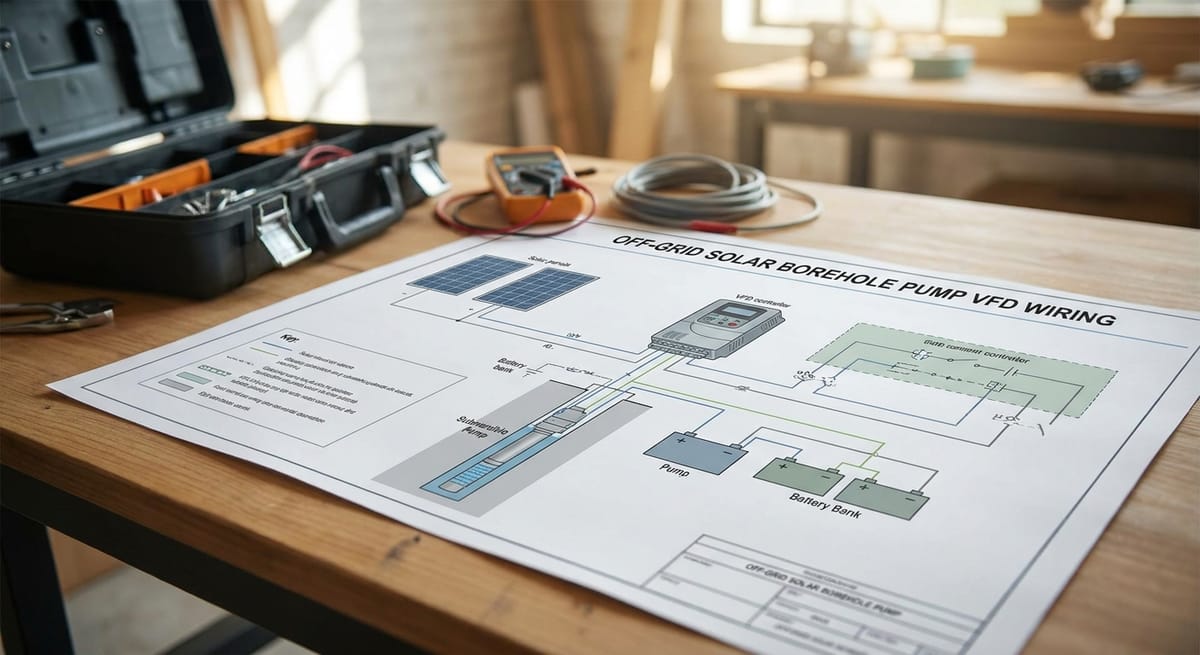
Two clean design paths exist: a dedicated DC solar pump that runs straight off its own PV array, or a standard AC pump behind a variable-frequency drive. Running a high-power AC submersible directly off an ordinary off-grid inverter is the path to avoid — the direct-on-line inrush surge can reach several times the motor’s running current, which is brutal on inverters and batteries.
Option A: Direct solar DC pumping
DC solar pumps (Lorentz and Grundfos both make well-regarded units) connect directly to a dedicated solar PV array via an MPPT solar pump controller. The pump runs whenever there’s sunlight, slowly filling a storage tank throughout the day — with zero draw on your home battery bank.
- Pros: Completely independent of home inverter capacity; highly efficient; long motor life.
- Cons: Water is only pumped during daylight; needs gravity-fed or booster pump distribution to the house.
Option B: AC pump with VFD or soft-starter
A variable-frequency drive or soft-starter fitted to a standard 230 V AC deep-well pump eliminates that brutal inrush surge. The VFD ramps motor speed up gradually based on pressure demand, which is far kinder to your inverter and batteries.
- Pros: Constant, direct pressure to household fixtures; no need for large header tanks.
- Cons: Draws from your primary battery bank during non-solar hours, so size your battery accordingly.
Whichever path you take, the pump becomes a load your energy system has to carry — our guide to how much solar you actually need covers sizing an array with loads like this in the picture.
What maintenance does a borehole water system need?
Less than most people expect, but not none. A short quarterly, semi-annual, and annual routine — filters, seals, UV lamp, pressure vessel, water test, and a pump electrical check — is what separates a borehole that serves for a decade from one that serves for thirty years.
Quarterly
- Filter inspections: Clean or replace mechanical sediment filter cartridges (typically 5-micron and 20-micron stages).
- Visual check: Inspect wellhead seals, sanitary caps, and surface pipework for leaks or cracking.
Semi-annually
- UV lamp maintenance: Wipe the quartz sleeve clean; replace UV bulbs annually — they lose efficacy well before they visibly fail.
- Pressure tank inspection: Check the air pre-charge pressure in the bladder vessel with a standard tyre gauge.
Annually
- Water quality testing: Send a raw sample to an accredited lab for microbiological (E. coli, coliforms) and chemical analysis.
- Electrical checkup: Measure pump operating amperage and insulation resistance — catching motor wear early saves you the cost and headache of an emergency pump pull.
Key takeaways
- Borehole water systems are a complete, private water utility — drilling and casing, pump, pressure control, storage, and treatment working as one chain, with the weakest link setting the quality of the whole supply.
- Cost is covered properly in What a borehole really costs in inland South Africa — the short version is that a quote prices metres, not a finished water supply, and the items that don’t appear on it (siting, casing, pump, electrical compliance, water analysis) are substantial.
- Check the regulatory position before drilling: general authorisation thresholds under the National Water Act 36 of 1998, DWS registration above them, and municipal borehole registration in some metros.
- Sequence the pump purchase behind a full working-day yield test, and size for the pessimistic seasonal number — inland yields swing between wet and dry season.
- For off-grid power, a dedicated DC solar pump filling storage through the day is the cleanest design; a VFD-controlled AC pump suits systems that need direct mains-style pressure.
- A SANS 241 laboratory analysis before the water enters the house, plus a simple quarterly-to-annual maintenance routine, is what turns a hole in the ground into a decades-long water supply.
Frequently asked questions
What are borehole water systems and how do they work?
Borehole water systems are private groundwater supplies built from a drilled and cased hole, a submersible pump, pressure control, surface storage, and water treatment. The pump lifts water from an aquifer into storage or directly to household fixtures. Paired with solar PV, borehole water systems can run entirely off-grid, with no reliance on municipal supply or grid electricity.
How deep does a borehole need to be?
As deep as the ground requires — depth is decided by local geology, not by the brochure. That is why a quote is a rate per metre rather than a total, and why sensible borehole water systems are budgeted past the quoted depth rather than to it. Site-specific hydrogeological advice before drilling is the cheapest line item on the project and the most important one.
Do I need a licence to drill a borehole in South Africa?
Reasonable domestic use generally falls under the general authorisation thresholds of the National Water Act 36 of 1998, so most household borehole water systems don’t need a water-use licence — but abstraction above those thresholds must be registered with the Department of Water and Sanitation, and some metros require property-level borehole registration. Confirm your position before the rig arrives.
Can I run a borehole pump entirely on solar power?
Yes — and it’s increasingly the preferred design for off-grid borehole water systems. A dedicated DC solar submersible pump on an MPPT pump controller runs independently of your home battery bank, filling a storage tank through daylight hours. Alternatively, a VFD-controlled AC pump can run from your main inverter with the inrush surge tamed, at the cost of battery draw after dark.
How much maintenance does a borehole water system require?
A modest, regular routine: sediment filter checks quarterly; UV quartz-sleeve cleaning and pressure-vessel pre-charge checks semi-annually; and annually, a laboratory water test plus a pump amperage and insulation-resistance check. Borehole water systems maintained this way routinely serve for decades — it’s the neglected ones that deliver the expensive emergency pump pull.
Water is one pillar of a working off-grid property, and a borehole is one leg of a resilient water supply — pair it with stored rainwater and honest measurement, and the taps stop being something you worry about. The rest of our water guides live in the Water pillar.