Journal
Off-grid herb garden in South Africa: six herbs that earn their place
In short
- An off-grid herb garden in South Africa needs drought-hardy, sun-tolerant species, not European “full sun” varieties that scorch and bolt.
- Six workhorses do most of the job: rosemary, thyme, oregano, garlic chives, spearmint and sweet basil. Each earns its place as food, pest barrier or pollinator forage.
- Shade netting, deep mulch and ground-level drip irrigation matter more here than in the cool climates most herb books were written for, because our sun is fiercer and our water is limited.
What’s in this guide
- Why does imported herb-gardening advice fail here?
- Which herbs earn their place on an off-grid homestead?
- Can herbs reduce pest pressure on your crops?
- What off-grid growing tactics actually work here?
- Are container herb gardens worth it off-grid?
- Where should I source affordable heirloom seed?
- Key takeaways
- Frequently asked questions
Building an off-grid herb garden in South Africa is one of the fastest, cheapest ways to add resilience to a homestead. Herbs ask for a fraction of the water and soil that heavy-feeding vegetables demand, yet they repay you with flavour, forage for pollinators and a natural pest barrier for the rest of your crops.
The problem is that most gardening books were written for a cool, moist European spring and a mild summer. That advice gets seedlings killed and rainwater wasted here. South Africa’s strong sun, split rainfall seasons, old soils and local insect pressures need their own playbook.
Why does imported herb-gardening advice fail here?
Standard guides assume gentle seasons, mild summers and rain spread through the year, none of which describe this country. South Africa splits into two climate worlds, and both punish imported assumptions.
| Summer rainfall zone (Highveld, Bushveld, KZN, Lowveld) | Winter rainfall zone (Western Cape, Swartland) |
|---|---|
| Hot, dry springs | Cool, wet, waterlogged winters |
| Afternoon thunderstorms and hail | Hot, dry summers |
| High evaporation, intense sun | Strong south-easterly winds (the “Cape Doctor”) |
| Dry winters with hard frost | Fire-prone summers |
Our summer sun is far stronger than the European spring that most “full sun” varieties were bred for, and imported cultivars can scorch, bleach or bolt in an unfiltered South African afternoon. You also have to flip the orientation advice: north-facing beds get the most sun here, while south-facing spots sit in cooler shade, which suits coriander and chervil in a heatwave.
Off-grid water adds another layer. JoJo tanks, earth dams and boreholes mean you live within strict limits, and borehole water in dry areas can be hard or brackish, so have yours tested before you plan irrigation.
Then there are the pests imported guides do not mention: CMR beetles stripping borage and squash blossoms, Bagrada bugs that can flatten brassica seedlings quickly, and harvester termites that strip young plants during a dry spell.
Which herbs earn their place on an off-grid homestead?
Prioritise herbs that do several jobs at once, such as flavour, pest deterrence and pollinator forage, while shrugging off heat and drought.
| Herb | Water · frost | Uses |
|---|---|---|
| Rosemary | Low · Hardy | Culinary, braai skewers, windbreak |
| Thyme | Low · Hardy | Culinary, edging, bee forage |
| Sweet basil | Moderate · Tender | Companion, pesto, seed-saving |
| Garlic chives | Low to moderate · Hardy (dies back) | Bed edging, daily greens |
| Oregano | Low · Hardy | Seasoning, ground cover |
| Spearmint | Moderate to high · Hardy (dormant) | Teas, cooking, container growing |
Rosemary (Salvia rosmarinus)
Tough across both rainfall zones and happy in poor, rocky soil. Plant it as a north-facing windbreak and it needs little or no irrigation once established. The woody stems double as braai skewers.
Thyme (Thymus vulgaris)
Thrives in dry heat and shallow, gravelly soil, and shrugs off Highveld frost. It needs sharp drainage, so mound it with crushed brick or grit in clay-heavy regions.
Sweet basil (Ocimum basilicum)
A warm-season annual that wants morning sun and warm nights. Pinch the tips to delay flowering and bulk out the foliage. It sets plenty of viable seed, so one packet can keep your garden supplied for years.
Garlic chives (Allium tuberosum)
Very hardy, from Karoo dry spells to Free State frost. Lift and divide the clump every two years. Gardeners grow it along bed edges for its strong smell and its daily supply of greens.
Oregano (Origanum vulgare)
Mediterranean by heritage, so hot, dry conditions suit it. Prune hard after flowering for tight, aromatic regrowth.
Spearmint (Mentha spicata)
Vigorous everywhere, dormant in frosty winters and back by spring. It spreads by runners, so confine it to containers or plant it where your greywater is discharged below the surface, away from anything eaten raw.
Two indigenous additions
For local resilience, add two indigenous shrubs: wild rosemary or kapokbos (Eriocephalus africanus) and wilde-als or African wormwood (Artemisia afra). SANBI’s PlantZAfrica describes wild rosemary as “an excellent shrub for the waterwise garden”, with grey, needle-like leaves adapted to lose little water, and wilde-als as tough and easy to grow in full sun, with heavy pruning in winter.
Both have a long history of traditional use in South Africa. PlantZAfrica records that Artemisia afra is one of the oldest and best-known medicinal plants in the country, traditionally used for coughs, colds and fever, and that it has also been used in natural insecticidal sprays and as a moth repellent. Wild rosemary was traditionally used for coughs and colds. That is history, not a recommendation: this site does not suggest either plant as a remedy. If you want to grow them for still-room work, our guide to salves and infusions covers the plants by climate.
Can herbs reduce pest pressure on your crops?
Aromatic herbs grown among crops can reduce some pests. A greenhouse trial found that intercropping rosemary with sweet pepper significantly reduced thrips, aphid and whitefly numbers without harming the predatory insects released to control them. Results vary by crop, pest and setting, so treat the pairings below as gardeners’ practice worth testing on your own plot rather than guarantees.
- Basil among tomatoes and peppers: a long-standing pairing. Let a few basil plants flower to feed beneficial insects.
- Rosemary and thyme near brassicas: their strong scent is used to confuse cabbage moths, and the rosemary trial above is the best evidence for the approach.
- Garlic chives along carrot and lettuce rows: a common edging, and the greens are useful either way.
- Borage beside squash and melons: its flowers draw bees, which squash and melons need for pollination.
- Mint in pots near brassicas: kept in pots so that its runners stay out of the beds.
None of this replaces checking your plants, but it costs little and does not poison the pollinators that your vegetable garden depends on.
What off-grid growing tactics actually work here?
Running a herb garden without municipal infrastructure means adapting layout and irrigation to local conditions, not fighting them.
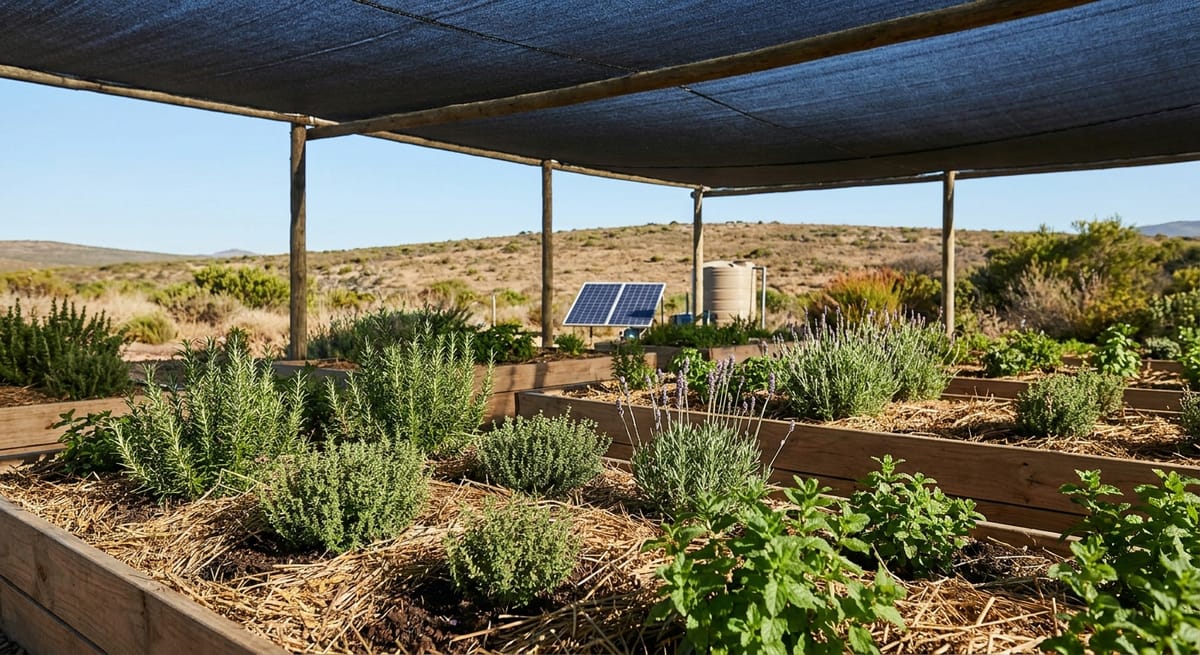
- Use 30–40% shade netting. Standard agricultural shade cloth softens the midsummer sun, reduces water loss from the beds and protects brittle stems from hail.
- Mulch deeply. Bare South African soil bakes hard and sheds water. Keep a permanent 50–80 mm layer of wood chips, dry veld grass or straw around every herb bed. Our mulching guide covers materials, and raised beds that work covers bed building and termites.
- Use the southern aspect for leafy annuals. Put bolt-prone coriander, chervil and dill in the cooler shadow of a wall or trellis, and save the hot north-facing beds for rosemary and oregano.
- Manage brackish borehole water. Avoid overhead spraying in the heat of the day, because salt left on the leaves can scorch them. Use ground-level drip lines or buried clay ollas instead.
For the wider design of a dry-climate plot, see permaculture in a dry climate.
Are container herb gardens worth it off-grid?
Yes. Containers give you a level of control that open ground cannot, especially where soil is poor or weather is extreme.
Growing in pots, up-cycled drums or grow bags lets you avoid bad native soil with a custom, free-draining mix. Containers are also mobile: shift them under shade netting ahead of a Highveld heatwave or a Lowveld hailstorm, or bring tender basil and coriander onto a sun-warmed stoep through winter. That mobility can lengthen your growing season.

Where should I source affordable heirloom seed?
Open-pollinated heirloom seed is cheap, and once your plants are established you can save your own.
Seeds for Africa, a Cape Town-based merchant shipping nationwide by courier and Pudo locker, is one local source. The prices below were checked on its online catalogue on 16 October 2026 (we rechecked them on 1 November 2026, when they were unchanged and the organic garlic chives were out of stock):
| Seed variety | Seeds per pack | Price (ZAR) | Cost per seed |
|---|---|---|---|
| Italian Large Leaf Basil (organic) | 200 | R20.00 | R0.10 |
| Greek Oregano | 200 | R15.00 | R0.08 |
| Garlic Chives (organic) | 50 | R18.00 | R0.36 |
| True English Lavender | 30 | R18.00 | R0.60 |
| Flat Leaf Parsley (organic) | 150 | R20.00 | R0.13 |
| Borage (organic) | 50 | R17.00 | R0.34 |
| Coriander (organic) | 100 | R22.00 | R0.22 |
| Chamomile | 100 | R15.00 | R0.15 |
That is about R145 in seed, plus courier, for 880 seeds across eight varieties. Because they are open-pollinated, letting a few plants flower and set seed each season means you rarely need to buy that variety again. Dry the seed heads, store the seed in labelled glass jars with silica packets, and you have seed for the seasons that follow.
Key takeaways
- Mediterranean perennials such as rosemary, thyme and oregano are the backbone of a herb garden that South African conditions will sustain with little irrigation.
- Flip Northern Hemisphere orientation advice: north-facing beds get the harshest sun here, and south-facing spots suit delicate leafy annuals.
- Shade netting and 50–80 mm of mulch are not optional extras. They are the difference between a surviving bed and baked soil.
- Companion planting with aromatic herbs can reduce some pests without chemicals; test it on your own crops.
- Containers add mobility you cannot get from open beds, which matters against hail, heatwaves and frost.
- Heirloom seed from a local supplier costs little and lets you save your own once plants are established.
Frequently asked questions
What is the easiest herb garden setup for a beginner?
Start with rosemary, thyme, oregano and garlic chives in a north-facing bed that needs little irrigation once established. Add mulch and basic shade netting, and you have a resilient, low-maintenance base before you try fussier annuals such as basil or coriander.
Can I safely irrigate my herb garden with household greywater?
Yes, with care. Feed untreated greywater below the surface or into mulch basins around robust perennials such as rosemary and mint. Never splash it onto leafy herbs eaten raw, such as basil, coriander or parsley, because of the contamination risk. Keep cleaning products biodegradable and low in sodium and boron. Our greywater systems page covers the setup.
How do I stop coriander and dill from bolting in summer heat?
Bolting is triggered by intense afternoon heat and fast-drying soil. Plant in a spot with full morning sun but dappled afternoon shade, keep a mulch layer down, water consistently at ground level and pinch out flower buds as soon as they appear.
How do I protect perennial herbs from severe Highveld winter frost?
Stop high-nitrogen feeding by late summer so that growth hardens off. Keep the soil on the dry side over winter, because dry roots resist freezing better than saturated ones. Mulch heavily and drape breathable frost fleece over tender plants on clear, freezing nights, removing it by mid-morning.
Which pests should a South African herb grower watch for?
CMR beetles strip blossoms off borage, squash and beans; Bagrada bugs can flatten brassica and herb seedlings quickly; and harvester termites can strip young thyme or oregano during dry spells. Imported gardening guides rarely mention any of them.
Building out the rest of the plot? Start with raised beds that work and permaculture in a dry climate.