Animals
Four hives, one season: what beekeeping actually returns
Establishment cost, actual yield, and the three products people forget about. Bees are the highest-return animal on a small property — and the one that asks least of you.
The short answer
Beekeeping is among the lowest-maintenance enterprises available on a small property, because the colony does the work and the equipment lasts years. The products are honey, wax and propolis, and propolis is the one most beginners ignore despite being the easiest to sell. The two things that most often cost a first-year beekeeper a colony are inspecting too often and taking too much honey before the first winter.
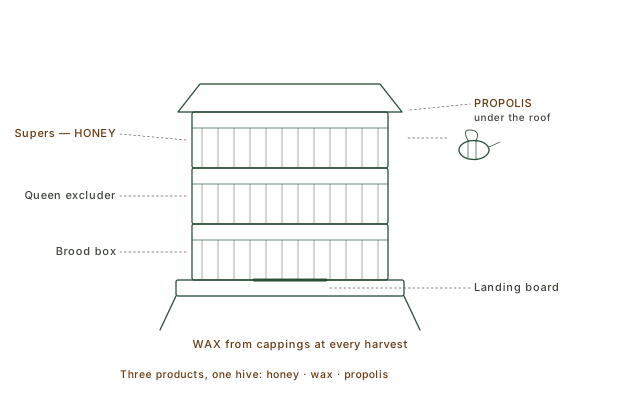
Most people start hives for the pollination and treat honey as incidental. It rarely stays incidental.
Three seasons later they are the most reliable thing on the property. They ask for maybe six hours of attention a year, they do not need feeding, watering or fencing, and they produce three separate things you can use or sell.
The two products everyone forgets
Wax. Every harvest produces cappings. Rendered, filtered and blocked, beeswax has an immediate market — candles, salves, food wraps, furniture polish. It stores indefinitely and it is the input for half of what happens in the still room.
Propolis. The resin bees collect to seal the hive, and the product most beekeepers scrape off and discard. It is the one with the most interesting demand profile: propolis returns 880 searches a month here at a difficulty of 35, which is genuinely winnable, and there is very little South African writing on harvesting it properly.
A propolis trap — a slotted mat laid under the roof — costs almost nothing and gives the bees somewhere to deposit it that is not the frame rebates.
What South African beekeeping does differently
Our bees are not European bees, and the guidance written for European bees will get you stung.
Apis mellifera scutellata, the African honey bee across most of the interior, is more defensive, far more prone to absconding, and swarms more readily. A hive that is disturbed too often will simply leave — not die, not weaken, leave. The practical consequence is that you inspect less than a European manual tells you to, and you work them early or late rather than in the middle of a hot day.
The upside is that they are hardy, they forage hard, and you rarely need to feed them. Ours have never been fed.
Where people get this wrong
The classic siting error is pointing entrances at a path people use. It is fine until the first hot, dry, windy afternoon, when a colony is irritable and someone walks past.
Nobody was badly hurt. It was still entirely our fault, and it was avoidable with ten minutes of thought at siting.
Face entrances at a fence or hedge set about two metres out, so the flight path lifts above head height before it crosses anywhere people walk. That one detail prevents most stings.
Before you buy a hive
- Check your municipal by-laws. Urban and peri-urban beekeeping is often permitted but conditioned on hive numbers and setbacks from boundaries.
- Tell your immediate neighbours before, not after. It costs nothing and it prevents almost every problem that beekeepers have with neighbours.
- Site for shade in summer afternoon, morning sun, and a water source within about thirty metres — otherwise they will use your neighbour's pool.