Grow
Building a worm farm that actually works
Two stacked crates, roughly twenty minutes a week, and it turns the thing you currently throw away into the most valuable soil amendment on the property.
Pillar 03
Soil before seed. Then the bed type that suits your ground, your water and your space.
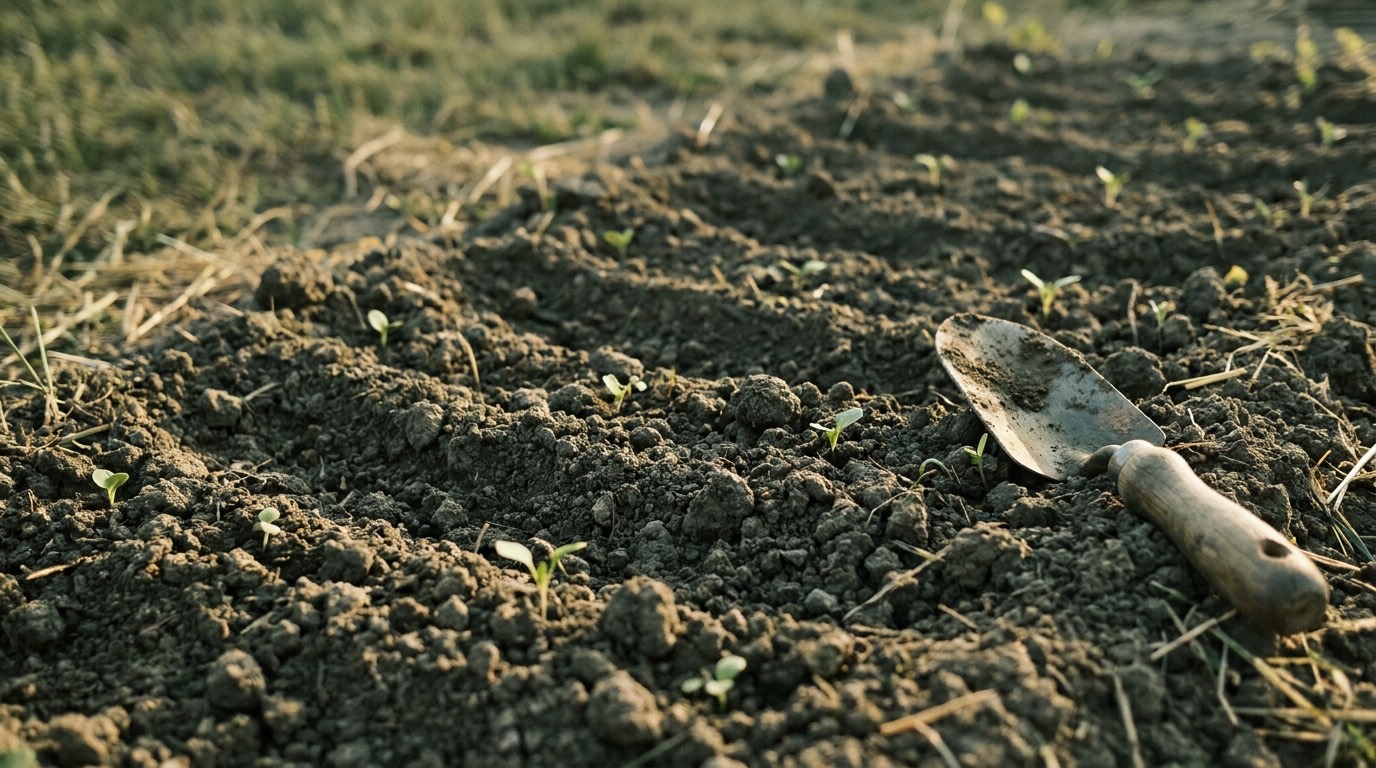
Growing food in South Africa means working with conditions most published advice ignores: alkaline clay soils, long dry seasons, extreme UV, and load-shedding that makes powered systems unreliable. Start with soil biology, choose a bed type that suits the available water, and select species that actually belong in your climate. The system that feeds you is the one that survives a bad year.
Most growing advice starts with seeds. The better starting point is what is underneath them — the biology of the soil, how water moves through it, and whether the climate will let you get away with what you are planning.
South African smallholders and backyard growers face a set of conditions that make temperate-climate gardening guides actively misleading. Rainfall is seasonal and increasingly unreliable. Soils across large parts of the country are either compacted clay, shallow and rocky, or nutrient-poor sand. Summer temperatures high enough to bolt cool-season crops arrive quickly, and hard frosts are possible at altitude in winter. The seasons themselves are the mirror image of every northern-hemisphere book on your shelf.
None of that makes growing impossible. It makes the sequence matter more. Soil comes first — specifically, the living part of it. Once the biology is working, the choice of bed type determines how water and labour behave. Then species selection, which in South Africa means leaning on what genuinely thrives here rather than chasing varieties bred for English summers.
Soil is not dirt. It is a biological system, and the gap between the two is the gap between a garden that fails every dry season and one that does not. Healthy soil contains billions of organisms per teaspoon — bacteria, fungi, nematodes, protozoa — that break organic matter into plant-available nutrients, build structure, and hold water. When that biology is absent or suppressed, fertiliser substitutes for it badly and temporarily.
Most South African garden soils start with one or more structural problems. Highveld clay soils compact under foot traffic and become waterlogged in summer and brick-hard in winter. Coastal sandy soils drain so freely that irrigation runs straight through without being used. Shallow rocky soils on slopes have almost no buffer capacity at all. The first job in any of these situations is not to plant — it is to build organic matter.
Compost feeds the biology. Mulch protects it. These are not interchangeable. A layer of compost worked into the surface introduces carbon and inoculates the soil with organisms; a layer of mulch on top keeps the soil temperature stable, slows evaporation, and prevents the UV-driven crusting that kills surface biology in South African summers. Both are needed. The common error is to use compost alone and wonder why it disappears within a season — without mulch, UV and heat oxidise it faster than it can be replaced.
Practical minimum: 100mm of compost worked into the first 200mm of soil at bed establishment, then 75mm of organic mulch on the surface, renewed at the start of each growing season. Straw, wood chip, dry leaves, and lucerne all work. Lucerne is the most nutrient-dense but also the most expensive; wood chip is slow to break down but excellent for perennial beds.
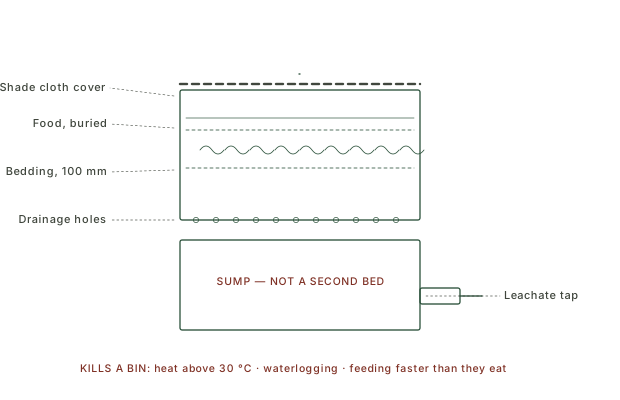
A worm farm is the most practical way to produce a consistent supply of high-quality compost and liquid feed at small scale. Eisenia fetida (red wigglers) process kitchen scraps, paper, and garden trimmings into vermicast that is biologically richer than hot-compost at a fraction of the labour. The liquid leachate, diluted to a pale straw colour, functions as a mild foliar feed and soil drench. See Building a worm farm that actually works for the full setup guide.
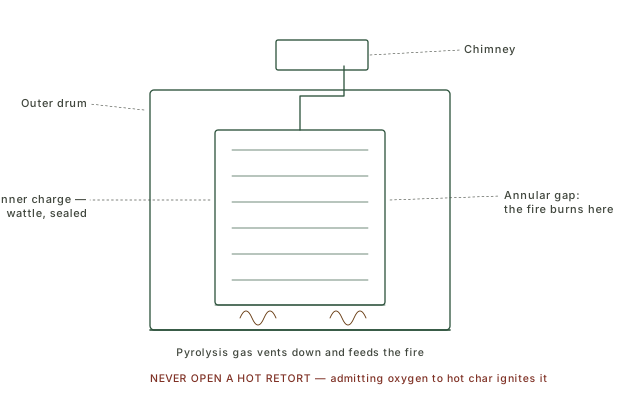
Biochar is charred biomass — not ash, but incompletely combusted carbon that is porous at the microscopic level. Mixed into soil at roughly 10% by volume, it holds water and nutrients in the root zone and persists for hundreds of years, which ordinary compost does not. It does not feed plants directly; it is a habitat and reservoir that makes other inputs more effective. South Africa produces an enormous supply of free biochar feedstock in the form of invasive wattle and rooikrans, both of which must be cleared anyway. See Making biochar from invasive wattle for the method.
| Amendment | What it does | When to apply | Approximate rate |
|---|---|---|---|
| Compost | Feeds soil biology, adds organic matter | Bed establishment and annually | 100mm worked in |
| Worm castings | Concentrated biology and nutrients, mild feed | Any time, especially transplant | 20–30mm top-dressed |
| Biochar | Water and nutrient retention, long-term structure | Bed establishment only | 10% by volume |
| Mulch (organic) | Temperature buffer, moisture retention, prevents crusting | After planting, renewed seasonally | 75–100mm on surface |
| Liquid vermicast | Foliar feed and soil drench, biological inoculant | Fortnightly during growing season | Dilute to pale straw colour |
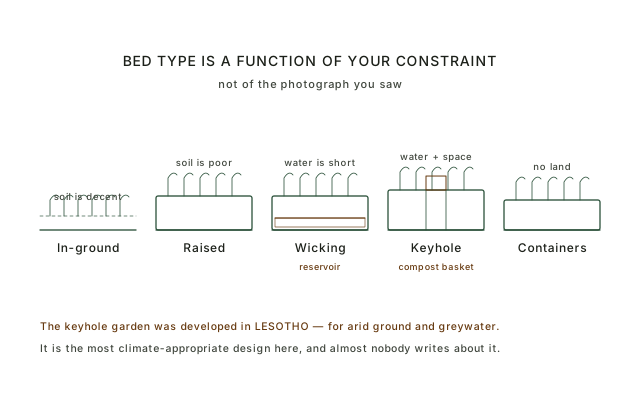
The bed type determines how water moves, how much labour is required, and whether the soil biology you have built is preserved or destroyed season after season. There is no universally correct answer — a no-dig bed in heavy clay behaves very differently from one on free-draining sand, and what works with 600mm of annual rainfall fails with 300mm.
A flat bed in amended soil is the lowest-effort starting point on sites with reasonable rainfall and workable soil. It preserves soil structure if it is never dug after establishment (no-dig or no-till), relies on surface mulch to protect biology, and requires no materials beyond compost and mulch. The limitation is water: on a flat surface, irrigation distributes evenly rather than concentrating at the root zone, and there is no water-harvesting advantage built into the geometry.
Raised beds are the right choice where the native soil is either too compacted to work, too rocky to dig, or contaminated (peri-urban sites near industry or old orchards). They allow you to import a growing medium and control it entirely. The disadvantage is cost — materials and fill must be sourced — and in a dry climate, raised beds dry out faster than ground-level beds and require more frequent irrigation. In very hot regions, dark-sided raised beds can become heat traps in midsummer. See Raised beds that work in a dry climate for design details specific to South African conditions.
Keyhole beds are circular or D-shaped, accessed from a central path, and designed so the gardener never stands on the growing surface. They are highly space-efficient and integrate a central compost column that feeds the bed as it breaks down. Swale beds are dug on contour to capture and infiltrate water rather than let it run off — a critical design in any garden where rainfall is episodic and intense rather than distributed. Both belong more to permaculture design than to standalone bed choice, and they are covered in the Permaculture section below.
The article Bed types: which one suits your soil, your water and your space runs through the decision matrix in full, including how to assess clay content and drainage before committing to a design.
| Bed type | Best suited to | Water use | Setup effort | Main limitation |
|---|---|---|---|---|
| Flat no-dig | Workable soil, 500mm+ rainfall | Moderate | Low | Fails on very poor or compacted soil |
| Raised bed | Poor, rocky or contaminated soil | High (dries fast) | High (materials cost) | Needs imported fill; heat trap in summer |
| Keyhole | Small spaces, water-efficient growing | Low–moderate | Moderate | Needs compost input maintained |
| Swale bed | Slopes, episodic rainfall | Very low (harvests rain) | Moderate–high (earthworks) | Must be on contour; fails if poorly set out |
| Wicking bed | Balconies, urban, very dry sites | Very low | Moderate | Container size limits root depth |
Permaculture is a design methodology, not a set of techniques. The distinction matters because people often arrive at it through one technique — swales, or food forests, or composting toilets — and mistake the technique for the system. The system is about observing how energy, water, nutrients, and labour flow through a site and designing so that each element provides multiple functions and waste from one process becomes input for another.
At its core, permaculture asks three questions before any intervention: What does this site already do? What do the people here need? How can those two be aligned with the least ongoing maintenance? A site that answers those questions well is more resilient than one that is simply productive, which is why permaculture design has more to offer in marginal climates — erratic rainfall, extreme heat, poor soil — than in easy ones.
Zone mapping assigns land use by frequency of access and intensity of management, from Zone 0 (the house) outward to Zone 5 (unmanaged, observed rather than intervened in). The practical value is that it prevents the common error of placing something that needs daily attention far from the house, or something that should be left alone near it. Most residential and smallholding-scale food gardens occupy Zones 1 and 2.
Swales — shallow trenches on contour — slow water movement across a slope, allow it to infiltrate, and recharge the soil moisture profile between rainfall events. They are the single most impactful permaculture intervention in a dry climate, and they are often confused with drainage channels, which do the opposite. A swale is on contour; a drainage channel is off it. Getting this wrong floods the low end of a slope.
Companion planting in permaculture is more specific than the folk-gardening version. A guild is a group of plants chosen because they collectively provide what a central plant needs: nitrogen fixation (legumes), pest distraction (trap crops), pollinator attraction (flowering herbs), and ground cover that suppresses competing weeds. The most-cited example is the Three Sisters — maize, beans, squash — which is genuinely effective but was developed for North American conditions and requires some adjustment for South African climates and growing calendars.
The article Permaculture principles that survive a dry climate works through which principles translate well to South African conditions and which require modification.
Hydroponics and aquaponics remove soil from the growing equation and replace it with water as the nutrient-delivery medium. The appeal in the South African context is specific: a controlled system is not subject to soil degradation, water can be cycled so consumption is a fraction of open-bed irrigation, and growing can continue through both winter and summer without being limited by outdoor conditions. The costs — in capital, electricity, and management attention — are real and worth understanding before committing.
In a hydroponic system, plants grow in an inert medium (perlite, coco coir, rockwool) and are fed a precisely balanced nutrient solution. The main systems in use at smallholding scale are NFT (nutrient film technique, where a thin film of solution flows over bare roots), DWC (deep water culture, where roots hang directly in aerated solution), and media-bed flood-and-drain. NFT and DWC suit leafy greens; media beds can carry fruiting crops.
The South African complication is electricity. Any active hydroponic system requires continuous or frequent pumping. Load-shedding — even brief, unpredictable interruptions — can kill a DWC system if aeration fails for more than a few hours. Designing around this means either battery backup, gravity-fed passive systems, or accepting a higher risk of crop loss during outages.
Aquaponics combines fish cultivation with hydroponics: fish waste provides the nitrogen that plants need, and the plants filter the water before it returns to the fish. The system is genuinely circular and, once established, requires less nutrient input than pure hydroponics. The management complexity is higher — two biological systems (fish and plants) must be kept in balance, and a crash in one typically affects the other.
Tilapia is the most commonly recommended fish for South African aquaponics: it is heat-tolerant, fast-growing, and not illegal to keep in a closed system. It does not tolerate temperatures below about 15°C, which limits year-round production at altitude without a heated system. The article Hydroponics or soil: which is right for a smallholding compares both approaches against soil growing across the dimensions that matter most at this scale.
| Factor | Soil bed | Hydroponics | Aquaponics |
|---|---|---|---|
| Water use | High (evaporation, runoff) | Low (recirculated) | Very low (recirculated, plant-filtered) |
| Capital to start | Low–moderate | Moderate–high | High |
| Electricity dependency | Low (drip or hand) | High (pumps, aeration) | High (pumps, aeration, heating) |
| Load-shedding risk | Low | High (crop loss risk) | Very high (fish mortality risk) |
| Skill required | Low–moderate | Moderate | High |
| Species range | Wide | Leafy greens and some fruiting crops | Leafy greens; fruiting crops harder |
| Soil building benefit | Yes | None | None (outputs can feed soil) |
The most common growing failure in South Africa is choosing varieties selected for temperate climates and then wondering why they bolt, fail to set fruit, or collapse under pest pressure. The second most common failure is ignoring the difference between summer-rainfall and winter-rainfall regions and planting to an imported calendar.
South Africa's main growing regions split broadly into summer-rainfall (Highveld, Lowveld, KwaZulu-Natal, Limpopo) and winter-rainfall (Western Cape). In summer-rainfall areas, the growing year runs from spring planting after the last frost through to autumn harvest, with irrigation carrying most of summer. In the Western Cape, cool-season crops go in during autumn for winter production, and summer is a rest or heat-tolerant-crop period. Every planting guide that does not state which regime it addresses is probably wrong for your context.
The crops that consistently outperform in South African summer conditions are those bred or selected for heat: sweet potato, cowpea, okra, amaranth, Malabar spinach (Basella alba), African eggplant, and the various Cucurbit family members — butternut, gem squash, pumpkin. Indigenous leafy vegetables including imfino (Chenopodium species) and morogo (various Amaranthus species) are both highly nutritious and genuinely drought-tolerant. They are significantly underrepresented in mainstream gardening advice and significantly overrepresented in what actually works.
Brassicas, peas, broad beans, spinach, and carrots all prefer cooler temperatures and can be grown in most of the country in winter. At altitude — much of the Highveld sits above 1,500m — frost is a real constraint. Light frost tolerates most brassicas; hard frost at -5°C or below will kill seedlings. Row cover and tunnel protection extend the season without requiring a full greenhouse.
Perennial food plants — fruit trees, berry bushes, productive shrubs — are systematically underused at small-scale growing operations that focus entirely on annual vegetables. A well-chosen fruit tree delivers without significant annual input once established, and its root system builds soil biology at depth. For most of the country, the reliable producers are citrus, guava, fig, pomegranate, avocado (frost-free areas), and subtropical stone fruits. Deciduous stone fruits (peach, plum, nectarine) require a reliable chill accumulation over winter and fail at lower altitudes in the summer-rainfall regions.
Most of the gardening literature available in South Africa was written for the United Kingdom, Australia, or the United States. It is not a minor adjustment to apply it here — the fundamental growing conditions are different in ways that change what works.
The errors below appear repeatedly. They are not exotic or obscure — they are the standard failure mode for someone who has read widely and still lost a first or second season.
Guides
Each one names its sources, and says plainly where a figure could not be sourced.
Grow
Two stacked crates, roughly twenty minutes a week, and it turns the thing you currently throw away into the most valuable soil amendment on the property.
Grow
A feedstock you are legally obliged to remove, turned into a soil amendment with a buyer — and the step everyone skips, which will cost you a season.
Grow
Where to put it, how to prepare the ground, and what to plant first — for a climate most gardening advice was not written for.
Grow
Raised beds are sold as the universal upgrade to any garden. In a dry climate with sandy soils and strong UV, the case is more complicated — and the irrigation bill is the first thing that catches people out.
Grow
Both systems grow food. Only one of them survives a stage 6 blackout without a backup plan. Here is what the comparison actually looks like in South Africa.
Grow
Permaculture is a design system, not a recipe — but most of its published recipes were tested in Britain, the Pacific Northwest, and temperate Australia. Applied uncritically in a semi-arid South African context, several of its most celebrated techniques will drain your time and your water table before they do any good.
From the journal
Dated write-ups from the journal that touch this pillar — what is being built, tested and costed right now.
The other six
Nothing on a smallholding is a closed system. These are the pillars this one touches most.
The Sunday Dispatch
What we are building, what we have sourced, and what it costs — with the supplier named and the quote dated. No affiliate padding, no doom, no filler.
One email every Sunday. Unsubscribe in one click, any time.