Grow
Making biochar from invasive wattle
A feedstock you are legally obliged to remove, turned into a soil amendment with a buyer — and the step everyone skips, which will cost you a season.
The short answer
Biochar is charcoal made for soil rather than fuel, produced by heating woody material with restricted oxygen. In South Africa invasive wattle is an ideal feedstock because landowners are legally required to clear it under the NEM:BA alien species regulations. Raw biochar must be charged with nutrients before use — applying it uncharged strips nitrogen from your soil for a full season.
Black wattle is one of the most damaging invasive species in South Africa. It drinks catchments dry, it takes over disturbed ground, and if you own land carrying it you have a legal obligation to control it under the alien and invasive species regulations of the National Environmental Management: Biodiversity Act.
Which means the feedstock is free, abundant, and you are required to deal with it anyway. Burning it in a heap wastes it. Turning it into biochar does not.
And the demand is moving: biochar returns 390 searches a month in South Africa, up from about 70 a year ago. That is a fivefold rise in twelve months on a term almost nobody local is writing about properly.
What is biochar, and how is it different from charcoal?
Chemically they are close. The difference is intent and therefore process.
Charcoal is made to burn, so it is optimised for energy density. Biochar is made for soil, so it is optimised for surface area and pore structure — a single gram has a surface area measured in hundreds of square metres. That structure is what does the work: it holds water, it holds dissolved nutrients, and it houses microbial populations.
Both are made by pyrolysis: heating wood hot with the oxygen restricted, so that it decomposes rather than combusts.
The retort, and what it cost
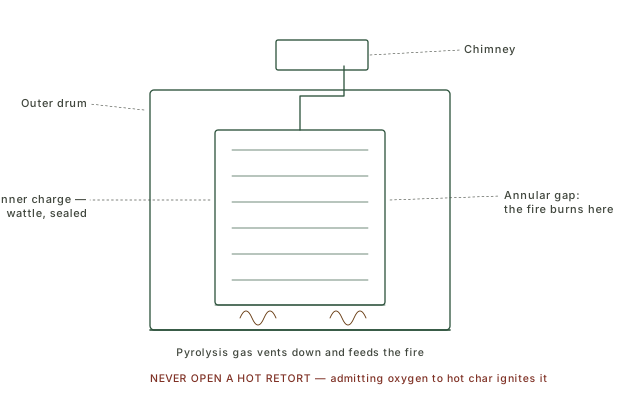
The principle is simple. The inner drum holds the wattle and is sealed but for a vent at the base. The fire burns in the annular gap outside it. As the inner charge heats, it drives off flammable gases through the vent, and those gases feed the outer fire. Once it is running the retort largely fuels itself, and the visible smoke drops to almost nothing because it is being burned rather than released.
The step everyone skips
Fresh biochar is not a fertiliser. It is a sponge with nothing in it.
Put it into soil raw and it will do exactly what a sponge does: absorb. It pulls nitrogen and dissolved nutrients out of your soil and holds them, and your plants go pale and stall. Every gardener who has tried biochar and concluded it does not work has almost certainly done this.
It must be charged first. Steep it for two to four weeks in something biologically rich — worm leachate, diluted urine, compost tea, or simply mixed through an active compost heap. Once the pore structure is loaded, it stops taking and starts giving.
Why South African conditions favour it
inland South Africa soils are frequently sandy, low in organic carbon and unforgiving in a dry winter. Biochar's water-holding and cation exchange are worth more here than in a temperate loam, and unlike compost it does not decompose away — the carbon structure persists in soil for decades.
There is a second, blunter argument. We have a nationally significant invasive biomass problem and an obligation to clear it. Converting that biomass into a stable soil amendment rather than smoke is straightforwardly the better outcome.
Safety, plainly
- Burn on bare ground or gravel, never near dry grass, and never on a windy day. In our fire season this is a real risk, not a formality.
- Never open a hot retort. Restricting oxygen is the whole mechanism; admitting it to hot char causes immediate ignition.
- Let it cool overnight, sealed. Quench with water only once you are certain it is cool, and expect steam.
- Check your local fire-permit position before burning. In many districts open burning is restricted seasonally.