Power
How much solar do you actually need?
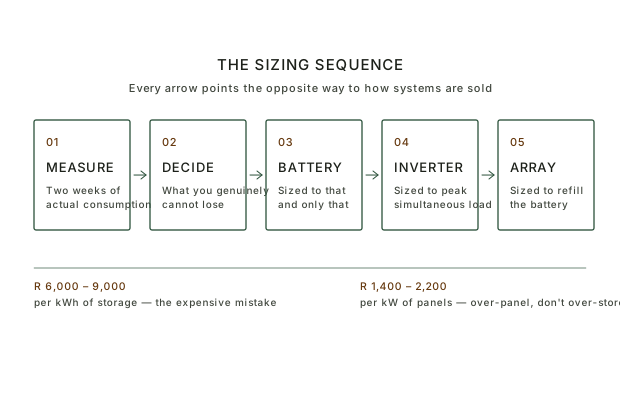
Measure first, then quote. The two-week logging method that will almost certainly shrink your system, and what every unnecessary kilowatt-hour of battery is costing you.
Pillar 02
Sized against a real load profile rather than a sales worksheet, and costed against what it displaces.

A properly sized off-grid or hybrid power system starts with a real load profile — not a guess and not a salesman's worksheet. In South Africa, load-shedding changes the calculation fundamentally: most households need a system that bridges outages rather than one that replaces the grid entirely, and those are sized differently.
Power is the hub around which everything else on a property turns. Without it, water pumps stop, refrigeration fails, and communication goes dark. With it, and with it sized honestly, a household or smallholding can run through weeks of load-shedding without noticing, grow its own food under electric irrigation, and cut its municipal bill to something manageable.
The trap most people fall into is designing the system around optimism rather than measurement. An installer quotes against a theoretical load; the actual load is larger, more unpredictable, and shaped by habits that only show up after the panels are bolted to the roof. The result is a system that works in winter when consumption is low and fails precisely when it is needed most — a hot December evening with the air conditioner on and the clouds overhead.
This pillar covers every layer of a standalone or hybrid power system: the panels that harvest sunlight, the batteries that store it, the inverters that make it usable, the discipline of sizing the whole thing against reality, and the backup strategies that keep essential loads running when the primary system cannot. The goal is not the largest system money can buy. It is the smallest system that reliably does the job.
Photovoltaic panels are the most visible part of any off-grid or hybrid system, and they are also the most misunderstood. The rated wattage on a panel — 400 W, 550 W, 600 W — is measured under Standard Test Conditions: 25 °C cell temperature, 1,000 W/m² irradiance, and a specific air mass. South African rooftops in summer regularly see cell temperatures above 60 °C, at which point a 400 W panel delivers closer to 340 W. That difference is not a defect. It is physics, and any sizing exercise that ignores it will be wrong.
South Africa sits between roughly 22 °S and 35 °S latitude, which gives the interior plateau a peak sun hour count that most European installers can only dream of — four to six hours per day depending on location and season. The Western Cape is drier and sunnier in summer than the Highveld, but the Highveld summer is also its rainy season, and a week of afternoon thunderstorms in Johannesburg can cut effective yield substantially. Neither climate is uniformly generous, and a properly designed array accounts for the worst two consecutive weeks of the year, not the average.
Panel orientation matters more in South Africa than published guidance suggests. Most global advice defaults to due north at an angle equal to latitude. That is broadly correct here, but the optimum tilt varies: a flat roof in Cape Town benefits from a steeper angle in winter when the sun is low; a high-tilt array in Limpopo may overheat in midsummer and produce less than a flatter one. A local installer with pyranometer data for your province is worth consulting before the brackets go in.
Monocrystalline panels dominate the South African market at this point, and for good reason: they carry the best efficiency-to-cost ratio in the panel sizes available here, perform better under high heat than older polycrystalline designs, and degrade more slowly over a 25-year warranty period. Thin-film panels have a performance advantage in diffuse light and at high temperatures but require more roof area for the same yield and are less widely stocked for residential use. For most installations, monocrystalline is the right default, but the decision should be driven by the output calculation, not the sales sheet.
The article How much solar do you actually need? works through a full sizing calculation, including the cell temperature derating, the seasonal yield variation, and the common mistake of quoting peak watts rather than kilowatt-hours per day. That is where to go when you are ready to put numbers to a specific site.
| Type | Typical efficiency | Heat performance | Notes |
|---|---|---|---|
| Monocrystalline | 19–23% | Good; temperature coefficient ~−0.35%/°C | Best all-round choice for SA conditions |
| Polycrystalline | 15–18% | Slightly worse at high temps | Less common in new installations; older stock |
| Thin-film (CdTe/CIGS) | 11–14% | Best; lower temperature coefficient | Requires more area; specialist market |
Most tier-one panels carry a linear power warranty guaranteeing at least 80% of rated output after 25 years. The practical degradation rate is around 0.5% per year for monocrystalline panels under normal conditions. A 400 W panel installed today will produce approximately 350 W in year 25 under STC. Size the array against the end-of-life figure if the system needs to carry its full load throughout its lifespan.
A solar array without storage is a grid-tie system that goes dark at sunset and during load-shedding. Storage — specifically, how much of it and what chemistry — is the decision that most determines how a system behaves in practice.
The South African market has moved decisively toward lithium iron phosphate (LiFePO4) for residential and smallholding applications. The reasons are specific to local conditions: LiFePO4 tolerates the temperature swings of an outdoor or unconditioned battery room better than other lithium chemistries, carries a longer cycle life than lead-acid at the depths of discharge that load-shedding forces, and does not off-gas hydrogen, which matters in enclosed spaces. The article Battery storage: chemistry and duty cycle explained goes into the full comparison of available chemistries and explains why cycle life is the figure to interrogate rather than nameplate capacity.
A battery is not a bucket. Its usable capacity depends on the chemistry, the discharge rate (C-rate), the temperature, and how deeply it is cycled. A lead-acid battery rated at 200 Ah delivers that capacity at a 20-hour discharge rate; draw it at a faster rate, as a large inverter load will, and actual capacity falls. The usable fraction also depends on the depth to which you discharge it: take a lead-acid battery below 50% regularly and its cycle life collapses. LiFePO4 tolerates 80–90% depth of discharge without the same penalty, which means a 10 kWh LiFePO4 bank effectively stores more usable energy than a 10 kWh lead-acid bank — sometimes substantially more.
The cycle trap catches buyers who compare nameplate capacity and purchase price without asking how many full cycles the battery will deliver before its capacity falls below 80% of rated. A battery that delivers 3,000 cycles at 80% depth of discharge and costs more upfront may work out cheaper per usable kilowatt-hour than one that delivers 500 cycles and costs less. Do the arithmetic before committing to a chemistry.
Every battery bank requires a battery management system (BMS) that monitors cell voltage, temperature, and state of charge, and disconnects the bank before damage occurs. On LiFePO4 systems the BMS is typically built into the battery. On lead-acid it is external and sometimes absent entirely — a common and expensive omission. Thermal limits are real: LiFePO4 should not be charged below 0 °C or stored above 45 °C for extended periods. South African highveld winters can push an outdoor battery enclosure below freezing overnight; a steel shed in Limpopo in January can exceed 50 °C inside. Neither extreme is a design edge case here.
The inverter converts DC from the panels and batteries into the AC that appliances use, and in a hybrid system it also manages the relationship between the solar array, the battery bank, the grid, and the load. Choosing the wrong inverter does not just mean inefficiency — it means the system behaves unpredictably under load-shedding conditions, which is exactly when it matters most.
There are three categories worth understanding: pure grid-tie inverters (which shut down when the grid fails, by regulation — they must, to prevent back-feed into a live line), hybrid inverters (which manage battery storage and can island from the grid), and off-grid inverters (which assume no grid connection at all). Most South African installations that are adding solar to an existing grid connection need a hybrid inverter, not a grid-tie unit. This is one of the most common and most expensive specification errors.
Inverters are rated in volt-amperes (VA) or kilowatts (kW), and these are not the same thing. The kW figure is the real power; the VA figure includes reactive power. Most resistive loads — element heaters, filament lights — have a power factor near 1.0, meaning VA and watts are roughly equal. Motors — pumps, compressors, air conditioners — have lower power factors and also require a surge current at startup that may be two to six times the running current. An inverter that is correctly sized for the running load of a borehole pump may trip on the startup surge. The article What actually matters when choosing an inverter covers VA rating, surge specification, and the transfer time that determines whether sensitive electronics survive a grid outage.
Larger properties and anyone running a workshop or agricultural equipment with three-phase motors need either a three-phase inverter or a parallel stack of single-phase units. The cost difference is significant and the installation complexity is greater, but the alternative — running single-phase off a three-phase supply with phase imbalance — creates problems of its own. This is a decision to make before the first panel goes up, not after.
Modern hybrid inverters communicate over Modbus, CAN bus, or proprietary protocols and can log production, consumption, battery state, and grid interaction continuously. That data is the foundation of honest sizing — it tells you what the system is actually doing versus what it was specified to do. An inverter without monitoring is a black box, and black boxes are poor tools for diagnosing problems or planning an expansion. Prioritise systems with open or well-documented protocols; proprietary cloud dashboards that require a subscription to access your own data are a liability.
Honest sizing starts with a load audit, not with a sales conversation. Before any installer visits, list every appliance in the household or working property, its rated wattage, and a realistic estimate of the hours per day it runs. Multiply the two to get watt-hours per day, add the items together, and that is the baseline daily consumption. It will surprise most people — not because it is enormous, but because the distribution is nothing like what intuition suggests.
Typically, in a South African household, the geyser and the air conditioner or heater together account for more than half of all electricity consumed. Lighting, which everyone notices, is a small fraction. This distribution determines the system design: a household that converts its geyser to solar thermal and manages its HVAC carefully can often be served by a substantially smaller battery and inverter than one that ignores the big loads and focuses on the small ones.
The article How much solar do you actually need? provides a worked example of this calculation, including the derating factors for panel temperature, inverter efficiency, battery round-trip efficiency, and the days of autonomy that determine battery bank size. Work through it with a real load profile before speaking to any installer — it takes an afternoon and it will change the conversation substantially.
Days of autonomy — how many consecutive days without solar input the battery bank must cover — is the single variable that most inflates system cost. One day of autonomy means the battery covers a single bad day before the system needs the sun back; three days means it can weather an extended cloudy period. In South Africa's interior, where clear-sky days dominate, one to two days is a reasonable design target for most households. On the south-facing Cape slopes where winter cloud can persist for a week, two to three days is more honest. Designing for five days of autonomy, as some salespeople recommend, produces a battery bank that almost never discharges deeply and costs roughly three times what a sensibly sized bank would. The right number depends on the site, not on the size of the budget.
| Load | Rated draw | Hours/day | Daily Wh | ||||||||||||||||||||||||||||||||||||||||||||||||||||||||||||||||||||||||||||||||||||||||||||||||||||||||||||||||||||||||||||||||||||||||||||||||||||||||||
|---|---|---|---|---|---|---|---|---|---|---|---|---|---|---|---|---|---|---|---|---|---|---|---|---|---|---|---|---|---|---|---|---|---|---|---|---|---|---|---|---|---|---|---|---|---|---|---|---|---|---|---|---|---|---|---|---|---|---|---|---|---|---|---|---|---|---|---|---|---|---|---|---|---|---|---|---|---|---|---|---|---|---|---|---|---|---|---|---|---|---|---|---|---|---|---|---|---|---|---|---|---|---|---|---|---|---|---|---|---|---|---|---|---|---|---|---|---|---|---|---|---|---|---|---|---|---|---|---|---|---|---|---|---|---|---|---|---|---|---|---|---|---|---|---|---|---|---|---|---|---|---|---|---|---|---|---|---|
| Electric geyser (150 L) | 3,000 W | 2–3 h | 6,000–9,000 Wh | ||||||||||||||||||||||||||||||||||||||||||||||||||||||||||||||||||||||||||||||||||||||||||||||||||||||||||||||||||||||||||||||||||||||||||||||||||||||||||
| Refrigerator/freezer | 150 W average | 24 h | 3,600 Wh | ||||||||||||||||||||||||||||||||||||||||||||||||||||||||||||||||||||||||||||||||||||||||||||||||||||||||||||||||||||||||||||||||||||||||||||||||||||||||||
| Lighting (LED throughout) | 200 W average | 5 h | 1,000 Wh | ||||||||||||||||||||||||||||||||||||||||||||||||||||||||||||||||||||||||||||||||||||||||||||||||||||||||||||||||||||||||||||||||||||||||||||||||||||||||||
| Laptop × 2 | 90 W total | 8 h | 720 Wh | ||||||||||||||||||||||||||||||||||||||||||||||||||||||||||||||||||||||||||||||||||||||||||||||||||||||||||||||||||||||||||||||||||||||||||||||||||||||||||
| Television | 120 W | 4 h | 480 Wh | ||||||||||||||||||||||||||||||||||||||||||||||||||||||||||||||||||||||||||||||||||||||||||||||||||||||||||||||||||||||||||||||||||||||||||||||||||||||||||
| Borehole pump (0.75 kW) | 750 W | 1 h | 750 Wh | ||||||||||||||||||||||||||||||||||||||||||||||||||||||||||||||||||||||||||||||||||||||||||||||||||||||||||||||||||||||||||||||||||||||||||||||||||||||||||
| Air conditioner (2.5 kW) | 900 W effective | 4 h | 3,600 Wh | ||||||||||||||||||||||||||||||||||||||||||||||||||||||||||||||||||||||||||||||||||||||||||||||||||||||||||||||||||||||||||||||||||||||||||||||||||||||||||
| Miscellaneous | — | — | 1,000 Wh | ||||||||||||||||||||||||||||||||||||||||||||||||||||||||||||||||||||||||||||||||||||||||||||||||||||||||||||||||||||||||||||||||||||||||||||||||||||||||||
| G | e | y | s | e | r | a | n | d | a | i | r | c | o | n | d | i | t | i | o | n | e | r | t | o | g | e | t | h | e | r | r | e | p | r | e | s | e | n | t | r | o | u | g | h | l | y | 6 | 0 | – | 7 | 0 | % | o | f | t | o | t | a | l | d | a | i | l | y | c | o | n | s | u | m | p | t | i | o | n | . | A | d | d | r | e | s | s | i | n | g | t | h | e | s | e | f | i | r | s | t | c | h | a | n | g | e | s | e | v | e | r | y | o | t | h | e | r | n | u | m | b | e | r | i | n | t | h | e | c | a | l | c | u | l | a | t | i | o | n | . |
That profile — roughly 17–19 kWh per day before a solar geyser or heat pump reduces the geyser draw — is a useful benchmark. An honest system designed around it looks nothing like the 3 kW panel, 5 kWh battery combination that appears in many entry-level quotations. Those systems are sized against the saleable-load figure, not the actual load. The solar geyser or heat pump question is explored separately in Solar geyser or heat pump: which is right for a South African house?
Backup power is not the same thing as off-grid power, and conflating the two is the source of much oversized and under-budgeted system design. An off-grid system must supply the full load, indefinitely, from its own resources. A backup system must supply an essential load for a defined period — typically the duration of a load-shedding event or a grid fault — and then return to grid supply without fanfare.
Defining the essential load is the first and most important step. In most households it includes refrigeration, lighting, communication, and a minimum of cooking; it almost never needs to include the geyser (which holds heat for hours), the air conditioner at full capacity, or the electric stove. An essential load that is half the full load can be served by a battery bank half the size, which is a meaningful difference in both installation cost and ongoing maintenance.
The article Backup power: what to keep running, and in what order provides a sequenced approach to identifying the essential load, the minimum battery capacity for standard load-shedding durations, and the inverter specifications that determine whether the transition is seamless or disruptive. It is the right starting point for anyone adding backup capability to an existing grid-connected property.
A petrol or diesel generator is a different tool from a battery backup system, and the two are not interchangeable. A generator is well-suited to running high-draw loads — a welder, a large pump, a workshop — for short periods where battery capacity would need to be impractically large. It is poorly suited to the quiet, seamless load-shedding coverage that a battery inverter provides; generators are noisy, require fuel storage, need servicing, and introduce their own failure modes. Diesel fuel availability in a regional town during extended grid failure is not guaranteed.
The hybrid approach — battery backup for daily load-shedding, generator available for extended outages or large intermittent loads — is what most working properties end up with. Sizing the generator to the actual intermittent load rather than to the full household load reduces the capital cost and the running cost. A 5 kVA diesel unit that runs a borehole pump and charges the battery bank simultaneously is a different specification from a 15 kVA unit sized to power everything at once.
| Technology | Transfer time | Duration | Fuel or consumable | Best suited to |
|---|---|---|---|---|
| UPS (online) | <1 ms | Minutes | Battery replacement | Sensitive electronics, NAS, routers |
| Battery inverter (hybrid) | <20 ms typically | Hours | Battery cycle life | Household loads during load-shedding |
| Generator (petrol) | 30–60 s manual; auto-start available | Indefinite with fuel | Petrol, oil, servicing | Large intermittent loads, extended outage |
| Generator (diesel) | 30–60 s manual; auto-start available | Indefinite with fuel | Diesel, oil, servicing | Large continuous loads, rural properties |
| LPG generator | 30–60 s | Indefinite with supply | LPG, servicing | Areas with reliable LPG supply, lower noise priority |
Most photovoltaic design guides, inverter specifications, and battery recommendations are written for Europe or North America. The assumptions embedded in them — that grid power is reliable, that the climate is temperate, that the design load is the average load rather than the worst-case load — do not hold here.
Load-shedding is the most obvious difference, but it is not the only one. South Africa's solar resource is genuinely exceptional: the interior plateau receives 4.5–6.0 peak sun hours per day on average, which changes the economics of solar relative to almost anywhere else in the world. A system that would take twelve years to recover its installation costs in Germany might do so in four or five years here — but that calculation depends entirely on what the system displaces, and those numbers come from real invoices, not from a model.
Dolomitic ground, present across large parts of Gauteng and the North West, affects not just borehole drilling but the physical installation of structures — including ground-mounted panel arrays and battery enclosures. A ground-mount designed for stable granite needs to be rethought on dolomite. This is a design consideration that no international guide will raise.
The National Regulator for Compulsory Specifications (NRCS) and the relevant SANS standards — particularly SANS 10142-1 for low-voltage wiring — govern how a system must be installed and what qualifications are required. An installation that does not comply cannot be inspected, cannot be signed off by a registered electrician, and may void the homeowner's insurance. The requirement for a Certificate of Compliance (CoC) issued by a registered person is not optional and it is not bureaucratic formality; it is the legal framework within which every grid-connected or hybrid system must sit.
Municipal net-metering (or feed-in) policies vary by municipality and continue to change. Some municipalities have relatively accessible small-scale embedded generation (SSEG) registration processes; others have been slow to implement the frameworks required by national policy. A system designed to export surplus power to the grid must be registered with the local authority, and a system registered under one municipality's rules may not automatically comply if those rules change — or if the property is sold and the new owner is in a different municipality's jurisdiction. Staying current with NERSA and municipal SSEG regulations is part of owning a grid-tied system.
The most common and most expensive error is buying the solar array before understanding the load. A 5 kW array sounds substantial, but it is meaningless without knowing how many kilowatt-hours the household consumes per day, what the worst-week solar yield is at the site, and how many hours of battery cover the essential load requires. The array and the battery bank are designed together, against a real load profile, not separately from a catalogue.
The second error is treating load-shedding cover and off-grid independence as the same requirement. They are not. Load-shedding cover is a smaller, simpler, and less expensive problem: bridge a four-to-six-hour outage, perhaps once or twice a day, with reliable essential load supply. Off-grid independence means covering the entire load, indefinitely, including the days the sun does not shine. Designing for the latter when the requirement is the former means spending substantially more than necessary on battery capacity and then running a system that almost never deep-discharges — poor use of money and poor for battery longevity.
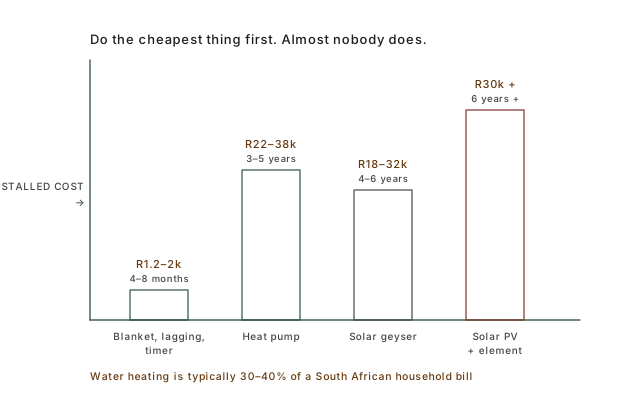
The third error is neglecting the geyser. A 3 kW element running for two to three hours per day represents between six and nine kilowatt-hours — the single largest load in most South African homes. Any power system designed without addressing the geyser is designed around a gap. Converting to solar thermal, installing a heat pump, or at minimum adding a timer and a geyser blanket changes the rest of the sizing calculation substantially. This is the intervention with the highest return in most households, and it is the one most often skipped because it is less visible than panels on the roof.
Guides
Each one names its sources, and says plainly where a figure could not be sourced.
Power
Measure first, then quote. The two-week logging method that will almost certainly shrink your system, and what every unnecessary kilowatt-hour of battery is costing you.
Power
Water heating is the largest single load in most South African homes. Before you solve it with panels, it is worth knowing that two much cheaper things beat both options on payback.
Power
The chemistry you choose for battery storage is decided by how often and how deeply you discharge — and load-shedding is a far more punishing regime than most published advice anticipates.
Power
The inverter is the single decision that shapes everything else in a power system. Get the type wrong and you are either buying equipment you cannot legally connect, or hardware that trips every time your borehole pump starts.
Power
Most backup power guides are written for emergencies that happen once a year. Load-shedding is scheduled and frequent, which changes everything about what to buy and what to run first.
From the journal
Dated write-ups from the journal that touch this pillar — what is being built, tested and costed right now.
The other six
Nothing on a smallholding is a closed system. These are the pillars this one touches most.
The Sunday Dispatch
What we are building, what we have sourced, and what it costs — with the supplier named and the quote dated. No affiliate padding, no doom, no filler.
One email every Sunday. Unsubscribe in one click, any time.