Power
Battery storage: chemistry and duty cycle explained
The chemistry you choose for battery storage is decided by how often and how deeply you discharge — and load-shedding is a far more punishing regime than most published advice anticipates.
The short answer
LiFePO4 handles daily deep discharge far better than lead-acid: it tolerates 80–100% depth of discharge over 3,000–6,000 cycles, where flooded lead-acid at 50% DoD delivers 400–700 cycles. For a load-shedding household cycling every day, lead-acid banks are typically exhausted within two to three years. Size storage against your measured daily load in watt-hours, not your panel capacity, and add 20% headroom so you never hit the warranty floor.
Why load-shedding is a harsher duty cycle than off-grid living
Most battery sizing guides are written for off-grid cabins in the northern hemisphere. The assumption is that you draw the bank down in winter, recharge it in summer, and run shallow cycles in between. The duty cycle is seasonal and forgiving. Load-shedding is neither.
A household on Stage 4 load-shedding loses grid power for eight or more hours a day, every day, year-round. If your battery storage carries the evening load — lighting, a television, a fridge, a laptop — it is being discharged and recharged 365 times a year at meaningful depth. That is not what the international literature calls "cycle life". That is what battery manufacturers call abuse, unless you have chosen the right chemistry.
Off-grid living, paradoxically, is kinder to a battery bank than grid-backup use. An off-grid system is sized for the worst day of the year and runs at moderate depth most days. A load-shedding system is sized for cost and then asked to perform at full depth daily. The distinction matters because cycle life degrades exponentially with depth of discharge, and because warranties are written around it.
LiFePO4 vs lead-acid: what the numbers actually say
There are four chemistries in common use for stationary storage: flooded lead-acid (FLA), absorbent glass mat (AGM), gel, and lithium iron phosphate (LiFePO4). Two others — NMC lithium and lithium-titanate — exist but are rarely the right answer for residential use. The comparison that matters for South African conditions is LiFePO4 against the lead-acid family.
| Chemistry | Usable DoD | Cycle life at stated DoD | Daily cycles per year | Approximate years at daily use | ||||||||||||||||||||||||||||||||||||||||||||||||||||||||||||||||||||||||||||||||||||||||||||||||||||||||||||||||||||||||||||||||||||||||||||||||||||||||||||||||||||||||||||||||||||
|---|---|---|---|---|---|---|---|---|---|---|---|---|---|---|---|---|---|---|---|---|---|---|---|---|---|---|---|---|---|---|---|---|---|---|---|---|---|---|---|---|---|---|---|---|---|---|---|---|---|---|---|---|---|---|---|---|---|---|---|---|---|---|---|---|---|---|---|---|---|---|---|---|---|---|---|---|---|---|---|---|---|---|---|---|---|---|---|---|---|---|---|---|---|---|---|---|---|---|---|---|---|---|---|---|---|---|---|---|---|---|---|---|---|---|---|---|---|---|---|---|---|---|---|---|---|---|---|---|---|---|---|---|---|---|---|---|---|---|---|---|---|---|---|---|---|---|---|---|---|---|---|---|---|---|---|---|---|---|---|---|---|---|---|---|---|---|---|---|---|---|---|---|---|---|---|---|---|---|---|---|---|---|---|---|
| Flooded lead-acid | 50% | 400–700 | 365 | 1.1–1.9 | ||||||||||||||||||||||||||||||||||||||||||||||||||||||||||||||||||||||||||||||||||||||||||||||||||||||||||||||||||||||||||||||||||||||||||||||||||||||||||||||||||||||||||||||||||||
| AGM | 50% | 400–600 | 365 | 1.1–1.6 | ||||||||||||||||||||||||||||||||||||||||||||||||||||||||||||||||||||||||||||||||||||||||||||||||||||||||||||||||||||||||||||||||||||||||||||||||||||||||||||||||||||||||||||||||||||
| Gel | 50–60% | 500–800 | 365 | 1.4–2.2 | ||||||||||||||||||||||||||||||||||||||||||||||||||||||||||||||||||||||||||||||||||||||||||||||||||||||||||||||||||||||||||||||||||||||||||||||||||||||||||||||||||||||||||||||||||||
| LiFePO4 | 80–100% | 3,000–6,000 | 365 | 8.2–16.4 | ||||||||||||||||||||||||||||||||||||||||||||||||||||||||||||||||||||||||||||||||||||||||||||||||||||||||||||||||||||||||||||||||||||||||||||||||||||||||||||||||||||||||||||||||||||
| D | o | D | = | d | e | p | t | h | o | f | d | i | s | c | h | a | r | g | e | . | C | y | c | l | e | l | i | f | e | f | i | g | u | r | e | s | a | r | e | a | t | t | h | e | s | t | a | t | e | d | D | o | D | ; | d | e | e | p | e | r | d | i | s | c | h | a | r | g | e | c | o | m | p | r | e | s | s | e | s | t | h | e | s | e | f | i | g | u | r | e | s | s | h | a | r | p | l | y | . | S | o | u | r | c | e | s | : | m | a | n | u | f | a | c | t | u | r | e | r | d | a | t | a | s | h | e | e | t | s | f | o | r | P | y | l | o | n | t | e | c | h | , | R | e | v | o | v | , | a | n | d | T | r | o | j | a | n | . |
The gap is not marginal. At daily use, a lead-acid bank of any type is likely exhausted before its capital cost has been recovered. LiFePO4 at the same daily cycle survives long enough to be a genuine infrastructure decision rather than a consumable.
Lead-acid is not worthless. If your load-shedding is occasional — Stage 1 or 2, infrequent — or if you are using storage as a pure emergency backup rather than daily cycling, the chemistry can still make economic sense. The mistake is specifying it for a regime it cannot survive.
What depth of discharge does to a warranty
Battery warranties are expressed in cycles at a specified depth of discharge. That figure is almost always buried in the technical appendix rather than the headline specification. A battery warranted for 3,500 cycles at 80% DoD may only be warranted for 1,500 cycles at 100% DoD. A battery warranted for 600 cycles at 50% DoD delivers around 300 at 80%.
The practical consequence: if you regularly run your bank flat — because the load-shedding slot was longer than expected, or because you forgot to check — you are not just stressing the cells. You are shortening the period in which the manufacturer will replace them. Check the datasheet for the DoD at which the warranty cycle count is specified, then set your inverter's low-voltage cut-off accordingly. For LiFePO4, most manufacturers specify 80% DoD; setting a cut-off at 90% DoD voids the same warranty the salesperson cited.
How to size battery storage from a measured load
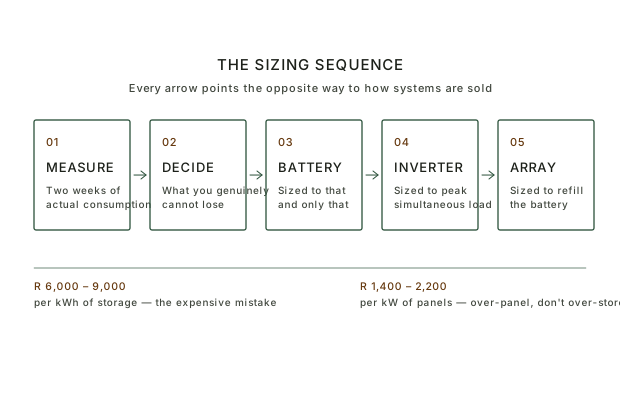
The most common sizing mistake is working backwards from panel capacity: "I have 5 kW of panels, so I need 10 kWh of storage." Panel capacity and storage capacity are related but not proportional, and conflating them leads to either oversizing (wasted capital) or undersizing (warranty damage from excessive depth).
The correct starting point is a measured load. Not an estimated load — a measured one.
How to measure your own load before buying anything
A plug-in energy monitor costs very little and belongs in every household before any battery storage decision is made. The process is straightforward:
- Plug the monitor into a wall socket and run each major appliance through it for a measured period — a fridge for 24 hours, a television for a typical evening, a laptop for a working day.
- Record watt-hours consumed per device per day. The fridge figure will surprise most people: a 15-year-old compressor fridge may draw 2–3 kWh per day; a modern inverter fridge 0.4–0.8 kWh.
- Add up the total daily watt-hours for everything you want to run during load-shedding — not everything in the house, just what matters during the outage.
- Multiply by the length of your worst expected load-shedding slot in hours, divided by 24, to get the daily storage requirement in watt-hours.
- Divide by the usable DoD of your chosen chemistry: if you want LiFePO4 at 80% DoD, divide by 0.8 to get the nameplate capacity you need.
- Add 20% headroom so that normal variation in load does not push you to the warranty floor.
Example: a household measures 8 kWh of daily consumption across lighting, a fridge, a television, and phone charging. Load-shedding removes power for six hours a day. The load-shedding share is (6 ÷ 24) × 8 kWh = 2 kWh. At 80% DoD with 20% headroom: 2 kWh ÷ 0.8 × 1.2 = 3 kWh nameplate capacity. Many households discover they need significantly less storage than a salesperson suggested — because the salesperson was sizing from panels, not from load.
The oversizing trap
A battery bank that is too large for your load is not simply wasteful. If your panels are not large enough to fully recharge an oversized bank before the next discharge cycle, the cells spend every day in a state of partial charge. For lead-acid, chronic partial charge causes sulphation and destroys capacity within months. For LiFePO4 it is less catastrophic but still reduces cycle life. The bank and the generation source must be matched to the actual load, not to each other.
A useful rule: your panels should be able to recharge your bank from its expected lowest state of charge within four to five peak sun hours, accounting for charge controller and inverter losses (typically 85–90% round-trip efficiency for a good LiFePO4 system). If they cannot, either the bank is too large for the panels or the panels are too small for the bank.
What goes wrong with battery storage — and why
Battery storage failures in South Africa follow a recognisable pattern. Understanding them is more useful than a list of brands to avoid.
- Under-ventilated installations. Lead-acid batteries off-gas hydrogen during charging. LiFePO4 does not, but lithium cells of all types are sensitive to heat. An unventilated room or metal cabinet facing west will shorten any battery's life. Ventilate the battery enclosure or install it in a shaded, temperature-moderated space.
- Specifying lead-acid for a daily cycling load. The chemistry cannot sustain it. This is the single most common source of premature failure in load-shedding installations.
- Setting the cut-off voltage too low. Installers sometimes set the inverter's low-voltage cut-off at 0% DoD to maximise runtime. This voids the warranty and destroys cell chemistry. Set it at the manufacturer's specified minimum voltage for the warranted DoD.
- Mixing old and new cells. Adding cells to an existing bank degrades the new cells to match the old ones. Replace banks entirely or not at all.
- Ignoring the charge profile. A LiFePO4 bank requires a charger that understands the LiFePO4 charge profile (bulk, absorption, float at LiFePO4 voltages). A charger configured for AGM will damage LiFePO4 cells over time. Verify the charge profile, not just the voltage.
- Over-relying on the battery management system (BMS). The BMS is a last-resort protection device, not a substitute for correctly configured charge parameters. If the BMS is cutting power frequently, something upstream is misconfigured.
Is battery storage worth it?
For a household experiencing regular load-shedding, battery storage is increasingly a quality-of-life decision rather than a pure financial one — the value is uninterrupted power, not a payback calculation. Whether the financial return stacks up depends on the cost of the battery, the cost of what you are replacing (grid power, or a generator running on diesel), and how many cycles you actually extract.
LiFePO4 storage sized correctly for a measured load and installed in a ventilated space with the right charge profile is a durable infrastructure investment. Lead-acid storage used for daily deep cycling is a consumable that will be replaced within three years. The decision between them is not primarily about price — it is about which one survives the duty cycle it will actually face.
Storage is not always the right answer. If your load-shedding slots are short and infrequent, a small generator or even a UPS for critical loads may be a more practical solution. Storage makes the most sense when the duty cycle is predictable, the load has been measured, and the chemistry matches what you are asking of it.
What we would do differently
- Measure the actual load with a plug-in monitor before speaking to any installer or salesperson.
- Size storage from the load-shedding duration multiplied by the measured daily load, not from panel capacity.
- Specify LiFePO4 for any installation where the battery will cycle daily, regardless of initial cost differential.
- Verify the inverter's charge profile is configured for the actual battery chemistry before the first charge cycle.
- Set the low-voltage cut-off at the DoD specified in the warranty, not at zero.
- Ensure the battery enclosure is ventilated and not exposed to direct afternoon sun.
- Ask for the datasheet — not the brochure — and find the cycle-life figure with its stated DoD before signing anything.