Power
Solar geyser or heat pump: which is right for a South African house?
Water heating is the largest single load in most South African homes. Before you solve it with panels, it is worth knowing that two much cheaper things beat both options on payback.
The short answer
Water heating is usually the largest single load in a South African house, and both a solar geyser and a heat pump are beaten by doing the cheap things first: a geyser blanket, lagging on the first metres of hot pipe, and a timer. Do those before you quote anything. Between the two, a heat pump generally wins on reliability and on performance through cloudy weather; a solar geyser wins where there is good year-round sun and no appetite for moving parts.
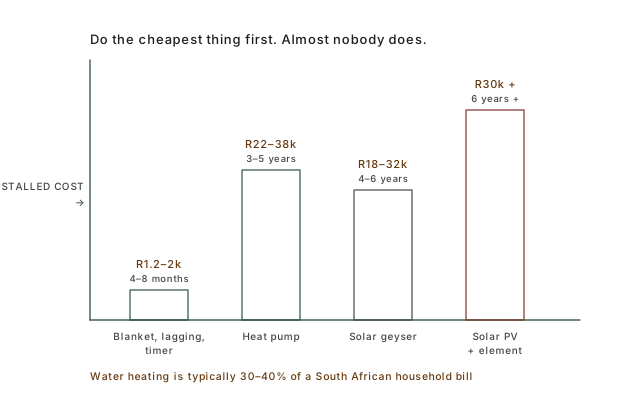
Water heating is the largest single line in most South African electricity bills. On a working smallholding it was 38% of consumption before we touched it.
Which makes it the highest-leverage thing in the house — and the place where the most money gets spent in the wrong order.
Do the cheap things first
A geyser blanket, lagging on the first two metres of hot pipe, and a timer. Together they are the cheapest intervention available on a geyser, and they work because a substantial share of a geyser's work is simply replacing heat it lost standing idle overnight.
Nobody sells you this, because there is almost no margin in it. It is still the correct first move, and it changes the sizing of anything you buy afterwards.
Heat pump or solar geyser?
A heat pump moves heat rather than making it, and delivers roughly three to four units of heat per unit of electricity. It works at night, in cloud and in winter, and it fits into the existing plumbing with no roof work.
A solar geyser makes heat directly from sunlight and uses almost no electricity at all when the sun cooperates. When it does not, it falls back to the element and you are back where you started.
For most households the heat pump wins, for a reason that has little to do with efficiency: it is indifferent to weather and it does not put anything heavy on your roof. Solar geysers win where sunshine is reliable, the roof orientation is good, and the household's hot-water demand falls in the afternoon and evening rather than at five in the morning.
The South African wrinkle
Two things change the answer here.
First, our winters are not gentle at altitude. A inland South Africa July morning is genuinely cold and a direct solar geyser needs freeze protection — either a drainback design or a glycol loop. Installers do not always mention this, and a burst collector in July is an expensive lesson.
Second, load shedding changes the calculus. A heat pump needs electricity. A solar geyser does not need it to collect heat, only to top up. If your supply is unreliable and your hot water matters, that asymmetry is worth more than the efficiency difference.
What we would do differently
Measure the load, fix it cheaply, and then size whatever you buy against the smaller number that remains. In that order, every time.