Power
How much solar do you actually need?
Measure first, then quote. The two-week logging method that will almost certainly shrink your system, and what every unnecessary kilowatt-hour of battery is costing you.
The short answer
Size the battery to what you genuinely cannot afford to lose, then size the array to refill it. Do that by logging your actual consumption for two weeks before you accept any quote. Most households are sold more storage than they need, and storage is the most expensive part of the system — so every unnecessary kilowatt-hour is paid for twice, once at installation and again at replacement.
There is more bad advice about solar in South Africa than about anything else on this site, and almost all of it originates with people who sell panels.
The tell is the order of the conversation. If the first question you are asked is how big your roof is, or what your monthly bill is, you are being sized for a product rather than for your house.
The correct sequence
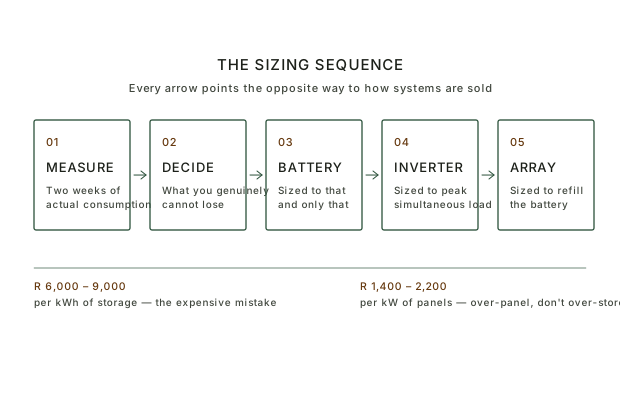
Five steps, and every one of them points the opposite way to how systems are usually sold.
- Measure the load. Two weeks of actual consumption, logged hourly.
- Decide what you genuinely cannot lose. Not what you would like on — what would actually stop your household or your business.
- Size the battery to that, and only that. This is where the money is.
- Size the inverter to peak simultaneous demand, not to the battery.
- Size the array to refill the battery in the worst realistic solar day you will face — which in inland South Africa is a wet January afternoon, not a June morning.
Why measuring first shrinks the system
Because people are wrong about their own consumption, consistently and in one direction.
The two loads that dominate a South African household bill are the geyser and, seasonally, resistive heating. Both are large, both are intermittent, and both are far better solved outside the solar system — a timer and a blanket on the geyser, or a heat pump, will do more for a bill than another two panels ever will.
Strip those out and what remains — lights, fridge, electronics, pumps, a laptop-based business — is usually a startlingly small number. That number is what you are actually buying storage for.
How to log your load without buying anything
If you have a prepaid meter, read it at the same time every morning for fourteen days and record the number. That gives you daily consumption, which is enough for a first pass.
Better, and still cheap: a clamp meter on the main feed, or a plug-in energy monitor moved around the house across a fortnight. What you are looking for is not the total. It is the shape — when the peaks happen, how long they last, and what causes them.
Two weeks catches a weekend, a wash day and at least one bad-weather day. One week does not.
Why South African sizing is not European sizing
Two differences matter and both cut the same way.
Our irradiance is excellent — an inland South African year delivers roughly twice the usable solar energy of a northern European one — so panels do more work here per rand. But our worst case is different too. A European system is sized around a short dark winter. Ours has to survive a run of overcast, wet summer afternoons in January and February, which is precisely when the load is highest.
And the grid failure mode is different. A European system is optimising a bill. A South African one is very often buying continuity. Those two objectives size a battery quite differently, and it is worth being honest with yourself about which one you are actually buying.
The mistake almost everybody makes
Sizing the whole system around the geyser.
A 3 kW element running two hours a day is 6 kWh — frequently more than everything else in the house combined. Put it on the solar system and you double the specification. Put it on a timer, insulate it properly, or replace it with a heat pump, and the entire problem shrinks.