Power
Backup power: what to keep running, and in what order
Most backup power guides are written for emergencies that happen once a year. Load-shedding is scheduled and frequent, which changes everything about what to buy and what to run first.
The short answer
Power your communications and medical devices first, then refrigeration, then lighting. An inverter with a battery handles the daily scheduled slots; a generator covers extended outages or high loads like a pump. Getting that sequence wrong is the most expensive mistake in load-shedding prep — not because of what you buy, but because of what you kill.
The short answer
Power your critical loads first — medical devices, a router, and a single fridge — before anything else. An inverter with a battery is the right tool for the scheduled daily slots South Africa lives with. A generator fills the gaps when outages run long or loads run heavy. The sequencing mistake almost everyone makes is buying the generator first, because it feels like the most powerful answer, and then discovering it cannot run quietly at 02h00 in a residential street.
What to power first, and the honest order
The priority order is not about comfort. It is about what costs money or health when it fails. Work through this list before you decide how much capacity to buy.
- Medical devices first. A CPAP machine, an oxygen concentrator, insulin that must stay cold, a powered wheelchair charger. These are not negotiable and they are often the load people forget to mention when sizing a system.
- Communications second. A router and one charged phone. Without these you cannot reach emergency services, cannot check the Eskom schedule, and cannot work from home. The load is small — a typical fibre router draws 15–20 W — but the consequence of losing it is disproportionate.
- Refrigeration third. A single well-maintained fridge running on backup is a meaningful saving. A large American-style double-door fridge-freezer on backup will empty a battery in two to three hours. Know which you have before you buy anything.
- Lighting fourth. LED lighting is so efficient it barely moves the needle on a battery. It feels important because darkness is uncomfortable, but it is rarely the constraint.
- Everything else last. Kettles, microwaves, air conditioners, tumble dryers, and pool pumps are high-draw appliances that have no place on a battery backup system unless the system was specifically sized for them.
The sequencing mistake almost everyone makes is adding loads from the bottom of this list — a television, a laptop charger bank, a second fridge — before the top of the list is secured. A battery that could have run a CPAP machine all night runs flat by midnight because the television was on.
Inverter, generator, and full system — what each is for
These three are not interchangeable. Each solves a different problem, and conflating them is how people end up with the wrong tool.
| Option | Best suited to | Main limitation |
|---|---|---|
| Inverter + battery | Daily scheduled load-shedding, quiet environments, critical loads under 3 kW | Cannot run high-draw appliances for long; battery capacity is finite |
| Petrol or diesel generator | Extended outages, high loads (pumps, compressors), sites where noise is not a constraint | Noise, fumes, fuel storage, and municipal by-laws in residential areas |
| Full hybrid solar system | Households that want to reduce grid dependence as well as cover outages | Higher capital cost; requires correct sizing or the solar contribution is wasted |
An inverter converts DC battery power to the AC your appliances expect. A pure-sine-wave inverter is the correct choice for sensitive electronics — routers, medical equipment, variable-speed motors. A modified-sine-wave inverter is cheaper but can damage or shorten the life of those loads. If you are powering anything with a motor or a microprocessor, spend the extra on pure-sine.
A generator produces AC directly from a running engine. It can supply more power than most battery systems — a 5 kVA generator will run a borehole pump; most inverter-battery combinations will not — but it requires fuel, produces exhaust, and makes noise. It is the right answer for a farm that loses power for three days, not for a suburban home that loses it for two hours twice a day.
A full hybrid system adds solar panels and a charge controller to the inverter-battery setup. The panels recharge the battery during the day so the same kilowatt-hours can be used again that evening. This is the architecture that genuinely reduces electricity bills over time, but it requires a correctly sized array or the solar contribution is too small to matter. See how much solar you actually need before sizing panels.
Why backup power is different in South Africa
Generator noise, fumes, and the by-laws
A petrol generator running at half load produces roughly 65–70 dB at seven metres — about the volume of a vacuum cleaner, continuously. A diesel unit at the same load is typically 5–10 dB louder. At night, in a quiet residential street, this is not a neighbourly choice and it is not a legal one in most municipalities.
Most local by-laws prohibit generators in residential areas between 22h00 and 07h00. Some extend this to Sundays and public holidays. The relevant authority is the local municipality's noise control or environmental health department. If you intend to run a generator in a residential setting, read your municipality's noise control by-law before you buy the machine.
Carbon monoxide is the fume risk, not smell. Generators must run outdoors or in a well-ventilated structure with no return path to living areas. Every year people die running generators in garages with the door closed. The exhaust must vent away from windows, air-conditioning intakes, and any opening into the building.
A transfer switch — or, at minimum, a properly wired changeover switch — is required wherever a generator connects to a building's distribution board. This is not optional and it is not about neatness: without isolation, a generator can back-feed live voltage onto the municipal network and kill a linesman working to restore power. The Occupational Health and Safety Act (Act 85 of 1993) and the SANS 10142-1 wiring standard both apply here. The work must be done by a registered electrician and a Certificate of Compliance must be issued.
Running a fridge, a router, and a medical device
These three loads together represent the realistic minimum for most households. Here is what the numbers actually look like.
| Appliance | Typical running draw | Hours per 2-hour slot | Wh consumed per slot | |||||||||||||||||||||||||||||||||||||||||||||||||||||||||||||||||||||||||||||||||||||||||||||||||||||||||||||||||||||||
|---|---|---|---|---|---|---|---|---|---|---|---|---|---|---|---|---|---|---|---|---|---|---|---|---|---|---|---|---|---|---|---|---|---|---|---|---|---|---|---|---|---|---|---|---|---|---|---|---|---|---|---|---|---|---|---|---|---|---|---|---|---|---|---|---|---|---|---|---|---|---|---|---|---|---|---|---|---|---|---|---|---|---|---|---|---|---|---|---|---|---|---|---|---|---|---|---|---|---|---|---|---|---|---|---|---|---|---|---|---|---|---|---|---|---|---|---|---|---|---|---|---|---|
| Fibre router | 15–20 W | 2 | 30–40 Wh | |||||||||||||||||||||||||||||||||||||||||||||||||||||||||||||||||||||||||||||||||||||||||||||||||||||||||||||||||||||||
| CPAP machine (no humidifier) | 30–60 W | 2 | 60–120 Wh | |||||||||||||||||||||||||||||||||||||||||||||||||||||||||||||||||||||||||||||||||||||||||||||||||||||||||||||||||||||||
| Fridge (165 litre, A-rated) | 80–120 W average | 2 | 160–240 Wh | |||||||||||||||||||||||||||||||||||||||||||||||||||||||||||||||||||||||||||||||||||||||||||||||||||||||||||||||||||||||
| LED lighting (4 × 9 W) | 36 W | 2 | 72 Wh | |||||||||||||||||||||||||||||||||||||||||||||||||||||||||||||||||||||||||||||||||||||||||||||||||||||||||||||||||||||||
| Laptop | 45–65 W | 2 | 90–130 Wh | |||||||||||||||||||||||||||||||||||||||||||||||||||||||||||||||||||||||||||||||||||||||||||||||||||||||||||||||||||||||
| A | c | t | u | a | l | d | r | a | w | v | a | r | i | e | s | b | y | a | p | p | l | i | a | n | c | e | a | g | e | a | n | d | a | m | b | i | e | n | t | t | e | m | p | e | r | a | t | u | r | e | . | M | e | a | s | u | r | e | w | i | t | h | a | p | l | u | g | - | i | n | e | n | e | r | g | y | m | o | n | i | t | o | r | b | e | f | o | r | e | s | i | z | i | n | g | a | b | a | t | t | e | r | y | . |
A two-hour slot with a fridge, a router, a CPAP, and four LED lights draws roughly 350–500 Wh. Two slots a day — a common load-shedding pattern — means 700–1,000 Wh of usable capacity needed per day. A 100 Ah 12 V battery (lithium) holds 1,200 Wh and should not be discharged below 20%, giving roughly 960 Wh usable. A single 100 Ah lithium battery is therefore approximately right for this load. A lead-acid battery of the same nominal capacity should only be discharged to 50%, giving 600 Wh usable — not enough for two slots without a second battery.
If a medical device is in the load, confirm its power draw from the manual, not the label. Labels state peak draw; the device usually runs at a fraction of that. A CPAP at 60 W for eight hours overnight is 480 Wh — the same as the combined fridge, router, and lights load above. Size for the overnight medical load separately and do not assume it is negligible.
What goes wrong
The failures we see repeatedly are not equipment failures. They are sequencing and specification errors.
- Undersized battery for the actual load. People size for what they want to run, not what they measure. An energy monitor costs very little and removes all guesswork. Every battery recommendation made without measuring the load is a guess.
- Modified-sine-wave inverter on sensitive loads. Routers, medical equipment, and variable-speed motors — including the compressor in a modern fridge — are sensitive to waveform quality. A cheap modified-sine inverter will often work, until it does not. The fridge compressor fails first; it is also the most expensive component in the appliance.
- Generator without a changeover switch. This is the wiring error that gets people killed or charged. Plug-in "suicide cables" — where a generator is plugged directly into a wall socket — are illegal and dangerous. They are still sold and still used.
- Running the generator indoors or in an attached garage. Carbon monoxide has no smell and no colour. By the time symptoms appear, the affected person may not be capable of leaving the space.
- Ignoring battery cycle life. A battery rated at 500 cycles to 80% depth of discharge, cycled twice a day, lasts less than a year. Cycle life is the number that matters for daily load-shedding use; total capacity is secondary.
- Buying a generator for daily use. A generator is designed for occasional, high-load operation. Running it for four hours every day, every week, for years wears it faster than the manufacturer's service intervals assume. Daily use demands either a battery system or a generator with a realistic service budget.
What we would do differently
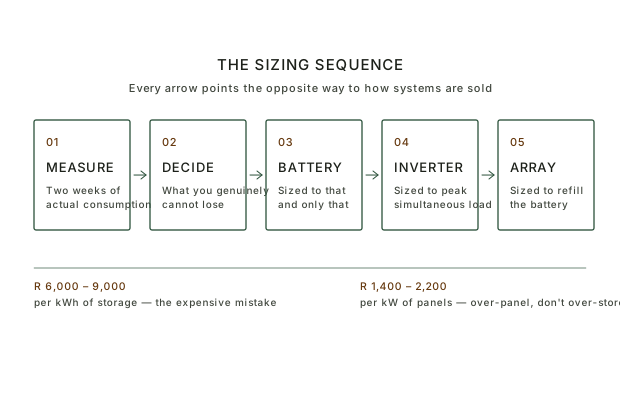
- Measure every load with a plug-in energy monitor before buying any equipment. The measurements will surprise you, and they will change what you buy.
- Start with communications and medical loads only. Secure those completely — right-sized battery, pure-sine inverter, correct wiring — before adding refrigeration.
- Choose lithium (LiFePO₄) chemistry for any battery that will be cycled daily. The cycle life advantage over lead-acid is decisive at South African load-shedding frequencies.
- Read the local municipality's noise by-law before buying a generator. If generator use at 22h00 is prohibited, a generator is not a backup for evening slots — it is a weekend tool only.
- Engage a registered electrician for any connection to the distribution board. Get the Certificate of Compliance. This is not bureaucracy; it is the legal condition for your insurance to pay out if something goes wrong.
- Size the system for two years of twice-daily cycling, not for the load alone. The battery that handles today's load-shedding must still handle it in 2027.
Is it worth it?
For most South African households, yes — with the right scope. An inverter-battery system sized for critical loads only pays back in comfort, productivity, and food preservation across a schedule that is unlikely to improve dramatically in the short term. The question is not whether to have backup power but what to put on it.
A generator is worth it for households with high-load requirements — a borehole pump, a workshop, a smallholding that needs refrigeration beyond what a battery can supply — or for outages that run beyond battery capacity. It is not worth it as the primary solution for daily residential load-shedding in a noise-restricted area.
A full hybrid solar system is worth it if grid-independence and long-term electricity cost reduction are goals alongside load-shedding cover. It is not worth the capital outlay if the only goal is surviving two-hour slots — a battery-only inverter system does that for less.
The honest answer is that the right system depends on your load, your budget, your property type, and your municipality's rules. What is not worth it, by any measure, is buying a large generator for daily use without reading the by-law, or wiring it without a changeover switch, or running it in a closed space. Those are not cost decisions. They are safety decisions.