Journal
Levelized Cost of Battery Storage: Essential Guide to LCOS
In short
- The levelized cost of storage (LCOS) — not the sticker price per nominal kWh — is the only number that tells you what each kilowatt-hour passing through your battery actually costs over its working life.
- Worked on real August 2026 South African listings, an LFP lithium battery comes out at roughly a rand per kWh stored over ten years of daily cycling; a lead-acid bank doing the same job works out at more than ten times that.
- Three numbers decide everything: usable capacity (nominal kWh × depth of discharge), cycle life, and round-trip efficiency. Get those three right and the “cheap” quote stops looking cheap.
What’s in this guide
- What is the levelized cost of storage, and how do you calculate it?
- How do the main battery chemistries compare?
- What does battery storage cost in South Africa right now?
- Why is lead-acid a ten-year financial trap?
- What do installation and soft costs add?
- What should be on your battery buyer’s checklist?
- Key takeaways
- Frequently asked questions
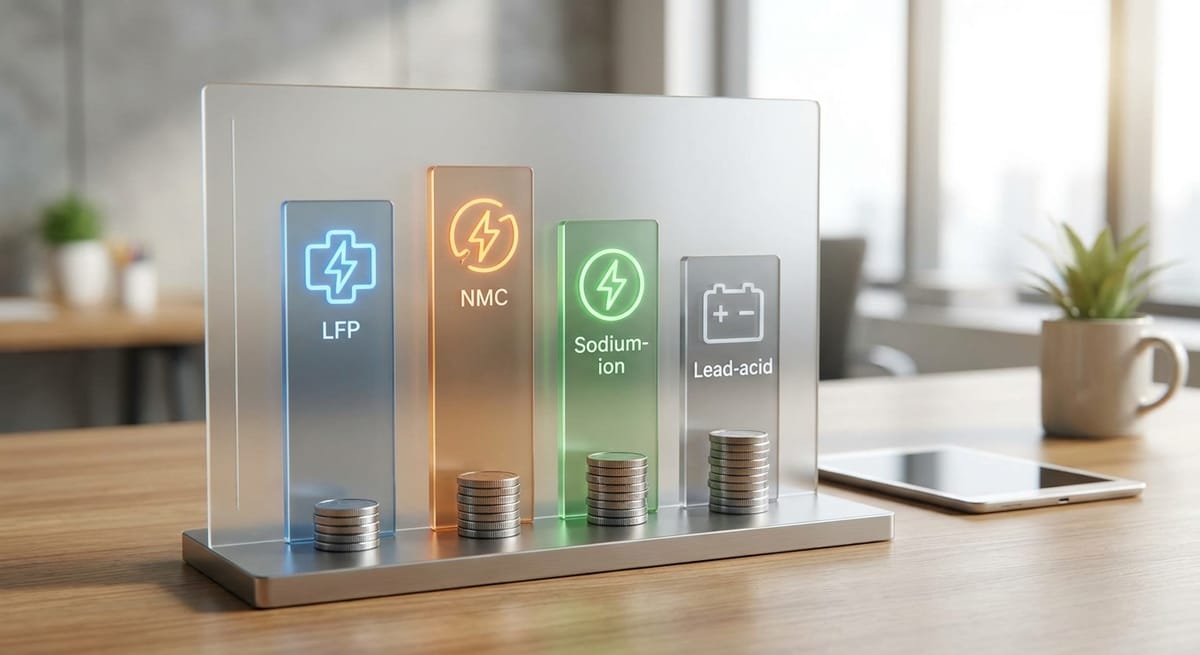
When you are pricing battery storage for an off-grid or backup system, the sticker price per “nominal” kilowatt-hour is a trap — and one of the most expensive mistakes a homeowner can make. The levelized cost of storage (LCOS) is the metric that tells you what every kilowatt-hour passing through that battery actually costs over its operating life. A battery advertised as a 10 kWh unit rarely delivers 10 kWh day after day, because usable capacity depends on depth of discharge — and lifetime value depends on how many cycles the chemistry can survive.
To judge the real return on a battery, you need three metrics together: usable capacity, cycle life, and the LCOS they produce. Get those three right and the “cheap” lead-acid quote stops looking attractive very quickly. This guide walks through the maths, compares the chemistries, and then anchors the arithmetic in real South African retail prices — every rand figure below comes from a listing we actually opened in August 2026, or is flagged as a round-number worked example. It pairs naturally with our guides to choosing battery storage and sizing your solar array.
What is the levelized cost of storage, and how do you calculate it?
The levelized cost of storage is your total battery spend divided by the total energy the battery will actually deliver over its lifetime — usable capacity multiplied by cycle life, adjusted for round-trip efficiency. It converts any quote, in any chemistry, into a single comparable number: rand per kilowatt-hour stored.
Three formulas drive every sensible battery purchase. Learn them once and you will never be fooled by a nominal-kWh price again.
Usable capacity
Nominal capacity is the total theoretical energy a battery holds when fully charged. Draining most chemistries to empty causes severe chemical stress, so manufacturers set a recommended depth of discharge (DoD). True usable capacity is simply:
Usable capacity (kWh) = Nominal capacity (kWh) × Depth of discharge (DoD)
- Lead-acid example: 10 kWh nominal × 50% DoD = 5.0 kWh usable
- LFP example: 10 kWh nominal × 95% DoD = 9.5 kWh usable
Cost per usable kWh
Dividing the price by usable — not nominal — capacity reveals the true acquisition cost:
Cost per usable kWh = Total pack price ÷ Usable capacity (kWh)
Levelized cost of storage (LCOS)
LCOS measures the cost of every kWh that passes through the battery over its lifetime, accounting for cycle life and round-trip efficiency (RTE):
LCOS (R/kWh stored) = Total battery spend ÷ (Usable capacity × Cycle life × RTE)
The core truth: a battery with a low initial price but a short cycle life can carry an LCOS many times higher than a premium battery with high cycle resilience. The worked example further down shows just how wide that gap gets.
How do the main battery chemistries compare?
LFP lithium leads on depth of discharge, cycle life and efficiency, which is why it dominates stationary storage. NMC trades lifespan for density, sodium-ion is a promising newcomer, and both lead-acid types are limited to half their nominal capacity and a fraction of lithium’s cycles. The table shows typical published specifications.
| Chemistry | Typical DoD | Typical cycle life (to 80% capacity) | Round-trip efficiency | Expected lifespan |
|---|---|---|---|---|
| Lithium iron phosphate (LFP) | 90–100% | 4,000–6,000+ | 92–96% | 10–15+ years |
| Lithium NMC | 80–90% | 2,000–4,000 | 90–94% | 8–10 years |
| Sodium-ion (Na-ion) | 80–90% | 3,000–5,000 | 88–92% | 8–12 years |
| Sealed lead-acid (AGM/gel) | 50% | 500–1,200 | 75–82% | 3–5 years |
| Flooded lead-acid (FLA) | 50% | 500–1,200 | 70–80% | 3–7 years (maintenance required) |
The numbers only tell part of the story. Here is what each chemistry actually delivers in the real world.
Lithium iron phosphate (LFP) — the standard for stationary storage
LFP is the default choice for off-grid and residential storage, and for good reason: excellent thermal stability, a non-toxic chemistry, and a very low risk of thermal runaway. Its one concession is lower volumetric energy density than NMC — it needs a slightly bigger box — but for a battery bolted to a wall that is essentially irrelevant.
Lithium NMC — high density, shorter life
NMC became a household name through early products such as Tesla’s Powerwall 2 and LG Chem’s home packs. High energy density in a small footprint is genuinely useful, but the shorter cycle life, higher thermal sensitivity, and steeper degradation in high ambient heat make NMC a questionable choice for daily cycling in a warm South African installation.
Sodium-ion — the newcomer to watch
Na-ion replaces lithium with abundant sodium salts, which should cut raw-material costs as production scales. It tolerates cold exceptionally well and carries no meaningful thermal-runaway risk. The catch: lower energy density than LFP, and local supply is still thin — availability and pricing in South Africa are not yet predictable enough to plan a build around.
Sealed and flooded lead-acid — the legacy options
Lead-acid once dominated off-grid power, and the low nominal price still attracts attention on a tight budget. But the 50% DoD ceiling, efficiency losses under high load (first described by Wilhelm Peukert back in 1897, and still very much a problem today), rapid capacity loss if left partially discharged, and poor round-trip efficiency make it a financially punishing choice for daily cycling.
What does battery storage cost in South Africa right now?
On August 2026 listings, a popular 5.5 kWh LFP wall-mount battery sells for roughly R16,000 to R21,000 — about R3,200 to R4,200 per usable kWh. A 200 Ah AGM lead-acid battery lists at R6,500 to R8,900, which is R5,400 to R7,400 per usable kWh. Lead-acid loses before cycle life even enters the picture.
Those figures come from listings we opened directly. The Hubble AM-2 (5.5 kWh nominal, 51 V) was listed at R15,899 by JC Solar Panels and at R20,954 including VAT by Sunstore in August 2026. At a 90% depth of discharge that is 4.95 kWh usable, or R3,212–R4,233 per usable kWh. On the lead-acid side, Sustainable.co.za listed the SonX 200 Ah 12 V AGM at R6,468.95 on promotion and the Deltec BR-12V 200 at R8,915.95, both including VAT, in August 2026. A 12 V, 200 Ah battery holds 2.4 kWh nominal — 1.2 kWh usable at 50% DoD — so those listings work out at R5,391–R7,430 per usable kWh.
Premium local LFP brands sell largely through installer networks and quote per project, so treat any internet price for them as indicative and get a written quote. Prices move constantly with the exchange rate — always check current listings before you budget, and compare at least three suppliers.
It is worth holding those numbers against what the grid charges. On Eskom’s published schedule of standard prices effective 1 April 2026, a direct Homepower residential customer pays an active energy charge of 322.06 c/kWh including VAT — about 355.56 c/kWh once the variable network demand and ancillary service charges are added, before the fixed daily charges. A storage LCOS of around R1/kWh on top of your solar generation cost is a workable proposition against a grid rate of roughly R3.56/kWh; a lead-acid LCOS of R11/kWh never will be.
One note for readers comparing overseas prices: battery economics in the United States and the United Kingdom are shaped by entirely different incentive and tariff regimes, and those rules change often enough that any imported figure dates quickly. The method in this guide travels anywhere; the rand prices are the ones that matter here.
Why is lead-acid a ten-year financial trap?
Because you have to keep buying it. Daily cycling burns through a lead-acid bank’s 500-odd cycles in under two years, so a decade of service means buying the bank roughly six times over. A single LFP battery covers the same decade — and the gap in cost per stored kilowatt-hour exceeds ten to one.
Here is the arithmetic as an explicit worked example, anchored on the verified August 2026 listings above and deliberately conservative assumptions. Take a daily requirement of about 4.8 kWh of usable storage, cycled once a day for ten years — 3,650 cycles.
- LFP option: one Hubble AM-2 at the R15,899 listing — 4.95 kWh usable at 90% DoD, typical LFP cycle life of 4,000+ cycles, 92% round-trip efficiency.
- AGM option: a bank of four 200 Ah AGM batteries at the R6,468.95 listing — call it R25,900 a bank — giving 4.8 kWh usable at 50% DoD, with a typical 600 cycles per bank and 80% round-trip efficiency.
| Metric | AGM lead-acid bank | LFP wall-mount |
|---|---|---|
| Usable capacity | 4.8 kWh | 4.95 kWh |
| Upfront cost | ~R25,900 | ~R15,900 |
| Typical cycle life | ~600 cycles at 50% DoD | 4,000+ cycles at 90% DoD |
| Banks needed for 3,650 daily cycles | ~6 (the original plus five replacements) | 1 |
| Ten-year hardware spend | ~R155,000 | ~R15,900 |
| LCOS per kWh stored | ~R11 | ~R0.96 |
The verdict is stark. The AGM bank is already more expensive on day one for the same usable capacity, and once replacements are counted it ends up more than ten times more expensive per stored kilowatt-hour. The DoD penalty and cycling degradation do the damage quietly, one replacement at a time. Run your own numbers with your own quotes — the formula is three lines of arithmetic — but the shape of the result will not change.
What do installation and soft costs add?
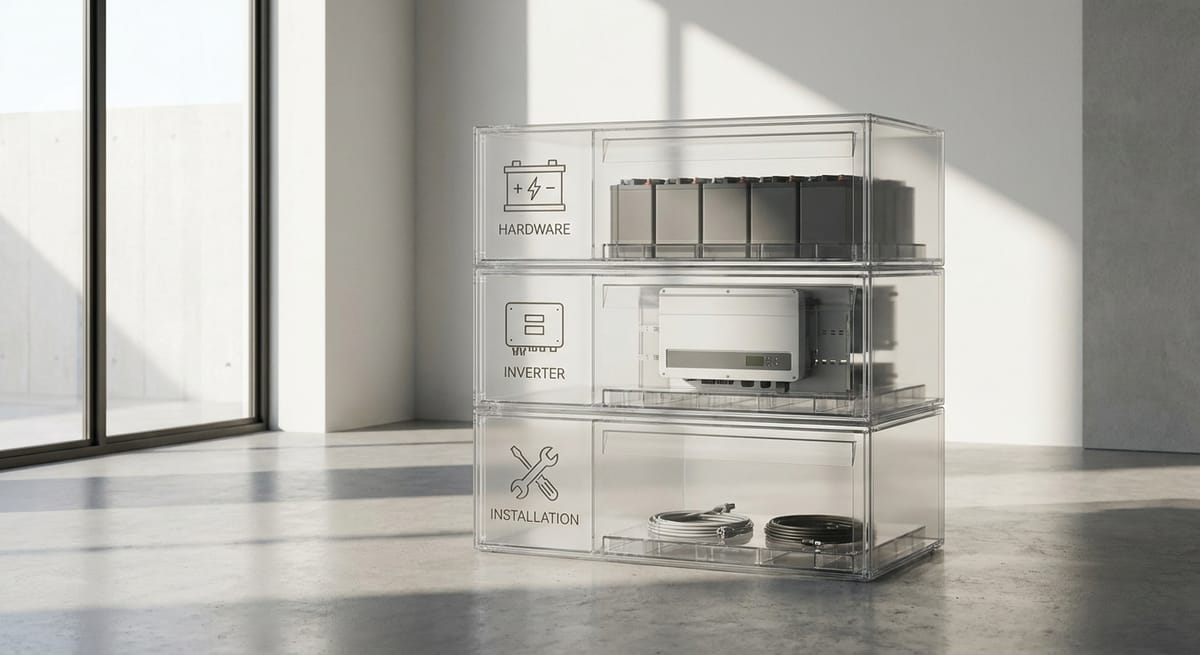
The battery is only one line on the final bill. The inverter, cabling, protection and mounting hardware add a substantial second tier, and installation labour with a Certificate of Compliance adds a third. As a rule of thumb, the battery itself is often only around half of the total project cost.
When comparing quotes, break the costs into three tiers:
- Bare battery hardware: the pack and its built-in battery management system (BMS).
- Inverter and balance of system: the hybrid inverter, heavy DC cabling, fusing and disconnects, combiners and mounting. Our guide to choosing an inverter covers this tier in detail.
- Installation and compliance: qualified electrician labour, the electrical Certificate of Compliance, and any distribution-board work the installation triggers.
The practical rule: always ask every installer for a fully installed cost per usable kWh, not a hardware quote. It is the only way to compare a wall-mount lithium proposal against a rack-mount one — or against the quote your neighbour got.
What should be on your battery buyer’s checklist?
Four checks separate a sound battery purchase from an expensive lesson: price it per usable kWh, confirm the warranted cycle throughput in writing, verify low-temperature charge protection, and make sure the BMS speaks your inverter’s language. Run every quote through all four before signing anything.
- Calculate cost per usable kWh. Never buy on nominal capacity. Multiply nominal kWh by DoD before comparing any prices.
- Verify warranted cycle throughput. The warranty should cover a specific total energy throughput or a minimum cycle count at a stated remaining capacity — not just a flat number of years.
- Check low-temperature charging protection. Charging lithium below 0°C permanently damages cells. Confirm the BMS has a hardware low-temperature charge cut-off — Highveld winter mornings get cold enough to matter.
- Confirm inverter protocol compatibility. Closed-loop CAN or RS485 communication between the battery’s BMS and your hybrid inverter is what keeps state-of-charge tracking honest.
Battery storage only earns its keep as part of a properly sized system — start with our power pillar if you are still scoping the whole build.
Key takeaways
- The levelized cost of storage — not the nominal-kWh price — is the only financially honest way to compare battery chemistries over the long term.
- LCOS is three lines of arithmetic: usable capacity (nominal × DoD), multiplied by cycle life and round-trip efficiency, divided into your total spend.
- On verified August 2026 South African listings, LFP works out at roughly R3,200–R4,200 per usable kWh to buy and about R0.96 per kWh stored over ten years of daily cycling; an AGM bank works out at R5,400–R7,400 per usable kWh to buy and around R11 per kWh stored.
- Lead-acid’s 50% DoD ceiling and short cycle life mean roughly six banks over a decade of daily cycling — the replacements, not the first invoice, are where the money goes.
- The battery is often only around half of the installed cost — always demand a fully installed cost per usable kWh that includes the inverter, balance of system, labour and Certificate of Compliance.
- Low-temperature charge protection and closed-loop CAN/RS485 inverter communication are non-negotiable checklist items, whatever chemistry you choose.
Frequently asked questions
What is the levelized cost of storage and how is it calculated?
The levelized cost of storage (LCOS) is your total battery spend divided by the total usable energy the battery delivers over its lifetime, accounting for depth of discharge, cycle life and round-trip efficiency: LCOS = total spend ÷ (usable capacity × cycle life × RTE). It converts any battery quote into one comparable number — rand per kilowatt-hour stored.
Why is nominal capacity so misleading when buying a battery?
Nominal capacity is the theoretical maximum, not what the battery safely delivers daily. Lead-acid is limited to about 50% depth of discharge, so a 10 kWh nominal bank yields only 5 kWh of usable power, while an LFP pack at 95% DoD delivers 9.5 kWh from the same rating. Levelized cost of storage calculations always start from usable, not nominal, capacity.
Why does LFP lithium end up cheaper than lead-acid over ten years?
Cycle life. Daily cycling exhausts a typical AGM bank’s roughly 600 cycles in under two years, so a decade means buying the bank about six times over, while one LFP battery covers the whole period. In our worked example on August 2026 South African prices, that gap produces a levelized cost of storage of about R0.96/kWh for LFP against roughly R11/kWh for AGM.
How does battery storage compare with Eskom’s tariff?
Eskom’s schedule of standard prices effective 1 April 2026 puts a direct Homepower customer’s variable rate at about R3.56/kWh including VAT, before fixed daily charges. An LFP system with a levelized cost of storage near R1/kWh — plus your solar generation cost — can compete with that; lead-acid at around R11/kWh stored cannot, which is why daily-cycling lead-acid has essentially disappeared from serious installations.
What soft costs should I budget beyond the battery itself?
Plan for three tiers: the battery, the inverter with its balance of system (cabling, fusing, disconnects, mounting), and installation labour with the electrical Certificate of Compliance. As a rule of thumb the battery is often only about half the installed total, which is why a levelized cost of storage comparison should be run on the fully installed price per usable kWh, not the hardware quote.