Journal
Off-Grid Livestock Housing: Essential Design & Cost Guide
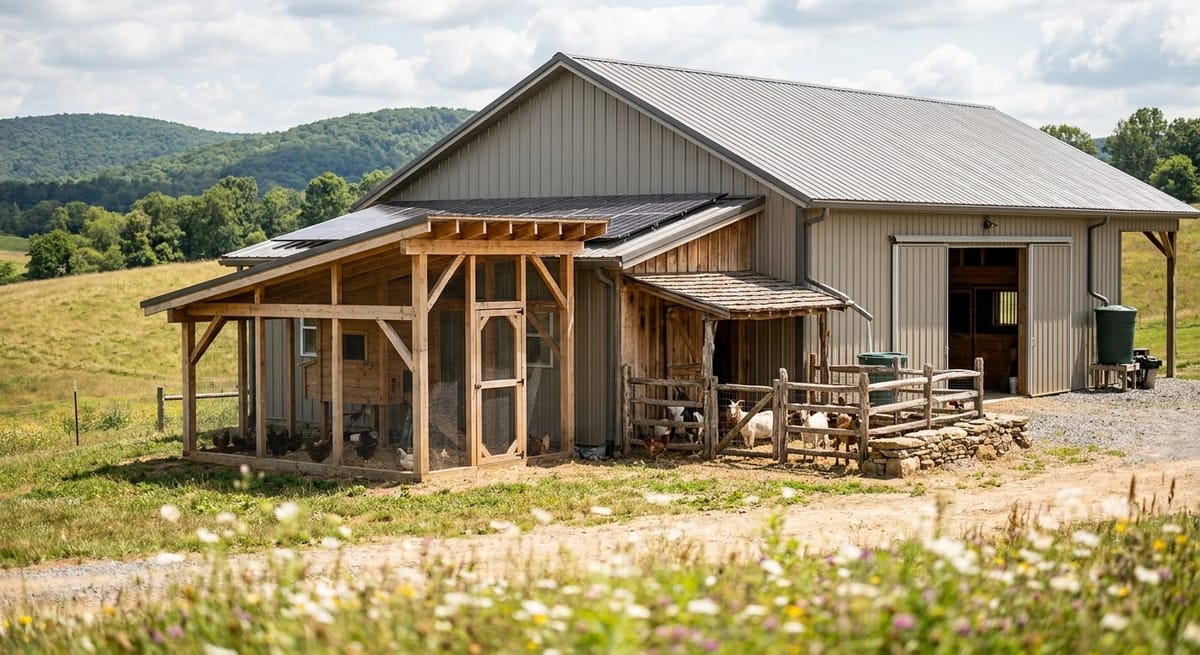
In short
- Most off-grid livestock housing fails in its first year because it is built for a fixed animal count instead of a growing, changing system — modularity is the single most important design decision.
- Recurring costs — feed, bedding, parasite control, maintenance — routinely overtake the original build cost, and feed dominates them all; budget for the running, not just the building.
- Heavy welded mesh with a buried dig apron, sealed feed storage, high-level ventilation, and on-site fodder production are the four levers that make keeping animals viable long-term.
What’s in this guide
- Why do most first animal builds fail?
- What are the four design pitfalls that sink most builds?
- What does off-grid livestock housing cost to build and run?
- What makes South African conditions different?
- How do you cut recurring livestock costs off-grid?
- Key takeaways
- Frequently asked questions
Off-grid livestock housing is the piece of the self-reliance puzzle that humbles almost everyone. The vision is compelling — warm eggs every morning, goat milk on the bench, a couple of pigs quietly converting kitchen scraps into next season’s compost. Then reality arrives, usually somewhere between month six and month twelve, and rearranges your priorities.
The breakdown is almost never about enthusiasm. It comes from one fundamental design flaw: building static shelters for dynamic, living systems. Most first builds are sized for the exact animal count on day one, lifted from a textbook square-footage guide, and expected to perform indefinitely. They don’t. Within a single season the perfectly planned coop is bursting at the seams, breached by something sharp-clawed, or quietly rotting from trapped moisture.
Why do most first animal builds fail?
First builds fail because they are designed for a fixed, idealised animal count. Herds grow, animals get sick, mothers need birthing space, and predators probe every weakness — and a static structure has no answer for any of it. The fix is conceptual, not expensive: modular housing that anticipates growth costs only marginally more to build.
Ten laying hens become an incubator full of chicks within a breeding season. A pair of dairy goats gives birth and suddenly you need kidding pens and weaning enclosures you never built. When modularity isn’t baked into the original design, you end up making panicked structural additions in the mud while animals are already in crisis. That is not self-reliance — that is reactive chaos.
Animal projects have a way of outrunning their infrastructure, and pretending otherwise is how good money disappears — the tilapia pond post-mortem is this site’s own honest account of exactly that. Brooding bays, isolation quarters, and birthing spaces are not optional upgrades. They are operational infrastructure from day one, even if they stand empty for a while.
What are the four design pitfalls that sink most builds?
Four failures account for the vast majority of first-year losses: no separation or isolation space, lightweight wire with no dig apron, unsealed feed storage, and ventilation that traps moisture and ammonia. All four are cheap to solve at the design stage and expensive — sometimes fatal — to fix afterwards.
1. No separation or isolation space
Without dedicated brooding bays, quarantine stalls, and birthing pens, a single sick animal can move through an entire group before you have even identified the problem. Build these spaces in from the start. A quarantine pen that stands empty is cheap insurance; a disease sweeping a shared pen is not.
2. Inadequate wire and no dig aprons
Standard hexagonal chicken wire keeps poultry in. It does absolutely nothing to keep predators out. Predators don’t just push against fences — they dig beneath them, chew through light timber, and work simple latches. A structurally sound build uses heavy-gauge galvanised welded mesh (at least 1.5 mm wire thickness) with an underground dig apron extending 30–40 cm outward — or buried vertically — around the entire perimeter. No apron means you are just delaying the inevitable.
3. Feed spoilage and rodent contamination
Feed is the single largest ongoing expense in animal husbandry, and first builds routinely skip rodent-proof feed storage. Paper sacks in a wooden shed are a standing invitation: rats consume and contaminate a frightening quantity of grain while spreading diseases like leptospirosis, and ambient humidity turns stored grain mouldy, producing mycotoxins that can quietly poison a whole flock. Feed storage must be elevated, airtight, rodent-proof, and moisture-controlled from day one. Full stop.
4. The ventilation paradox
Cold-climate keepers seal coops up tight to hold warmth. Hot-climate keepers build open structures that offer no protection from driven rain. Both approaches kill animals, just through different mechanisms. Livestock generate enormous amounts of heat and water vapour through breathing and manure; without high-level passive ridge ventilation, that moisture builds up — frostbitten combs and wattles in winter, trapped ammonia scorching respiratory tracts in summer. The Agricultural Research Council’s guide to poultry housing makes the same point from the engineering side: temperature, humidity, and airflow are the environment, and the structure exists to control them. Ventilation must happen well above the animals’ heads — clearing gases without creating cold draughts at floor level.
What does off-grid livestock housing cost to build and run?
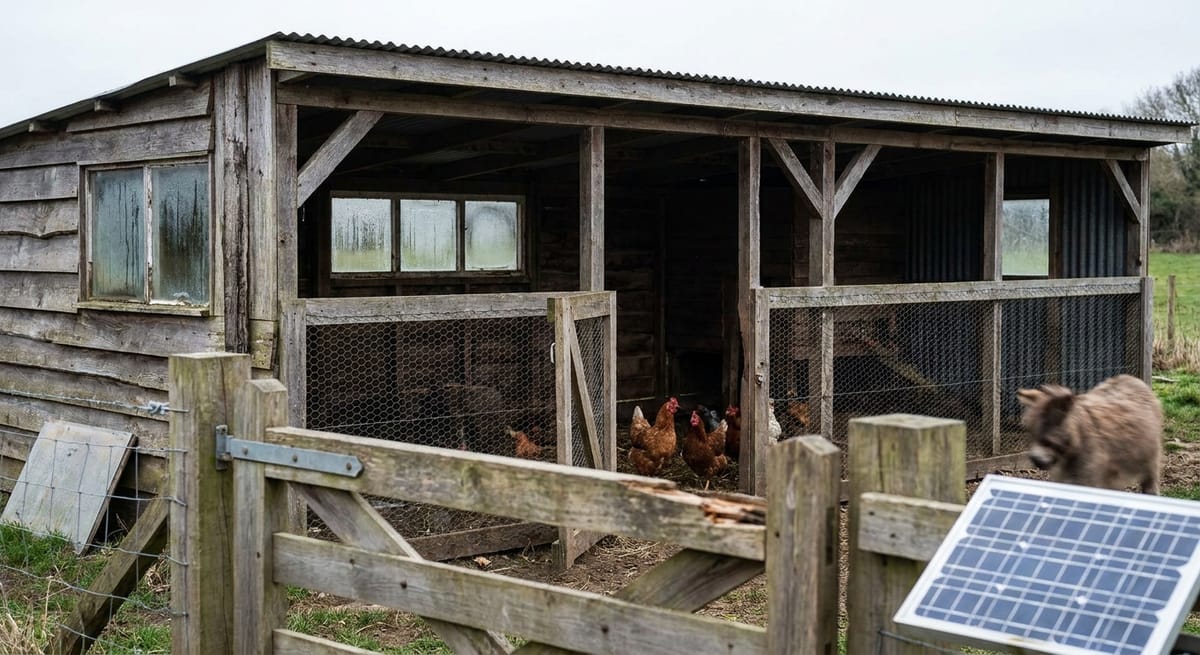
The build is a one-off capital cost you can price to the rand from retailer listings before you start. The running costs are forever, they are dominated by feed, and they move with the maize and lucerne markets — so price a month of feed at your local co-op before you commit to a single animal.
On the materials side, real numbers are easy to anchor. At the time of writing, Cashbuild’s online listings (August 2026) show a 6.6 m galvanised corrugated roof sheet (0.3 mm profile) at R339.95, a 2.4 m CCA H4-treated gum pole (75/100 mm, rated for ground contact) at R132.95 each, and a 25 m roll of 1.2 m diamond-mesh fencing at R639.95. Stock and pricing vary by branch and province, and predator-grade welded mesh sits above ordinary boundary mesh in most ranges — so draw up your own cutting list, take it to Builders and Cashbuild, and price the actual build before the first hole is dug.
The recurring costs are where budgets really break. Five categories make up the monthly bill for a working setup:
- Commercial feed and concentrates: layer mash, pig grower pellets, and dairy rations to cover baseline metabolic demand when pasture is dormant. For scale: typical layer intake is around 110 g of feed per bird per day, so ten hens work through roughly a kilogram a day between them. Count the bags honestly.
- Bulk roughage: lucerne, teff, or meadow hay for ruminants through the dry season.
- Bedding: shavings, straw, or sawdust to absorb moisture and keep floors hygienic.
- Veterinary care, parasite control, and minerals: dewormers, tick treatments, vaccines, lick blocks, and trace minerals.
- Infrastructure maintenance and power: fence energiser upkeep, solar battery replacements for water pumps, timber repairs, and UV-degraded water lines — the quiet costs that creep up on everyone.
What makes South African conditions different?
South African off-grid livestock housing must handle Highveld frost and Karoo heat in the same design, plus predator pressure most overseas guides never mention — caracal, black-backed jackal, honey badger — and tick-borne disease on top. Most online plans are written for the UK or the US; follow them uncritically here and you will lose animals.
The predators are the headline. Caracals (rooikat) clear high fences with ease; black-backed jackals dig aggressively under soft perimeter boundaries; honey badgers rip through standard chicken wire and pop lightweight latches without breaking a sweat. Enclosures need heavy galvanised weld-mesh, solid drop-bolts, and — in high-pressure areas — electric perimeter fencing run off a proper livestock energiser, which typically delivers a pulse in the 6,000–8,000 V range. Venomous snakes, mainly puff adders and cobras, are drawn to coops by eggs and rodents, so fine mesh (12 mm × 12 mm) must cover every opening up to at least a metre above ground.
Then there is the feed calendar. Through the dry winter months across the interior, natural grazing loses most of its nutritional value, and goat keepers end up buying lucerne or Eragrostis teff bales — winter feed bills climb sharply, and the jump catches almost everyone the first year. Warm summers bring tick-borne diseases — heartwater, redwater, gallsickness — which make routine dipping and deworming a permanent line on the monthly bill, not an occasional one.
How do you cut recurring livestock costs off-grid?
Four strategies do the heavy lifting: grow perennial fodder, fit sealed treadle feeders, run a deep litter floor, and harvest roof water into gravity-fed drinkers. None of them needs major capital, and together they attack the two biggest line items — bought feed and daily labour.
1. Grow your own high-protein fodder
Relying entirely on bagged commercial feed ruins off-grid margins. Dedicating even a modest area to perennial fodder cuts bought roughage substantially: lucerne, tree lucerne (tagasaste), and Napier grass along swales all earn their keep, and spineless cactus (Opuntia) is an outstanding drought-hardy supplement for goats in the drier provinces. Fodder is a crop like any other — plan it alongside the rest of your growing beds.
2. Fit sealed treadle feeders
Open feed troughs lose a meaningful share of every bag to spillage, wild birds, and rodents. Mechanical treadle feeders — which need the bird’s own weight on a plate to open the hopper — give wild pests nothing, and the saving on feed tends to repay the feeder surprisingly quickly.
3. Use the deep litter system
Instead of weekly muck-outs, layer fresh high-carbon material — dry wood shavings, chopped straw, autumn leaves — over droppings. Microorganisms break the manure down in place, creating a dry, virtually odourless floor with natural biological warmth in winter. Muck it out once or twice a year and you have rich, ready-made compost for the growing beds. It is elegant, low-labour, and genuinely effective.
4. Harvest roof water into gravity-fed drinkers
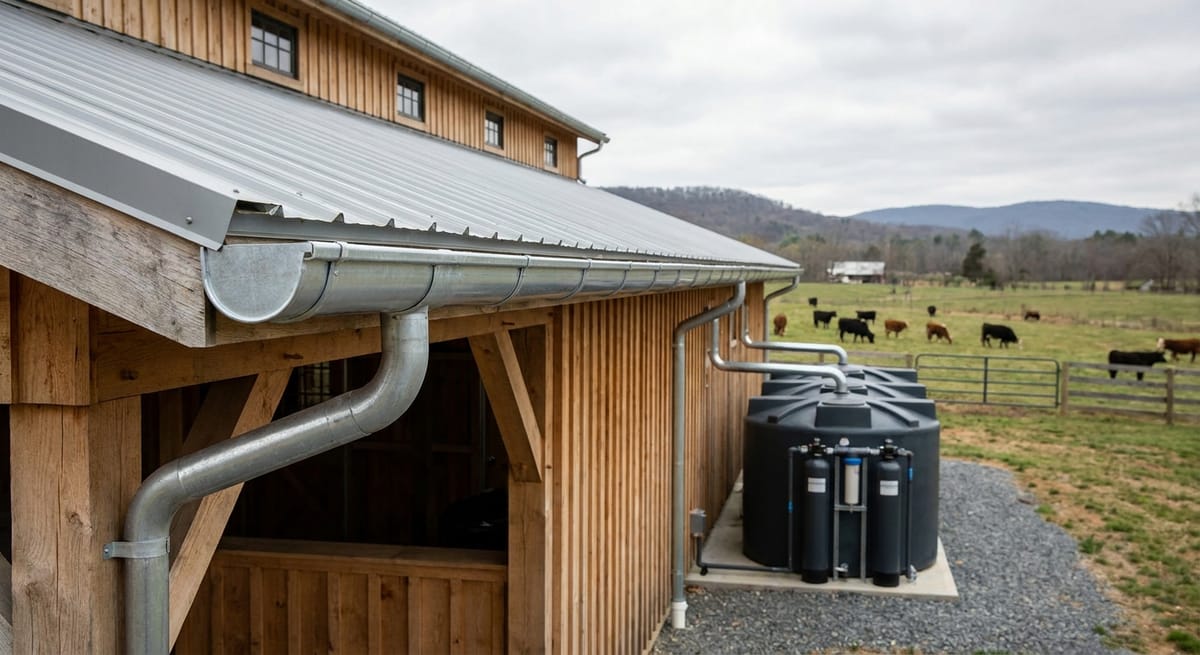
Every 10 mm of rain on a 50 m² barn roof is 500 litres of water — that is straightforward arithmetic, and it is why gutters and an elevated tank are one of the best-value additions to any animal shelter. Paired with automatic float valves or nipple drinkers, a gravity-fed supply eliminates daily water hauling and keeps animals hydrated through any pump or power failure. The rainwater harvesting guide covers tank sizing, first-flush diverters, and keeping stored water clean.
Key takeaways
- Off-grid livestock housing fails most often because of static design — build modular from the outset, with isolation stalls, kidding pens, and brooding bays included even if they stand empty at first.
- Predator-proofing is the baseline, not a premium option: heavy-gauge galvanised welded mesh (minimum 1.5 mm), a buried dig apron of 30–40 cm, solid drop-bolts, and — in South African conditions — electric perimeter fencing and fine snake mesh over low openings.
- Price the build from real retailer listings before you start — corrugated sheeting, treated poles, and mesh are all listed online by Cashbuild and Builders — and budget the running costs separately, with feed as the largest line by a distance.
- Feed storage must be airtight, elevated, and rodent-proof from day one; damp grain grows mycotoxins that can poison a flock silently, and rats add disease to the theft.
- On-site fodder, treadle feeders, deep litter flooring, and roof-water harvesting are the four most effective ways to pull the monthly bill down — and all four are design decisions, not afterthoughts.
Frequently asked questions
What are the most common off-grid livestock housing mistakes to avoid?
The biggest off-grid livestock housing mistakes are designing for a fixed animal count with no expansion or isolation space, using lightweight chicken wire instead of heavy-gauge welded mesh, skipping the underground dig apron, storing feed in unsealed sheds, and getting ventilation wrong — either sealing a coop tight or building it too open. Every one of them is cheap to avoid at the design stage and expensive to fix afterwards.
How much does off-grid livestock housing cost in South Africa?
The build cost is materials-driven and easy to price: draw up a cutting list of poles, sheeting, and mesh, then price it against current Builders or Cashbuild listings, because prices shift with steel and timber markets and vary by branch. The running cost of off-grid livestock housing is feed-driven and recurring — price a month of feed, bedding, and parasite control at your local co-op before committing to animals.
What wire mesh should I use for predator-proof animal housing?
Use heavy-gauge galvanised welded mesh with a minimum wire thickness of 1.5 mm. Standard hexagonal chicken wire is designed to contain poultry, not to stop predators — jackals and honey badgers breach it quickly. Bury a dig apron of the same mesh 30–40 cm outward at the base of every wall, and in high-pressure areas add electric perimeter fencing off a proper livestock energiser.
How do I stop rodents contaminating my livestock feed?
Never store feed in paper sacks inside a wooden shed. Use sealed galvanised bins or a purpose-built store with a concrete floor, elevate containers, and close any gap wider than about 12 mm. Pair sealed storage with treadle feeders inside the coop so spilled grain never accumulates — spillage is what draws rodents into off-grid livestock housing in the first place, and rats bring leptospirosis with them.
What is the deep litter system and does it actually work off-grid?
The deep litter system layers fresh high-carbon material — dry shavings, chopped straw, autumn leaves — over droppings instead of weekly muck-outs. Microbial activity breaks the manure down in place, keeping the floor dry and low-odour while generating gentle warmth in winter. It suits off-grid livestock housing particularly well because it cuts labour and bedding costs, and the annual clear-out produces excellent compost for vegetable beds.
Housing is only one corner of keeping animals well. The animals pillar gathers the rest — from bees to the hard lessons — so the next build starts from what actually works, not from a textbook drawing.