Journal
Mulching for Off-Grid Homesteads: The Essential Guide
In short
- Mulching is the highest-return, lowest-tech practice on an off-grid homestead: a thick organic layer sharply cuts soil evaporation, easing your irrigation load and water-tank draw-down.
- South Africa’s agricultural byproducts — macadamia shells, sugarcane bagasse, alien wattle woodchips — are world-class mulch materials, often available cheaply or free near where they’re processed.
- The doughnut rule (never pile mulch against plant stems) and the right depth for the material are the two techniques that separate thriving homestead beds from rotting, pest-ridden ones.
What’s in this guide
- What does mulch actually do to your soil?
- Which mulch materials does South Africa produce best?
- Which mulch strategy suits your South African climate zone?
- What does mulch cost in South Africa?
- How do you apply mulch correctly on a homestead?
- How do you generate your own mulch on-site?
- Key takeaways
- Frequently asked questions
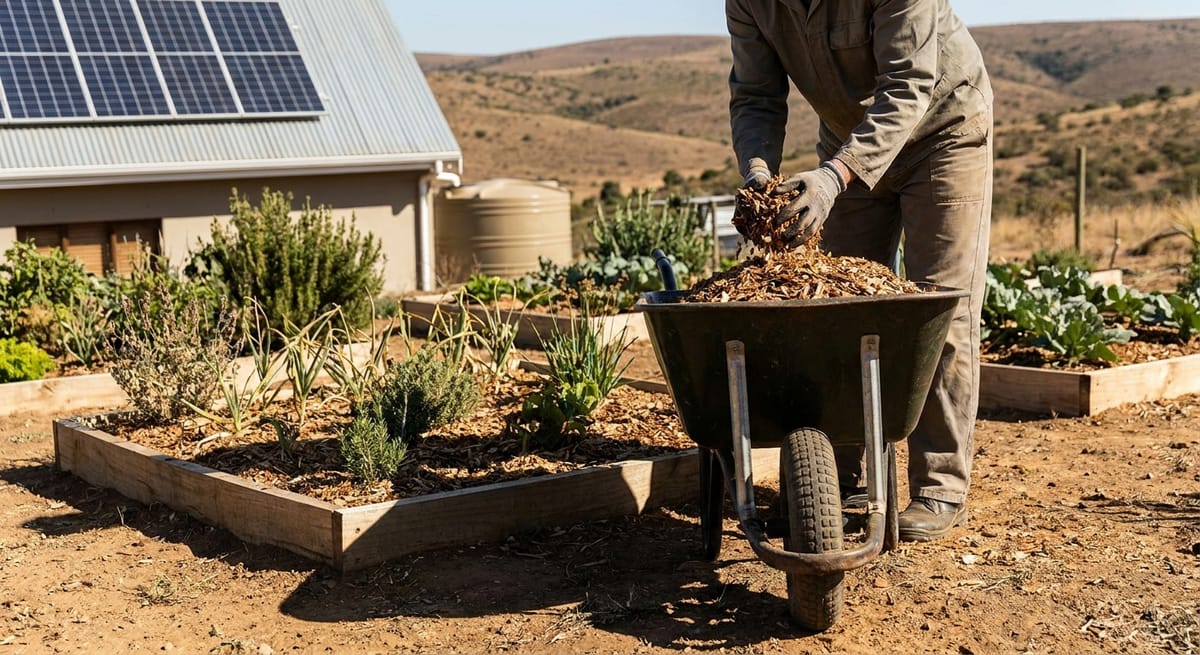
Mulching off-grid is, without question, the highest-return, lowest-tech practice on any homestead — and it’s almost always the most underrated. When people talk about off-grid energy efficiency they reach for solar array specs and battery bank calculations. But the most critical biological energy battery on your property sits directly beneath your feet: the soil.
Bare soil is an ecological emergency. Exposed to direct sunlight, thermal stress, and driving winds, it bleeds moisture, bakes its microbial networks to death, and loses all structural integrity. In South Africa — and across arid regions like the Australian Outback, the American Southwest, and Southern Europe — uncovered soil behaves like an uninsulated house during a blizzard. It haemorrhages system efficiency at exactly the moment you can least afford it.
Whether you’re managing a Western Cape vegetable garden, an Mpumalanga Lowveld orchard, or a Karoo dry-land homestead, mastering mulch is non-negotiable for genuine food security and self-reliance.
What does mulch actually do to your soil?
Mulch acts as biological armour: it sits on the soil surface, intercepting solar radiation and wind, buffering root-zone temperatures, holding moisture in the profile, and feeding the microbial life below. Covered soil stays cooler, wetter, and biologically active far longer than bare ground — which is why the FAO lists permanent soil cover among the founding principles of conservation agriculture.
Moisture retention
Every litre of water pumped from a borehole costs solar or battery energy; every litre drawn from a rainwater tank shrinks your drought buffer. A 75–100 mm layer of organic mulch breaks the capillary action that pulls moisture from deep soil up to the surface, where sun and wind strip it away. Mulched soil in a warm climate holds water for weeks longer than bare ground — a direct reduction in your electrical pumping load.
Thermal regulation
Soil biology operates in a narrow temperature window. Root growth and microbial processing slow markedly below about 10 °C; the biological sweet spot sits roughly between 20 °C and 30 °C; beneficial microbes begin dying off as soil passes about 45 °C. On bare ground across the South African Highveld, summer surface temperatures can climb well past those limits on a hot afternoon. A thick coarse mulch layer holds the root zone inside the comfort band — plants keep photosynthesising and growing straight through a heatwave.
The C:N ratio — nitrogen tie-up explained
The carbon-to-nitrogen (C:N) ratio determines how quickly a mulch breaks down and whether it temporarily steals nitrogen from your plants. High C:N materials (woodchips, straw, pine bark) decompose slowly and can starve roots of nitrogen if you till them into the soil — kept on the surface as a shield, the drawdown is minimal. Low C:N materials (lucerne, fresh grass clippings, sugarcane bagasse) break down quickly and supply immediate nitrogen, but need more frequent topping up.
| Bare Soil | Mulched Soil |
|---|---|
| Moisture evaporates rapidly from the surface | Evaporation sharply reduced; moisture held for weeks |
| Summer surface temperatures hot enough to kill microbes | Root zone buffered inside the biological comfort band |
| Severe crusting and erosion | Soft, porous, water-absorbing surface |
| High weed emergence | Most weed seed never sees the light it needs to germinate |
| Nutrients wash away in storms | Slow-release organic feeding |
Which mulch materials does South Africa produce best?
South Africa holds a genuine advantage here: its forestry, sugarcane, and nut-processing industries generate exceptional mulch byproducts — macadamia shells, bagasse, pine bark, alien wattle woodchips — often at a fraction of what growers in the UK or USA pay for comparable materials. The smart move is sourcing them close to where they’re processed.
South African specialty materials
- Macadamia nut shells (Mpumalanga, Limpopo, KZN, Southern Cape) — extraordinarily hard and extremely carbon-rich, so a layer lasts for years. Perfect for permanent pathways, food-forest beds, and windy sites where lighter mulches take flight.
- Sugarcane bagasse & trash (KZN, Mpumalanga Lowveld) — fibrous pulp left after juice extraction. High moisture absorption; breaks down into rich dark humus within a season or two. Excellent earthworm habitat.
- Alien invasive woodchips (nationwide, via alien-clearing initiatives such as Working for Water) — abundant, carbon-rich, and essentially an ecological win-win: sourcing wattle chips clears thirsty invasive trees from water catchments while giving you free soil-moisture retention. If you’re clearing wattle anyway, some of it is better value converted to soil carbon another way — see making biochar from wattle.
- Rooibos tea processing waste (Cederberg, Western Cape) — fine, aromatic, slightly acidic. Ideal for blueberries, acid-loving ornamentals, and urban permaculture boxes.
- Peach pips & pecan shells (Klein Karoo, Free State, Northern Cape) — ultra-durable and heavy enough to resist fierce Karoo winds. Great for arid-zone orchards and drought-hardy landscaping.
International equivalents (and where SA wins)
- Wheat/oat straw (Europe, North America) — the global vegetable-garden standard. In South Africa, Eragrostis hay, lucerne, or sugarcane bagasse are direct functional equivalents.
- Shredded cedar/hardwood (USA, Canada) — cedar’s natural oils repel insect pests. SA’s closest equivalent: pine bark or eucalyptus chips, with similar longevity and weed suppression.
- Cocoa shell mulch (UK, Western Europe) — nitrogen-rich, chocolate-scented, but expensive and toxic to dogs. Macadamia shells or rooibos waste offer similar byproduct benefits with zero risk to homestead livestock.
- Inorganic rock and gravel (American Southwest, Mediterranean, Australia) — heavy stone collects morning dew condensation and insulates roots. This directly mirrors traditional dry-land farming in the Karoo and Kalahari.
Which mulch strategy suits your South African climate zone?
No single mulch suits the whole country. An arid Karoo plot, a winter-rainfall Cape garden, a humid KZN smallholding, and a frost-bitten Highveld bed each punish the wrong mulch in a different way — wind theft, waterlogged rot, runaway decomposition, frozen roots. Match the material and depth to your biome and the layer works with your climate rather than against it.
| Climate Zone | Primary Challenge | Recommended Mulch System |
|---|---|---|
| Arid Interior (Karoo / Kalahari) | Extreme sun, high heat, fierce drying winds | 50 mm gravel/stone over 75 mm coarse pecan/peach pip layer |
| Winter Rainfall (Western Cape) | Wet winter root rot, dry summer baking | Coarse pine bark or rooibos waste — high-permeability materials |
| Subtropical Coast (KZN / Lowveld) | High humidity, rapid decomposition, fungal growth | Thick sugarcane bagasse or macadamia shells at 100–120 mm depth |
| Summer Highveld (Gauteng / Free State) | Severe winter frost, baking summer afternoons | Layered Eragrostis hay / straw as insulating thermal blankets |
Arid Interior: Apply a 75 mm base of coarse organic material (pecan shells, woodchips, or peach pips), then cap with 30–50 mm of river gravel or crushed stone. The stone layer pins the organics down against wind, and acts as a thermal condenser that drips morning dew directly into the root zone.
Western Cape: Heavy winter rains create conditions ripe for fungal root rot if mulches become waterlogged and anaerobic. Coarse-milled pine bark or chipped branch wood drains freely during winter downpours, then seals in deep soil moisture when the South-Easter starts blowing in summer.
KZN / Lowveld: High heat combined with high humidity accelerates decomposition dramatically. A mulch that lasts years in a dry climate may be gone within months here. Go thick — 100–120 mm minimum — and replenish regularly to maintain a continuous supply of decaying organic matter feeding your soil food web.
Highveld / Drakensberg Foothills: Severe black frosts can freeze the upper soil layers and devastate perennial roots. Apply thick carbon-rich straw or grass hay in late autumn to act as a winter insulation blanket, allowing winter greens, garlic, and brassicas to keep growing through cold snaps.
What does mulch cost in South Africa?
Less than almost anywhere else — if you buy at the right point in the chain. Bagged nursery mulch carries a retail premium, bulk loads from landscaping suppliers cost far less per cubic metre, and arborists or alien-clearing teams will often tip a load of woodchips for little more than the favour of taking it.
Two verified price points show the spread. At the retail end, Darling Organics in Cape Town lists a 30 dm³ bag of composted milled pine bark at R50 (listed price, August 2026). At the bulk end, Builders Merchant’s delivered landscaping bark works out to roughly R1,200–R1,800 per cubic metre depending on load size — a 3 m³ load listed between R4,095 and R5,350, and 15 m³ between R17,485 and R21,500 (listed prices, August 2026). The lesson is in the gap: the same material costs several times more per litre in a nursery bag than on a tipper.
Prices for the more regional materials — macadamia shells, bagasse, Eragrostis and lucerne bales, peach pips — move with the season, the harvest, and your distance from the processor, so don’t take a number from the internet (including this site). Phone the co-op, mill, or canning factory nearest you and price a load delivered.
| Mulch Type | Typical Form | Best Sourcing Channel |
|---|---|---|
| Pine bark (milled/fine) | 30 L bag | Local nursery / hardware store |
| Pine bark / rough mulch | Bulk tipper load | Landscaping supplier / sawmill |
| Macadamia nut shells | Bags or bulk | Processing co-ops / nurseries |
| Woodchips (unrefined) | Bulk tipper load | Arborists / tree fellers / alien-clearing teams |
| Eragrostis / lucerne hay | Square bale | Agricultural co-op / farmers |
| Peach pips | Bags | Canning factories / specialty suppliers |
For international context: growers in the USA, UK, and Australia routinely pay full retail rates for the same class of material that South African processors treat as waste. If you can source from arborists, sawmills, or alien-clearing programmes, you’re playing the game on the easiest setting — often for nothing but the diesel to fetch it.
How do you apply mulch correctly on a homestead?
Correct application is where most homesteaders either win or lose. Depth matters, and contact with stems matters more: the classic mistakes — mulch volcanoes against trunks, fine material laid too thick, weed-seeded hay on clean beds — trap moisture where it rots stems, or block water from ever reaching the soil. The rules below prevent all of them.
The doughnut rule vs. the volcano disaster
Never pile mulch directly against tree trunks or plant stems — this is called a “mulch volcano” and it creates a perfect environment for collar rot, fungal infection, and rodent damage. Always leave a 50–100 mm bare gap around the base of every tree, shrub, and vegetable stem. Shape your mulch like a flat doughnut: root flare exposed to air, surrounding root zone covered.
Depth guidelines
- Fine mulches (compost, milled bark, rooibos waste): 30–50 mm. Finer materials pack tightly and block water infiltration if applied too deep.
- Coarse mulches (woodchips, macadamia shells, coarse bark): 75–100 mm. Larger air spaces mean you need a thicker layer to block sunlight and prevent weed germination.
- Inorganic mulches (gravel, crushed river stone): 50–75 mm over permeable geotextile or cardboard.
Sheet mulching (lasagna gardening) for new beds
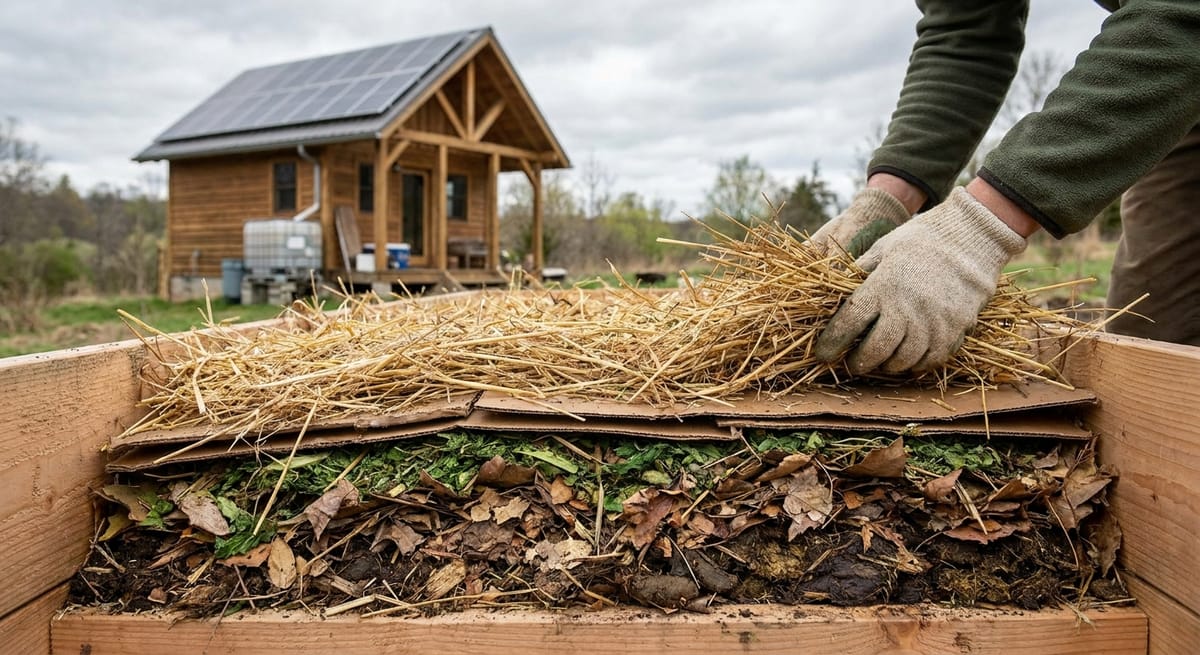
Building new beds on tough, uncultivated veld doesn’t require a diesel tiller or a broken back. Sheet mulching suppresses weeds and builds fertile topsoil simultaneously — it’s the gentlest possible way of starting a vegetable garden on raw ground. Build this layered stack from the ground up:
- Scalp and water: Cut down weeds or grass and water the plot thoroughly.
- Cardboard barrier: Lay thick, non-waxed corrugated cardboard over the entire area, overlapping edges by at least 150 mm. Water it damp.
- Nitrogen layer (green): 25–50 mm of manure, fresh grass clippings, or green compost.
- Carbon layer (brown): 50–75 mm of chopped dry leaves, bagasse, or straw.
- Top protective mulch: 50 mm cap of coarse woodchips, pine bark, or macadamia shells.
Within a season or two, earthworms and soil microbes break down the cardboard and organic layers into rich, sponge-like topsoil — without turning a single spade of earth.
How do you generate your own mulch on-site?
True self-reliance means producing as much mulch as possible on the property itself, so the supply never depends on a supplier, a bakkie, or a budget. Chop-and-drop species, a small chipper for prunings and cleared bush, used livestock bedding, and crop residues can close the loop on almost any plot with a bit of planning.
Chop-and-drop agroforestry
Plant fast-growing, nitrogen-fixing pioneer species specifically to serve as mulch crops:
- Pigeon pea (Cajanus cajan): Drought-hardy, deep-rooted legume that produces abundant woody green biomass. Prune heavily two or three times a year and drop branches directly onto surrounding beds.
- Comfrey (Symphytum officinale): A dynamic accumulator with deep taproots that mine subsoil minerals. Cut the large nutrient-dense leaves every few weeks to mulch vegetable beds.
- Vetiver grass (Chrysopogon zizanioides): Plant along contours for erosion control; trim the long, tough leaves twice a season to yield high-carbon, wind-resistant mulch.
On-site wood chippers
A small petrol or tractor PTO-driven wood chipper pays for itself remarkably quickly on an off-grid property. Use it to process orchard prunings, cleared alien vegetation, and bush-encroachment branches into high-value woodchips on demand. Other closed-loop sources include used livestock bedding (straw plus manure mix) and crop residues like maize stalks and pumpkin vines.
Key takeaways
- A 75–100 mm coarse mulch layer dramatically reduces surface evaporation, directly cutting your pumping energy and water storage demands.
- South Africa’s agricultural byproducts — macadamia shells, sugarcane bagasse, alien wattle woodchips — are world-class mulch materials, often available cheaply or free from processors, arborists, and alien-clearing programmes.
- Always match mulch type and depth to your climate zone: arid interiors need a stone-cap hybrid; subtropical coasts need thick, fast-replenished organics; the Highveld needs straw insulation blankets before frost arrives.
- Never create a mulch volcano against plant stems — the doughnut rule (a 50–100 mm bare gap) is the single most important application technique on any homestead.
- Sheet mulching converts raw, weedy veld into fertile planting beds within a season or two, using zero machinery and whatever organic waste your homestead generates.
- Buy at the right point in the chain: bagged retail mulch costs several times more per litre than a bulk tipper load, and arborists or clearing teams will often deliver woodchips for next to nothing.
- Long-term, the goal is a closed-loop on-site mulch system: chop-and-drop species, a wood chipper, crop residues, and livestock bedding replacing commercial purchases entirely.
Frequently asked questions
Does mulching with high-carbon materials like woodchips deplete soil nitrogen?
Only if you make the mistake of tilling the material into your soil. When mulch is kept as a surface shield, the biological nitrogen drawdown is restricted to the thin interface where it meets earth — the deeper root zone remains fully nourished. For nitrogen-hungry annuals, simply spread a layer of compost or manure before capping with your carbon-heavy mulch.
Will thick organic mulch attract termites to my South African homestead?
Organic mulch does create a damp, carbon-rich habitat that can draw termites if it contacts untreated timber or building foundations. Maintain a metre-wide mulch-free defensive zone around all wooden structures using paving or river gravel, apply the doughnut gap strictly around all tree trunks, and in high-risk areas opt for pest-resistant materials like macadamia shells, pine bark, or inorganic stone layers.
How do I manage mulch safely during South Africa’s fire season?
Fine bark, dry leaves, and straw are volatile fuels during Western Cape summers or Highveld winter droughts. Keep loose organic mulch well clear of buildings — several metres at minimum; use river stone, gravel, or fire-resistant succulents like spekboom in those critical zones. Cap dry organic layers with heavy gravel to suppress airborne embers, and keep mulched areas near infrastructure moist on high-danger days.
How often do I need to top up mulch in different South African regions?
In arid zones like the Karoo and Kalahari, coarse mulch materials like macadamia or pecan shells can last several years. On the subtropical KZN coast or in the Lowveld, decomposition is so rapid that sugarcane bagasse may need topping up more than once a year. The Western Cape and Highveld typically fall somewhere in between — expect to refresh organic layers annually, usually in autumn before the critical season ahead.
Can I use alien invasive woodchips for mulch without harming my garden?
Yes — and you should. Black wattle (Acacia mearnsii) and eucalyptus woodchips are abundant, carbon-rich, and produced in volume by alien-clearing programmes such as Working for Water. Applied as a surface mulch (not tilled in), they present no allelopathic risk to most established plants and are a genuine ecological double-win: clearing thirsty invasives from catchment areas while building your soil’s moisture retention for free.
Want to go deeper on building a genuinely self-sufficient homestead water and soil system? Start with the rest of the grow pillar, then look at rainwater harvesting — every system on the property works better when the soil underneath it is properly protected and alive.