The Still Room
A pantry that rotates: three months of food that does not go to waste
Not a bunker. A deeper version of the cupboard you already have, sized by arithmetic rather than by anxiety, and rotated so nothing is ever thrown away.
The short answer
A three-month food store should be built from the food you already eat, not from specialist rations. Size it by taking what it costs to feed your household for one day and multiplying by seven, then repeating that weekly for twelve weeks. In South African conditions the binding constraint is not shelf life — it is weevils and humidity, which the imported storage lists almost never address.
There is a version of this subject that involves buckets in a cellar and a great deal of anxiety. This is not that.
The most durable framework we have found comes from a source most people would not think to look at, and it is worth being open about where it came from: the food storage guidance published by the Church of Jesus Christ of Latter-day Saints. Set the theology entirely aside — as a piece of household logistics it is the best-documented system in the world, it has been refined over decades, and almost all of it is published openly.
Three things stand out, and all three run against how preparedness is usually written.
Three legs, not one
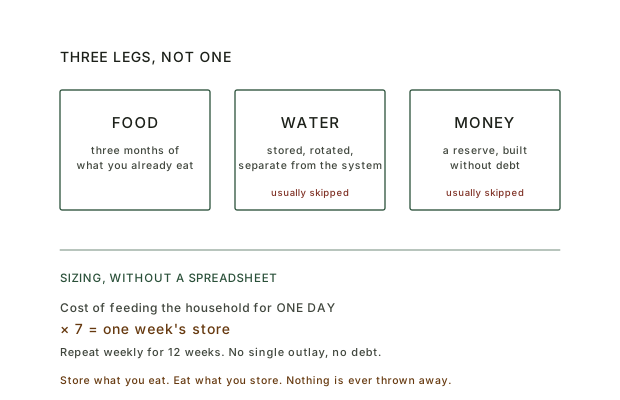
The guidance is explicit that a household store has three components, not one: food, water, and a financial reserve. Almost everything written about preparedness covers the first and ignores the other two, which is odd, because a month's expenses in the bank will get most households through far more real-world disruptions than a shelf of tinned food.
Store what you eat, eat what you store
The three-month supply is explicitly food from your normal diet. Not freeze-dried rations, not a sealed bucket you will never open. The things you actually cook with, in greater quantity, rotated through the kitchen so the oldest is always the next one used.
This single principle is what makes the difference between a store and a write-off. A cupboard of unfamiliar emergency food will sit until it expires and then be thrown away. A deeper version of your ordinary cupboard costs nothing extra over time, because you were going to buy the food anyway — you have simply bought it earlier.
How to size it without a spreadsheet
The method is disarmingly simple, and it is the reason the system works for ordinary households: take what it costs to feed your family for one day, and multiply it by seven. That is one week's store. Buy it. Next week, do it again.
Twelve weeks of that and you have a three-month supply, built incrementally, with no single large outlay and no debt. The published guidance is emphatic on this point — build gradually, do not borrow to do it, and in its own words, you should not go to extremes.
The long-term staples, and why the imported list is wrong here
The published long-term list is wheat, rice, pasta, oats, beans and potatoes — items which, correctly stored, are said to last thirty years or more.
That list is northern-hemisphere. The South African pantry is maize meal, samp, dried beans, rice, oil, sugar and salt, and the difference is not cosmetic. Maize meal in particular does not behave like wheat berries: it is milled, it carries more oil, and it goes rancid rather than simply ageing.
And our real enemy is not time. It is weevils and humidity. Almost every imported storage guide is written for a dry, cool climate and treats infestation as a footnote. In an inland South African summer, an unprotected bag of maize meal will be alive within a season.
Where to put it
- Not the garage and not the roof space. Both cycle 20 °C or more in a day here, and temperature cycling is what ages food fastest.
- The coolest interior wall you have, off the floor, out of direct light.
- Sealed food-grade containers for anything bulk. Original packaging is fine for the three-month rotating supply, because it is being eaten.
- Label everything with the date it was bought, not a best-before. You are managing rotation, not expiry.
Water, which everybody skips
The guidance is plain: sturdy, leak-proof, breakage-resistant containers, stored cool and dark, and pre-treated if the source is not already treated.
On a property with a borehole or tanks this looks like a solved problem. It is not — a borehole without power is a hole in the ground, and municipal supply failing is precisely when you need stored water. Keep some genuinely stored, separate from the system, and rotate it.
What this is not
It is not a response to a threat, and we are not going to sell you one. It is the same logic as keeping a spare tyre: cheap, dull, and occasionally the difference between an inconvenience and a crisis.
The guidance we drew on says it better than we would: build gradually, without debt, and do not go to extremes. That is the whole of it.