Journal
Grey Water Systems: The Essential Off-Grid Guide
In short
- Grey water systems reroute bath, shower, basin, and laundry water to your garden — typically the largest recoverable water stream in an off-grid household, and the most commonly wasted.
- A gravity diverter is the cheapest entry point; on verified August 2026 pricing, pumped kits start around R5,820 (Garden ResQ) and full treatment units run to roughly R77,500 and beyond (Sustainable.co.za).
- South African law has teeth here: stored grey water must be used within 24 hours, it may never pool on the surface, and anything beyond a direct diverter needs municipal approval under SANS 10252-2.
What’s in this guide
- What exactly is grey water — and why should off-grid homesteaders care?
- How does a direct-to-garden grey water system work?
- When do you need a surge tank grey water system?
- What about treated and biological grey water systems?
- What do grey water systems cost in South Africa?
- What does South African law require for grey water systems?
- Which soaps and detergents are safe for grey water systems?
- Key takeaways
- Frequently asked questions
Grey water systems are, without question, one of the most underrated infrastructure upgrades on an off-grid homestead. On any property running off boreholes, wells, or rainwater tanks, water security sits second only to power generation in determining long-term productivity — and yet most homesteaders let a substantial share of their indoor water vanish straight into a septic drain field.
Roughly half of what a household uses indoors leaves as grey water: used water from showers, baths, hand basins, and washing machines. A three-person household typically produces somewhere between 150 and 250 litres of it a day — our pillar guide on how a greywater system works and what the law requires unpacks that arithmetic, along with the by-laws. Every litre you pump from a borehole burns battery capacity or generator fuel. Every litre you drain into the soil unused is a litre your dry-season buffer will miss.
This guide walks through the three primary grey water pathways, what each one genuinely costs in South Africa on prices we checked in August 2026, and the rules you must design around before you pick up a shovel.
What exactly is grey water — and why should off-grid homesteaders care?
Grey water is household waste water from baths, showers, hand basins, and laundry — high in volume, low in pathogens, and reusable for irrigation. It is distinct from black water, which has contacted a toilet and requires full septic treatment. That distinction is the foundation of every grey water system design.
| Water type | Sources | Pathogen risk | Off-grid treatment path |
|---|---|---|---|
| Fresh water | Rainwater, borehole, spring | Low (drinking quality) | Drinking, cooking, stock watering |
| Grey water | Showers, baths, basins, laundry | Low–moderate | Gravity diversion, surge tank, or treatment system |
| Black water | Toilets — plus kitchen sinks and dishwashers, which most SA municipalities treat as black water | High | Septic tank or composting toilet — never a grey water system |
Note the kitchen sink. Fat, food solids, and the pathogen load from raw-meat preparation push kitchen and dishwasher water toward black water treatment under most South African by-laws. Stick to the four established sources — bath, shower, basin, laundry — and you are working in well-understood territory.
Managed correctly, grey water gives you a steady irrigation stream for fruit trees, windbreaks, and ornamental beds that tracks your household’s daily rhythm rather than the weather. It is not a complete water strategy on its own — it complements rainwater harvesting and a borehole rather than replacing them — but letting it flush straight into a drain field is an entirely avoidable loss.
How does a direct-to-garden grey water system work?
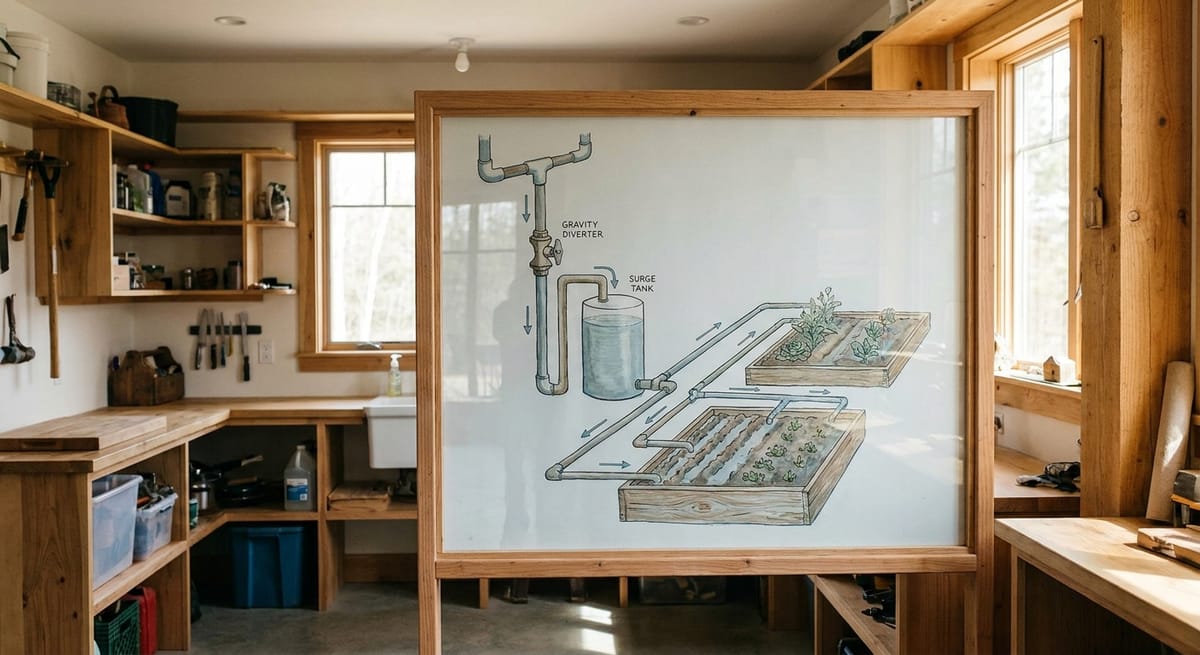
A direct-to-garden system fits a diverter valve to a bath, shower, or laundry outlet and routes the water straight into mulch basins or sub-surface irrigation lines — no storage, no pump, no electricity. Gravity does all the work, which is why it is the cheapest and most reliable of all grey water systems.
How it works
- A three-way diverter valve is fitted to the drain line leaving the bathroom or laundry.
- When garden-friendly soaps are in use, the valve sends water through smooth-bore 40mm–50mm piping out to the garden.
- Water discharges beneath 75mm–100mm of woodchip or gravel mulch around fruit trees; soil microbes process the organic traces before pathogens can build up.
- When bleach or harsh chemicals go down the drain — or when someone in the house is ill — you flick the valve back to sewer. Simple.
Pros and cons
- Pros: Lowest possible cost; zero electricity; no pumps to fail; no stored water, so the 24-hour rule is trivially satisfied.
- Cons: Garden beds must sit downhill from the outlet; you can only irrigate while someone is actually bathing or washing; sub-surface discharge only; manual valve switching.
On cost: the parts are a diverter valve, pipe, and fittings from any plumbing merchant, and prices move with pipe runs and fittings — price your own materials list rather than trusting a generic figure. Budget separately for the plumber, because in South Africa a diverter is a plumbing alteration that requires a certificate of compliance — more on that below.
When do you need a surge tank grey water system?
You need a surge tank when gravity cannot do the work — when the garden lies uphill or far across flat ground, or when the household bathes in the morning and you want to irrigate in the evening. The tank buffers the water; a pump moves it. That flexibility comes with rules attached.
How it works
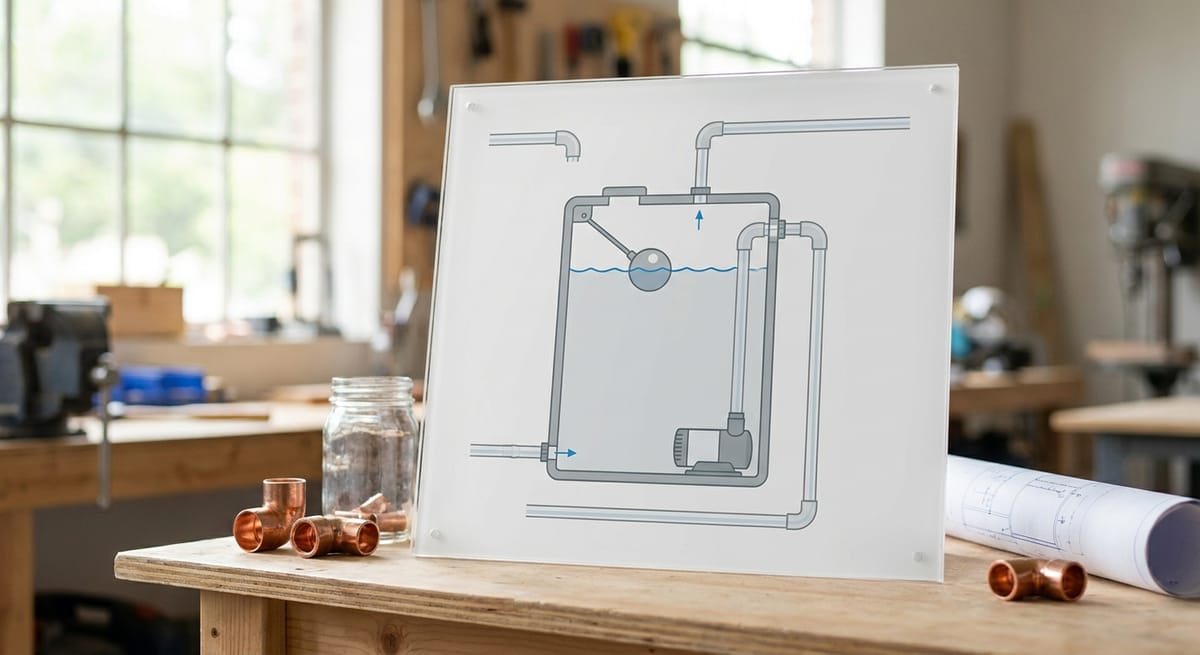
- Grey water drains into a vented surge tank, typically 100 to 500 litres.
- A coarse mechanical filter — basket sieve, brush filter, or foam core — captures hair and lint before it reaches the pump.
- As the tank fills, a float switch triggers a submersible pump, discharging the tank’s contents to garden drip lines within minutes.
- The tank returns to empty on every cycle — which is precisely how it complies with the 24-hour rule. An oversized tank is not a bigger reserve; it is a vessel of slowly fermenting water that will get the whole system abandoned.
Pros and cons
- Pros: Overcomes flat or uphill topography; absorbs peak flow from family bath time; lets you irrigate at a sensible hour.
- Cons: The pump draws power in bursts, and a load-shedding outage that spans the storage window leaves you with a compliance problem and a smell problem — favour gravity or put the pump on backup power. Filters need cleaning every couple of weeks, and impellers clog if hair gets past them.
On real pricing: Garden ResQ, the Fish Hoek supplier whose kits have been a fixture of the SA grey water market for years, listed its automated Maxi Pro system at R5,820 plus delivery (from R275 by post) on its own site in August 2026. At the next tier, Sustainable.co.za listed the Ecogator 120L surge system at R11,818.95 on sale against a regular price of R14,774 in the same month. Water Rhapsody’s Garden Rhapsody is the other established name in this bracket — they quote per installation rather than publishing prices.
What about treated and biological grey water systems?
If you want to store grey water beyond a day, flush toilets with it, or irrigate above-ground food crops, raw grey water is not safe — it must be treated. Treatment systems strip organic matter and neutralise pathogens, and they range from planted gravel beds to fully automated membrane units.
Option A: constructed wetlands and reed beds
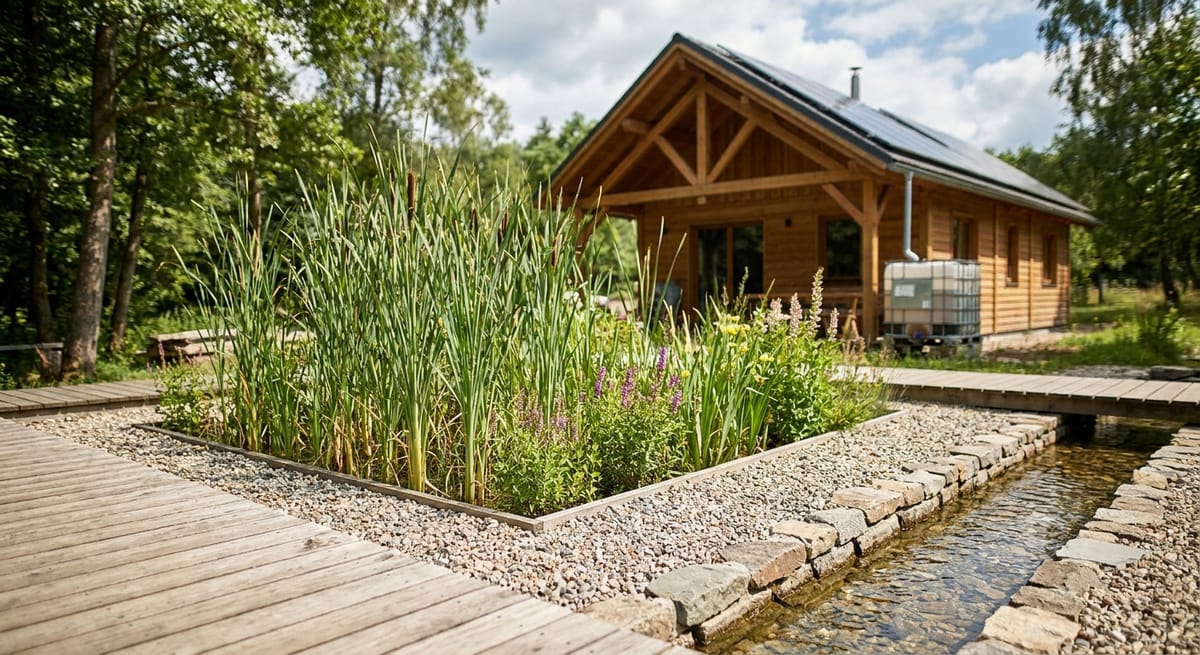
Grey water passes through a lined gravel basin planted with reeds and other wetland species; microorganisms on the gravel and root surfaces digest soaps, organic pollutants, and nitrates. Gravity-fed, it needs no grid power and no chemicals — and it doubles as habitat. Costs are dominated by earthworks and liner, so they vary widely with your site; we cover the design in detail in our constructed wetland guide.
Option B: membrane bioreactors and UV systems
Grey water enters a primary tank with aeration, passes through hollow-fibre micro-membranes, and receives UV disinfection. The result is clear, odourless water suitable for toilet cisterns and washing machines. Compact and automated — but the price reflects it, and it draws power continuously. For a verified benchmark: Sustainable.co.za listed the INTEWA Aqualoop AL300 treatment system at R77,546.95 on sale, against a regular price of R104,688, in August 2026.
One caution before you fall for the closed-loop dream: reusing treated grey water inside the house raises the regulatory bar meaningfully. Formal municipal approval is required everywhere, and depending on volumes, indoor reuse may need a water use licence under the National Water Act. Check before you buy, not after.
What do grey water systems cost in South Africa?
Grey water systems in South Africa run from a modest parts list for a gravity diverter to six figures for a top-end treatment unit. The table below sticks to prices we actually verified on supplier sites in August 2026 — where no verified figure exists, it says so rather than guessing.
| System level | Verified SA benchmark (August 2026) | Energy draw | Best off-grid application |
|---|---|---|---|
| DIY gravity diverter | Valve, pipe, and fittings from any plumbing merchant — price your own list, and budget for the plumber’s certificate | Zero | Cabins and houses with beds or trees downhill |
| Automated pumped kit | R5,820 — Garden ResQ Maxi Pro, supplier’s own listing | Low (pump bursts) | Flat land, orchard drip lines |
| Commercial surge system | R11,818.95 (list R14,774) — Ecogator 120L at Sustainable.co.za | Low (automated bursts) | Turnkey homestead garden feed |
| Constructed wetland | Site-dependent — earthworks and liner dominate; get local quotes | Zero to low | Homesteads with space and gravity fall |
| Membrane treatment unit | R77,546.95 (list R104,688) — INTEWA Aqualoop AL300 at Sustainable.co.za | High (continuous) | Whole-house reuse including toilets |
Overseas kit prices you will find on American and British sites do not translate into SA landed costs once shipping, duties, and support are added — compare against local suppliers first.
What does South African law require for grey water systems?
Three rules govern grey water in South Africa: stored grey water must be used within 24 hours, it may never pond on the surface, and any system beyond a direct diverter needs approval from your municipality. The framework is SANS 10252-2, read with the National Building Regulations and your local by-law.
- The 24-hour rule. SANS 10252-2 requires that stored grey water be used within 24 hours of collection. This is biology, not bureaucracy — in a warm tank, bacterial load climbs fast, and South African ambient temperatures accelerate the curve. Size tanks to your actual daily production so every cycle empties them.
- No surface ponding. Grey water must discharge below mulch, into sub-surface lines, or directly onto root zones where it absorbs immediately. Pooling water is a human-contact and mosquito-breeding vector, and your municipality will treat it as a public health matter.
- Certificates and approvals. A diverter valve is a plumbing alteration, so a registered plumber’s certificate of compliance is required even for the simplest system. Any system that stores grey water — a surge tank of any size — needs municipal approval in most metros, and treated systems need formal approval everywhere. By-laws differ between metros, so phone your water and sanitation department before buying anything, and write down who you spoke to.
- Watercourses and boreholes. Keep discharge well away from streams, dams, and drinking-water boreholes, and never route grey water into a stormwater drain. Any discharge that could reach a watercourse falls under the National Water Act 36 of 1998 and needs authorisation regardless of system type.
If you are reading from the US or UK: both have their own codes — several American states regulate grey water at state level, and the UK regulates indoor reuse through its building regulations — so check your local rules; the principles in this guide travel, but the paperwork does not.
Which soaps and detergents are safe for grey water systems?
Your grey water system is only as healthy as what goes down your drains — and this matters more in South Africa than almost anywhere, because our detergent market is dominated by high-sodium formulations. Sodium displaces the calcium that holds clay soils together, leaving compacted, water-shedding ground after months of irrigation. Boron, present in many dishwasher and laundry products, is toxic to beans, stone fruit, and most vegetables at low concentrations. Chlorine bleach kills the very soil organisms doing your treatment for you.
The fixes are practical: switch to low-sodium, boron-free products marketed as “greywater safe” before the first drop reaches a bed; apply gypsum (calcium sulphate) to irrigated areas each season to displace accumulated sodium; and divert to sewer whenever bleach is used. And observe the root vegetable rule without exception — never apply untreated grey water to root vegetables or leafy greens where the edible part touches the soil. Keep it for fruit trees, berry bushes, windbreaks, and flowering beds.
Key takeaways
- Grey water systems recover the single largest reusable water stream in the house — roughly half of indoor use, or 150–250 litres a day for a typical three-person household — that would otherwise be lost to a drain field.
- Start with a direct-to-garden gravity diverter if your beds sit downhill: zero electricity, zero pumps, and the 24-hour rule satisfied by design. Only move to a surge tank when topography or timing genuinely demands it.
- On verified August 2026 pricing, an automated pumped kit starts around R5,820 (Garden ResQ Maxi Pro), a commercial surge system around R11,800–R14,800 (Ecogator 120L at Sustainable.co.za), and a full membrane treatment unit R77,500–R104,700 (Aqualoop AL300 at Sustainable.co.za).
- The law is not optional: a plumber’s certificate of compliance for any diverter, municipal approval for any system that stores grey water, use within 24 hours, no surface ponding, and National Water Act authorisation for anything that could reach a watercourse.
- Soap chemistry decides whether the system helps or harms — low-sodium, boron-free detergents are a prerequisite, gypsum repairs what sodium has already done, and untreated grey water never touches root vegetables or leafy greens.
- Size storage to your real daily production, not your aspirations — an oversized tank is the most common failure, because water that sits past 24 hours turns anaerobic and the system ends up abandoned.
Frequently asked questions
What are grey water systems and are they worth installing on an off-grid homestead?
Grey water systems capture used water from showers, baths, basins, and washing machines and redirect it to garden irrigation or, after treatment, indoor reuse. On an off-grid property, where every litre pumped costs battery power or fuel, they are worth it — recovering roughly half of indoor water use and providing an irrigation stream that tracks your household rather than the rainfall.
How does a direct-to-garden setup compare to a surge tank system?
The core difference is gravity versus mechanical pressure. A direct-to-garden grey water system drains passively into mulch basins — no power, no pumps, no stored water. A surge tank uses a float switch and submersible pump to push water uphill or across flat ground, and needs municipal approval because it stores grey water. Choose gravity wherever the topography allows it.
Why is the 24-hour rule critical for grey water systems?
Because raw grey water is warm, nutrient-rich, and biologically active. Stored beyond 24 hours, bacteria multiply on soap residue, skin cells, and lint until the water is closer to dilute sewage than to irrigation supply. South African heat accelerates this, which is why SANS 10252-2 makes 24-hour use a legal requirement — design every tank to empty on every cycle.
What soaps are safe to use with a grey water system?
Avoid the mainstream high-sodium powders, boron-containing products, and anything with chlorine bleach — sodium wrecks clay soil structure, boron poisons sensitive plants, and bleach kills soil organisms. Look for detergents labelled low-sodium or “greywater safe”, divert to sewer on bleach days, and apply gypsum to irrigated soil each season to undo accumulated sodium.
Can I use grey water on vegetable gardens?
Not untreated — never apply raw grey water to root vegetables or leafy greens where the edible part contacts the soil, because the pathogen risk is real. Restrict untreated grey water to fruit trees, berry bushes, windbreaks, and flowering beds. Irrigating food crops more broadly requires a proper treatment stage, and that brings formal municipal approval with it.
Ready to design your homestead water supply from the ground up? Grey water is one layer of a resilient system, not the whole of it — pair it with our guide to rainwater harvesting, and read the full greywater law and design guide before you connect anything.