Journal
Companion planting in South Africa: Evidence vs Folklore
In short
- Companion planting works when it uses a measurable mechanism (masking scent, feeding predators, fixing nitrogen, shading soil), not “likes and dislikes”.
- Marigolds and the Three Sisters are the best-evidenced pairings, but both come with South African caveats, especially heat and timing.
- Your province decides your pests, so choose companions for the pressure you actually have.
What’s in this guide
- What does the evidence actually support?
- Do marigolds really work in South African gardens?
- How do the Three Sisters actually work?
- Which pests should you plan for in each province?
- Which companions suit seven core vegetables?
- How do you design a resilient off-grid guild?
- Key takeaways
- Frequently asked questions
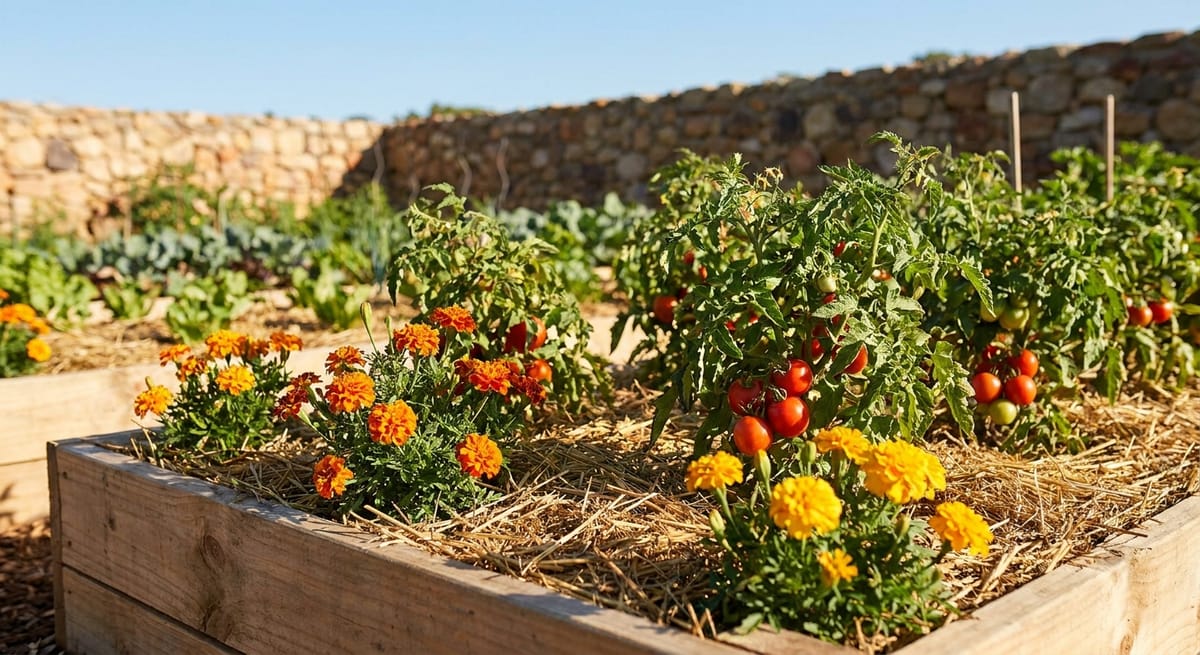
For off-grid homesteaders and self-sufficient growers, companion planting in South Africa is really an exercise in risk management. Between erratic rainfall, fierce summer ultraviolet radiation, municipal water interruptions and local pest pressure, a monoculture patch (rows of bare soil, one crop) is an ecological vulnerability.
When an outbreak hits a monoculture, pests get an uninterrupted buffet, and bare topsoil bakes and loses moisture. Companion planting is a low-input, biologically driven answer, yet it is one of the most misunderstood practices in horticulture. Popular gardening books blur the line between genuine agroecology and centuries-old superstition.
Strip away the folklore, anchor your design in plant biochemistry, insect ecology and your own province’s climate, and you can build a food system that conserves water and suppresses pests naturally.
What does the evidence actually support?
Companion planting is the deliberate placing of different plants together so one benefits another. The benefits that hold up are ecological mechanisms; the ones that don’t are mostly inherited lore. Much of that lore traces back to early twentieth-century biodynamic and mystical texts, which assigned “likes and dislikes” by intuition, astrology or elemental affinity rather than controlled field trials. Follow a rigid, myth-based chart without understanding why, and results are inconsistent at best.
Three myths to drop
- The flavour-enhancement myth. Basil beside tomatoes does not make the fruit sweeter. Controlled horticultural trials have found no strong evidence that basil’s volatile compounds change the sugar or acid profile of tomato fruit. They are good neighbours because they pair well in the kitchen and share similar irrigation needs.
- The single-plant forcefield myth. One marigold or a sprig of rosemary at the corner of a bed will not repel pests across the whole bed. Pests navigate by complex chemical and visual cues, and an isolated plant rarely produces enough volatiles or root exudates to disrupt an infestation.
- The ant-repelling mint myth. Mint has strong essential oils, but claims that it stops ants farming aphids are not supported by any trial we could find.
Mechanisms that do work
Where companion planting succeeds, it does so through one of these routes. For a peer-reviewed overview, see Parker, Snyder, Hamilton and Rodriguez-Saona (2013), Companion Planting and Insect Pest Control (InTechOpen).
- Olfactory camouflage. Many specialist pests find host crops by airborne plant chemicals. Interplanting strongly aromatic herbs or non-host crops releases competing volatile organic compounds that mask the host’s signature, so the insect struggles to land and lay eggs.
- Conservation biological control. Flowering companions give nectar and pollen to hoverflies, lacewings, ladybirds and indigenous parasitic wasps, whose larvae hunt and parasitise caterpillars and aphids.
- Trap cropping. Sacrificial plants that pests prefer, planted around the bed edges, concentrate the pest in one manageable zone.
- Symbiotic nitrogen fixation. Legumes form root nodules colonised by Rhizobium bacteria, turning atmospheric nitrogen into a form neighbouring heavy feeders can use.
- Microclimate and root stratification. Mixing heights and root depths shades the soil, cuts evaporation and prevents underground competition.
- True allelopathy. Some plants exude chemicals from roots or decomposing residues that inhibit weed germination or suppress soil-borne pathogens and nematodes.
Do marigolds really work in South African gardens?
Yes, but only for the right target and only when planted densely. Few plants are as widely recommended, or as often misapplied. South African gardeners mainly use French marigolds (Tagetes patula) and African marigolds (Tagetes erecta), and the research backs them as powerhouses of organic pest management.
Below ground: root-knot nematodes
Root-knot nematodes (Meloidogyne incognita and M. javanica) are microscopic roundworms that invade the roots of tomatoes, potatoes, peppers and carrots. They form galls that block water uptake, and South African sandy and loamy soils are notoriously prone to them.
Both types of marigold produce a sulphur-containing compound called alpha-terthienyl in their roots. In the work by Hamaguchi, Sato, Vicente and Hasegawa (2019) in PLoS ONE, this marigold exudate was shown to penetrate the nematode’s outer layer and induce oxidative stress in M. incognita.
The practical catch: alpha-terthienyl comes from living roots and does not travel far through dry soil. A few marigolds scattered round a big tomato patch will not protect it. For genuine suppression, plant French marigolds densely as an intercrop through the whole bed, or grow a solid cover crop of African marigolds in an infested bed and chop the foliage into the topsoil before planting susceptible summer vegetables.
Above ground: predators versus water stress
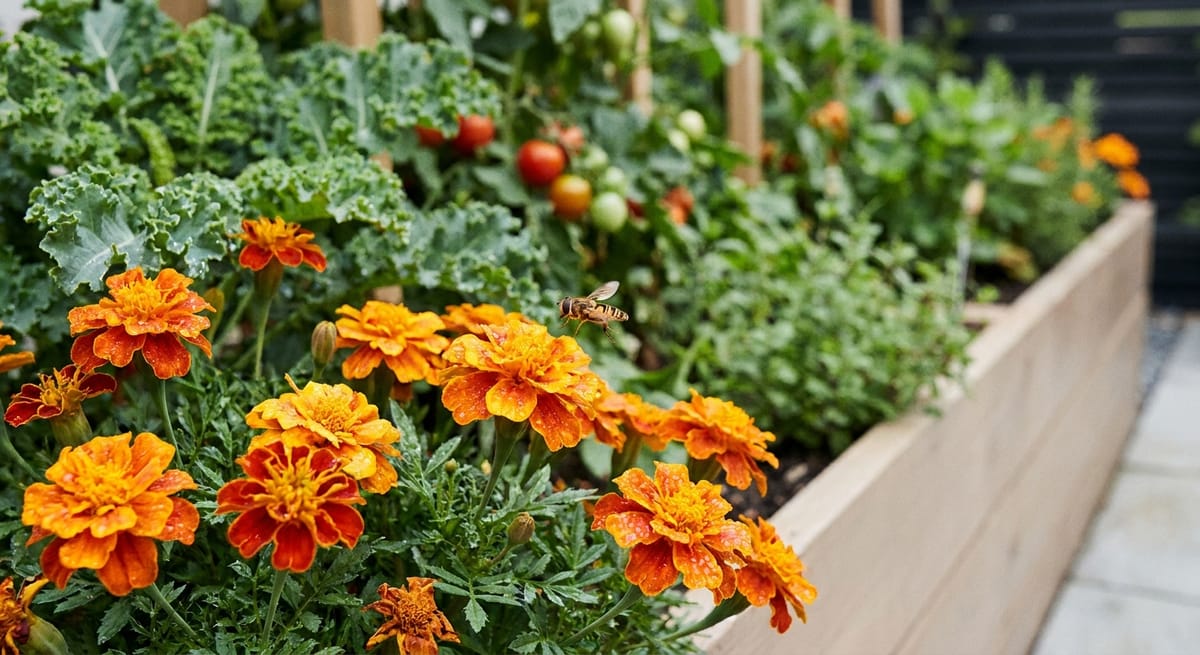
The open, nectar-rich blooms of single-petalled French and signet marigolds (Tagetes tenuifolia) draw hoverflies, tachinid flies and tiny braconid wasps that parasitise caterpillar pests. Their pungent foliage also helps confuse whiteflies and aphids hunting for hosts.
The South African caveat: in hot, arid inland provinces, marigolds are highly attractive to red spider mites (Tetranychus urticae). If they become drought-stressed during a Highveld or Karoo heatwave, they can become breeding hubs that spill mites onto neighbouring tomatoes and beans. Keep companion marigolds mulched and irrigated through peak summer heat.
How do the Three Sisters actually work?
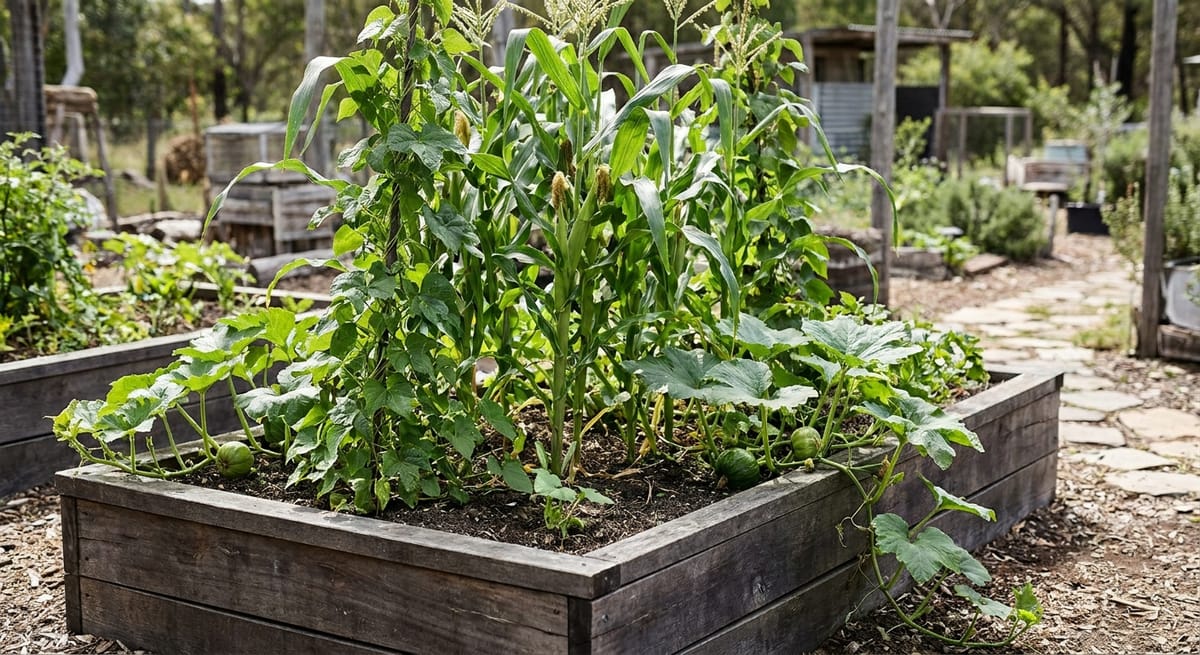
The Three Sisters (maize, climbing beans and squash or pumpkin) work because each crop fills a different spatial, nutritional and structural niche, not because of any mystical compatibility. The system originated in Indigenous Mesoamerican agriculture and has been widely adapted across Southern African homesteads. It is the gold standard of functional polyculture, and root research by Zhang, Postma, York and Lynch (2014) in Annals of Botany links it to niche complementarity and a yield advantage.
- Maize gives structure and a windbreak. Tall, rigid stalks act as a living trellis and buffer bean flowers from drying winds. Maize is wind-pollinated, so plant it in dense blocks, not single rows, for full kernel development.
- Beans fix nitrogen. Maize is a heavy nitrogen feeder; as the beans climb, their root nodules stabilise soil fertility over the season.
- Pumpkin or gem squash is the living mulch. Large, prickly leaves shade the soil, suppress weeds, lower topsoil temperature in the scorching afternoon sun and cut evaporative water loss, which matters a great deal off grid.
For South African small-scale growers, Motsi (2024) in Health For Mzansi covers root stratification, nitrogen fixation and living mulches.
Timing is where people go wrong. Do not sow all three on the same day. Vigorous runner beans and trailing pumpkins will outgrow and smother young mealie seedlings. Sow the maize first, and plant the beans and squash only once the maize stalks are well up.
Which pests should you plan for in each province?
Your province’s climate decides your pest list, so check it before choosing companions. South Africa spans Mediterranean winter-rainfall zones, arid semi-deserts, high-altitude grasslands and humid subtropical coast, and pest pressure shifts sharply across provincial borders. Indigenous plants also help with pest management. The table condenses the draft’s regional profiles; for a pest reference, see Prinsloo (2010), a review of Visser’s A Complete Guide to Vegetable Pests in South Africa (African Entomology).
| Province | Key pests | Companion response |
|---|---|---|
| Western Cape (winter rainfall, hot dry summers, strong southeasterly winds) | Brown garden snail, slugs, Bagrada bug, diamondback moth, Medfly (Oriental fruit fly is absent/eradicated here) | Border brassicas with rosemary, thyme and sage; mustard trap crops for Bagrada bugs; maize or sunflower windbreaks |
| Eastern Cape (bimodal coastal rainfall, arid Karoo interior) | African bollworm, diamondback moth, cutworms, red spider mite inland, coastal snails | Flowering dill and coriander plus marigolds to sustain parasitoid wasps |
| Northern Cape (arid, extreme heat, intense UV, winter frost) | Red spider mite, aphids on drought-stressed crops, potato tuber moth | Canopy shade from tall maize or sunflowers; living pumpkin mulch to prevent heat-driven mite outbreaks |
| Free State (continental Highveld, cold winters, clay-heavy soils) | Cutworms, Bagrada bug, Astylus beetle, white grubs, red spider mite in dry spells | Tansy (traditional; we found no trial), wild garlic (Tulbaghia violacea) and rue on bed edges; radishes and marigolds among crops |
| KwaZulu-Natal (humid subtropical coast, frost-free winters) | Pumpkin fly, Oriental fruit fly, fall armyworm, root-knot nematodes, fungal blights | Wide spacing for airflow; dense French marigolds; maize intercropped with cowpeas or beans |
| North West (semi-arid bushveld, sandy-loam soils) | Root-knot nematodes, Bagrada bug, African bollworm, leafminers, potato tuber moth | Rotate heavily with Tagetes; nasturtiums and wild mustard as perimeter trap crops |
| Gauteng (temperate Highveld, hail, urban heat island) | White grubs, cutworms, Bagrada bug, tomato leafminer, whiteflies, winter red spider mite | Tomatoes with basil and French marigolds; sweet alyssum and coriander for hoverflies |
| Mpumalanga (cool escarpment Highveld vs hot Lowveld) | Lowveld: Oriental fruit fly, pumpkin fly, Tuta absoluta, nematodes. Highveld: cutworms, bollworms, late blight | Lowveld: tansy (traditional; we found no trial), African wormwood (Artemisia afra) and dense marigold cover crops |
| Limpopo (hot bushveld to Lowveld, recurring drought) | Oriental fruit fly, Tuta absoluta, African bollworm, red spider mite, nematodes, whiteflies | Heat-hardy indigenous companions (wild garlic, African wormwood, amaranth/thepe) with cowpeas for nitrogen and cover |
Which companions suit seven core vegetables?
Pair each staple crop with companions whose job you can name: masking, trapping, feeding predators, fixing nitrogen or sharing the soil profile. The table sets out the seven vegetables, and the notes below give the mechanisms that matter most.
| Vegetable | Main South African threats | Companions | Avoid nearby |
|---|---|---|---|
| Tomatoes | Root-knot nematodes, bollworm, Tuta absoluta, red spider mite | French marigolds, basil, carrots, sweet alyssum | Potatoes |
| Cabbage, kale, broccoli | Diamondback moth, Bagrada bug, cabbage aphids | Rosemary, sage, thyme, coriander, Indian mustard | Strawberries, climbing beans |
| Pumpkin, gem squash, butternut | Pumpkin fly, powdery mildew, heat stress | Maize, sunflowers, nasturtiums, radishes | Potatoes |
| Potatoes | Potato tuber moth, nematodes, leafminers | Bush beans, peas, marigolds, sweet alyssum | Sunflowers, tomatoes, cucumbers |
| Carrots | Nematodes, aphids, soil crusting | Onions, spring onions, chives, leeks, radishes | Dill, parsnips |
| Beans | African bollworm, red spider mite, nematodes | Maize, beetroot, celery, summer savory | Onions, garlic, leeks, chives |
| Maize / sweetcorn | Fall armyworm, African bollworm, maize stalk borer | Climbing beans, cowpeas, pumpkins, Desmodium | Tomatoes |
Why these pairings hold up
- Tomatoes. Dense French marigolds release alpha-terthienyl into the root zone, and their blooms attract parasitic wasps that attack bollworm and Tuta absoluta larvae. Basil emits linalool and estragole, which help confuse whiteflies and thrips. Carrots take the deeper taproot horizon, so there is no underground competition. Keep potatoes away: both are Solanaceae and share pests, creating a host bridge for bollworm and Tuta absoluta.
- Brassicas. Brassicas release glucosinolates that act as beacons for diamondback moths and Bagrada bugs. Rosemary, sage and thyme mask the signal. Let coriander bolt and it attracts hoverflies whose larvae eat many cabbage aphids. Indian mustard is a validated trap crop that lures Bagrada bugs away so you can remove them by hand.
- Pumpkins. Cucurbits depend on bee pollination; poor pollination makes young fruit abort and rot, which creates breeding sites for pumpkin flies. Sunflowers and nasturtiums bring in native bees, and fast radishes break surface crust and act as an early trap crop for flea beetles before the vines spread.
- Potatoes. Bush beans and peas fix nitrogen early without shading the foliage. Sweet alyssum forms a low living mulch that cools the soil, which matters because tuber moths lay eggs in cracked, dry soil. It also feeds the tiny parasitoid wasp Copidosoma koehleri, which targets tuber moth larvae.
- Carrots. Onion and chive sulphur volatiles help confuse foliage-feeding pests, while shallow allium roots leave the deeper subsoil to the carrot taproot. Sowing radish with slow carrot seed cracks the crust and marks the row. Dill and parsnips share the Apiaceae family, so they attract the same specialist pests.
- Beans. Rhizobium nitrogen fixation benefits heavy-feeding beetroot and celery. Maize adds support and wind protection, and summer savory deters black bean aphids through aromatic masking.
Maize and the push-pull system
In East and Southern African agroecology, intercropping maize with legumes such as cowpeas and Desmodium underpins the “push-pull” system. Perimeter trap grasses “pull” moths out of the crop, while Desmodium fixes nitrogen and suppresses parasitic Striga weeds. Be careful with the old explanation, though: Erdei et al. (2024) in eLife found that Desmodium does not repel pests but intercepts and kills them. Keep tomatoes away from maize too; both are primary hosts for African bollworm (the tomato fruitworm, when it attacks tomatoes), and together they amplify local moth numbers.
How do you design a resilient off-grid guild?
Build polyculture guilds for your province instead of planting exposed rows from unverified compatibility lists. A guild is simply a group of plants chosen so each one does a job for the others.
- Anchor with structure and shade. Put tall crops (maize or sunflowers) on the northern or western side of beds to shield heat-sensitive greens from scorching afternoon sun.
- Layer the soil profile. Pair deep taproots (carrots, beetroot) with shallow feeders (lettuce, spring onions) and nitrogen fixers (beans, cowpeas), so every litre of harvested rainwater is used across several soil horizons.
- Feed your predators. Give a good share of each bed to nectar-producing flowers, such as single French marigolds, sweet alyssum, bolting coriander and indigenous wild garlic (Tulbaghia violacea), to keep predatory insects on site year-round.
- Use raised beds and permaculture design. Raised beds hold water where the roots are: see raised beds that work and permaculture in a dry climate.
What is different in South Africa?
The principles are the same worldwide; the local differences are heat, water and pests. Summer heat turns drought-stressed marigolds into mite hosts, rainfall is erratic, and the pest list (Bagrada bug, Tuta absoluta, pumpkin fly, fall armyworm) shifts from province to province. Treat any generic overseas chart with suspicion until you have checked it against your own region.
Key takeaways
- Choose companions for a named mechanism, such as masking, trapping, predator feeding, nitrogen or shade, not for folklore “likes and dislikes”.
- Plant marigolds densely, not as a token few, and keep them mulched and watered so they don’t breed red spider mites.
- Sow maize first and add beans and squash once the maize is well established, or the Three Sisters will smother your mealies.
- Match companions to your province’s pest profile before you plant.
- Build guilds with shade, layered roots and flowers for predators, and use raised beds to hold water.
Frequently asked questions
Does companion planting in South Africa really work?
It works when it relies on a documented mechanism: scent masking, trap crops, flowers that feed beneficial insects, nitrogen fixation or soil shading. Folklore claims, such as basil sweetening tomatoes or a single marigold guarding a whole bed, are not supported by controlled trials. Use it as one low-input tool alongside good watering and mulching, not as magic.
Why shouldn’t I sow all Three Sisters on the same day?
Vigorous climbing beans and trailing pumpkins grow much faster than young mealie seedlings and will smother them. Sow your maize in a dense block first, to ensure proper wind pollination, and only plant the runner beans and squash once the maize stalks are well established.
Are marigolds always helpful in hot, inland gardens?
No. Dense French and African marigolds release alpha-terthienyl that harms root-knot nematodes, but drought-stressed marigolds attract red spider mites (Tetranychus urticae). In hot provinces such as the Northern Cape, Free State and Limpopo, keep them mulched and irrigated so they don’t become mite hubs that spill onto your tomatoes.
Why does companion planting vary across South Africa’s nine provinces?
Regional climates dictate which pests threaten your crops. Western Cape growers prioritise winter snail deterrents, windbreaks and mustard trap crops for Bagrada bugs. In KwaZulu-Natal, Mpumalanga and Limpopo, Oriental fruit fly, Tuta absoluta and year-round nematodes call for dense marigold cover crops and flowering herbs that sustain parasitoid wasps.
Which plants should I keep away from tomatoes?
Keep potatoes away, because both are Solanaceae and share pests and pathogens, creating a host bridge for African bollworm and Tuta absoluta. Maize is a poor neighbour too: African bollworm attacks both crops, so planting them together can amplify local moth populations.
Ready to turn this into a bed plan? Start with our guide to permaculture in a dry climate to find a design that suits your site and water supply.